
Learn to fold bedding like a professional and save space
Anyone who has ever struggled with an overstuffed wardrobe full of bed linen knows exactly what this is about. Bedding is one of those tricky things that seems to grow on its own – fold it wrong just once and it suddenly takes up twice the space it should. Yet the right technique for folding bed linen can completely transform the way storage space works in a home, and bring calm to those morning moments when you're desperately searching for clean bedding to change the sheets.
It's not rocket science. It's a matter of a few clever methods that can be picked up in just a few minutes and then become second nature. Home organisation has become a genuinely popular topic in recent years – and for good reason. When everything has its place and takes up only as much space as it truly needs, the whole household runs more smoothly and feels more pleasant to live in. Bedding tends to be one of the biggest sources of wardrobe chaos, because folding it properly requires a little practice and patience.
Try our natural products






Why the way you fold matters more than you might think
Let's be honest: most people simply scrunch their bedding into some vague shape and stuff it into the wardrobe. The result? Piles that collapse every time the wardrobe is opened, bed linen that can't be found, and a sense of chaos where there should be order. Folding bedding properly can reduce its volume by up to a third, without any special equipment whatsoever.
The key is understanding what causes bedding to take up so much space. The main culprit is air. The more air pockets created during careless folding, the bulkier the result. That's why the fundamental principle of any good bedding folding technique is the gradual smoothing out and elimination of air pockets, step by step. Duvet covers are particularly problematic in this regard, as they are large in size and the fabric tends to be bulky.
Another factor is the shape of the final bundle. If bedding ends up in an irregular shape, it can't be stacked efficiently alongside other pieces, and wardrobe space is wasted. On the other hand, a firm, regular rectangle or square can be stacked like books on a shelf – and that is precisely the goal that modern folding techniques aim for.
The inspiration for home organisation was brought to the world by Japanese consultant Marie Kondō, who in her book and television series showed how radically changing the way things are folded and stored can transform the overall feel of a home. Her approach applies to bed linen too: "Store vertically, not horizontally – everything must be visible at a glance." This principle holds true for bedding as well, although applying it requires a slightly different method than with T-shirts or jeans.
How to fold a duvet cover step by step
The most challenging part of the whole process is undoubtedly folding the duvet cover, as it is the largest piece of bed linen. There are several approaches, but one of the most effective is the so-called thirds method.
The duvet cover is first laid flat on a bed or a clean floor. It's important that it is carefully smoothed out and that no part is hanging over the edge. It is then folded lengthways into thirds – first one third over the centre, then the other third over that. This creates a long, narrow strip. The strip is then folded crossways, again into thirds or quarters depending on the length of the cover, until a compact rectangle is formed. At each fold, it's worth gently pressing down with the palm of your hand to push out the air and make the resulting bundle as flat as possible.
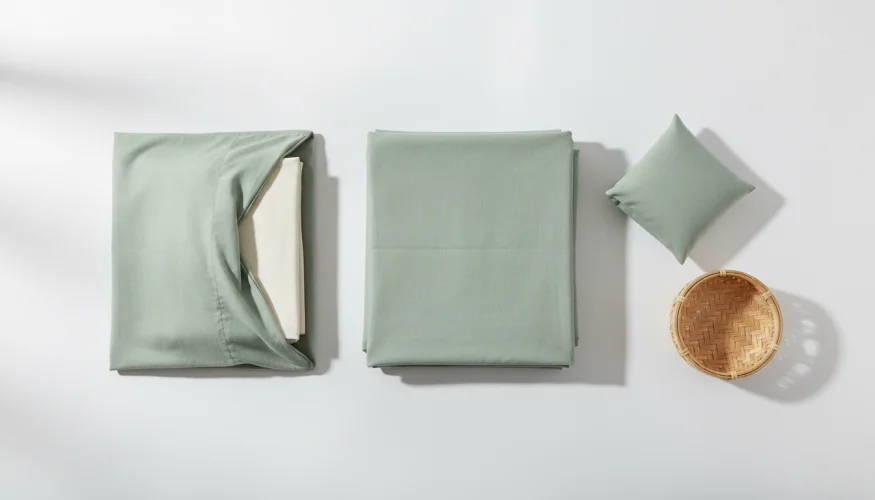
Some people swear by the pocket folding method, which is particularly popular in the United States. With this method, one piece of the set – most often a pillowcase – is used as a wrapper for the rest of the set. The entire bedding set is folded into a compact bundle and tucked inside the pillowcase. The result is a neat "parcel" that stays together, is easy to identify, and takes up minimal space. This method has one major advantage: the set can never fall apart and end up scattered across different parts of the wardrobe.
When it comes to fitted sheets, these are widely regarded as the most dreaded piece of bed linen of all. Their corner pockets make them impossible to fold into a regular shape in the usual way – or rather, impossible without knowing the right technique. The trick is to tuck one corner of the sheet into another, creating a kind of pocket. This process is repeated for all four corners, gradually shaping the sheet into a regular rectangle. Then the process continues as with any other piece – folding into thirds or quarters, pressing down, until a firm, flat shape is achieved.
Storing in the wardrobe: vertical or horizontal?
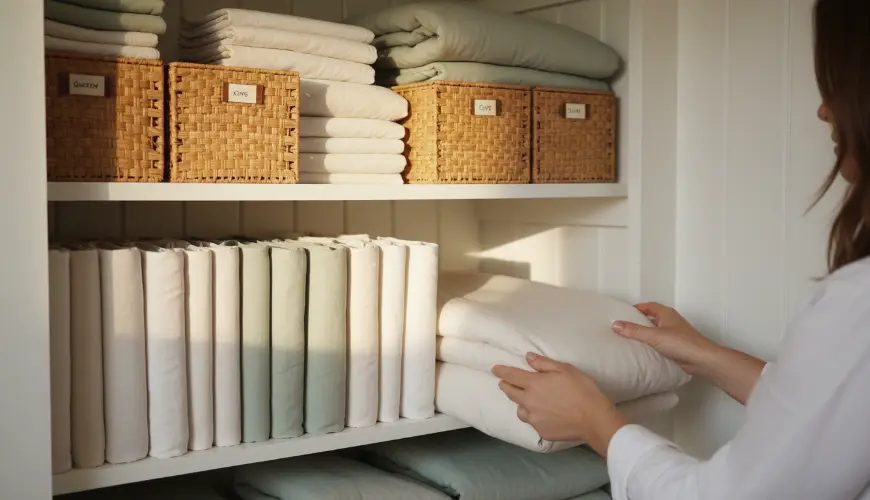
Once the bedding is folded correctly, the second part of the puzzle begins – how to store it so that it remains accessible while taking up as little space as possible. Opinions among home organisation experts differ here, but the general consensus leans towards vertical storage, which allows the entire contents of a shelf to be seen at once.
Vertical storage works similarly to files in a filing cabinet: each bundle of bedding stands on its edge and is visible without having to rummage through an entire pile. This has a practical impact – not only on clarity, but also on the condition of the bedding itself, as it is no longer crushed under the weight of other pieces. Bedding that is folded and stored vertically retains its shape for longer and is easier to iron, or may not need ironing at all.
Horizontal storage makes sense when shelves are deep or when the bedding is heavier and stiffer, such as cotton satin. In that case, the bundles are stacked on top of one another, with the most frequently used sets placed at the top. It's important to follow the rule that the stack should not be too high – otherwise the situation will quickly return to the original chaos.
A practical solution, particularly appreciated by families with children or households with larger quantities of bed linen, is the use of fabric organisers or baskets on shelves. These allow different sets or different sizes to be separated while also visually calming the space inside the wardrobe. Choosing organisers made from natural materials such as bamboo or recycled textiles also contributes to a sustainable approach to the home – a value that goes beyond mere practicality.
Take a specific situation as an example: a family with three children who have bedding for single beds, double beds, and cots at home. Without a system, the linen wardrobe is a constant source of frustration – nobody knows where anything is, sets get mixed up, and finding the right size before changing the sheets takes far too long. After introducing the pocket folding method and vertical storage with separate baskets for each size, the time spent searching and changing bedding is reduced to a fraction of what it was before. And that is a change the whole family will feel.
Regular stocktaking also helps. Research in the field of home organisation shows that most households keep significantly more bed linen than they actually need. The general recommendation is: two to three sets of bedding per bed is enough – one on the bed, one clean in the wardrobe, and possibly one spare. Fewer items in the wardrobe automatically means more space and less chaos.
The choice of material also plays a role in this context. Bedding made from natural materials such as organic cotton, bamboo, or linen tends to be airier and less bulky when folded than synthetic alternatives. It is also gentler on the skin and on the environment. Bamboo, for example, is a material with natural antibacterial properties that also regenerates quickly as a raw material – making it a choice that makes sense both in terms of comfort and sustainability.
For those looking for inspiration or a specific guide, a useful overview of bed linen folding techniques can be found on the Real Simple website, where various methods are described in detail and illustrated visually, including how to fold a fitted sheet. It is one of the most frequently searched guides in the field of home organisation, which only confirms that a great many people struggle with this very problem.
Interestingly, the habit of regularly and carefully folding bedding also has a psychological dimension. An organised wardrobe contributes to an overall sense of calm and control over the home. It's not just about aesthetics – it's about functionality and ensuring that everyday routines run without unnecessary obstacles. Changing the bedding ceases to be a task that gets put off and becomes a quick, straightforward affair.
Folding bedding so that it takes up as little space as possible is therefore not merely a trick for organisation enthusiasts. It is a practical skill that pays off for everyone – regardless of the size of the wardrobe or the amount of bed linen. Once you've got the right technique down, the linen wardrobe will no longer be a source of daily frustration, but a place where order reigns.