
# Salting sidewalks and its impact on soil and garden plants
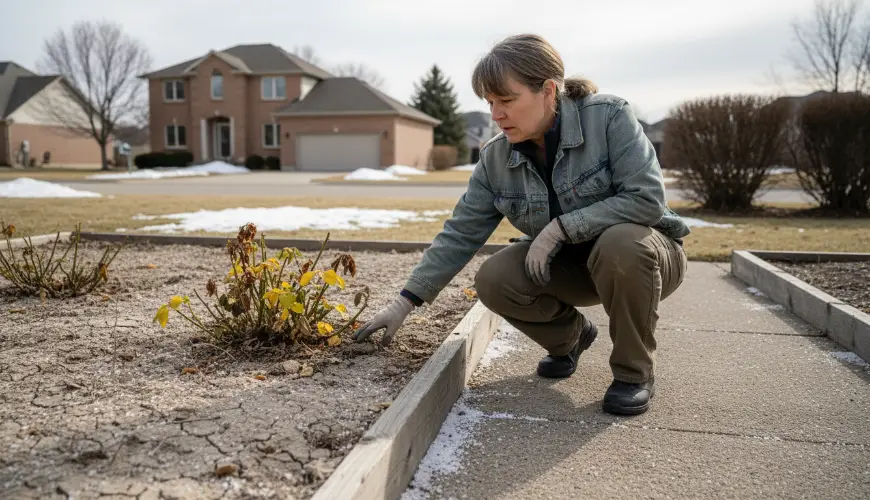
Every winter, the same ritual repeats itself across the country. As soon as snow falls or black ice appears, handfuls of salt are scattered onto pavements, driveways and car parks. It's quick, cheap and effective – the ice disappears within moments and pedestrians can safely continue on their way. But what remains after winter, when the snow melts and the salt soaks into the surrounding soil? This question increasingly troubles gardeners, ecologists and ordinary people who have noticed that their lawn or flower beds look worse and worse each spring.
Salting pavements is such a common practice that few people question it. Yet the annual consumption of sodium chloride for winter road maintenance in the Czech Republic amounts to tens of thousands of tonnes. A large proportion of this salt never stays on the road surface – it is washed away by rainwater, pushed aside by ploughs or carried by the wind into adjacent green spaces. And that is precisely where a problem begins that manifests slowly and imperceptibly, but all the more permanently for it.
Try our natural products

What salt actually does in soil
To understand the impact of pavement salting on soil, it is useful to return to basic chemistry. Sodium chloride dissolves in water into sodium and chloride ions. Both of these elements are toxic to plants and soil organisms at high concentrations. Sodium ions also have the ability to displace calcium and magnesium from soil particles – minerals that are absolutely essential for healthy soil structure. The result is so-called soil salinisation, in which the physical properties of the soil change: it becomes more compact, less permeable to water and air, and loses its ability to retain nutrients available to plants.
This phenomenon is well documented in the scientific literature. Studies published in the specialist journal Environmental Science & Technology repeatedly show that chloride concentrations in soil alongside roads and pavements can be up to a hundred times higher than natural levels during winter months. Such values exceed the tolerance of the vast majority of commonly cultivated plants.
Chloride ions also travel through soil very rapidly, as they barely bind to soil particles. They easily penetrate groundwater and from there into streams, ponds and rivers. Freshwater ecosystems are highly sensitive to increased salinity – many aquatic invertebrates, fish and amphibians cannot survive in water with elevated salt content. A study published in PNAS in 2018 warns that approximately one third of lakes in the United States are showing a growing trend of salinisation as a direct result of winter road maintenance.
Consider the situation of Mrs Nováková from the Prague suburbs. Every year she carefully fertilises her rose bed, mulches it and waters it. Yet after several seasons, the roses stopped flowering as abundantly as before. It was only when a garden adviser pointed to the driveway right next to the bed – and to the kilograms of salt that ended up there every winter – that the cause became clear. The soil in the bed had a pH shifted into the alkaline range and the sodium content was alarming. No fertiliser will solve this problem until the approach to winter gritting changes.
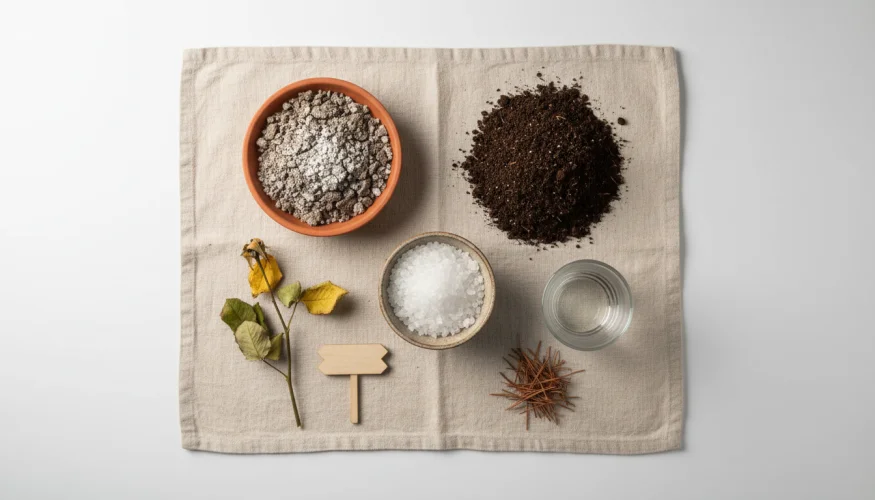
How salt directly damages plants
Beyond the direct impact of salting on soil, salt also acts immediately on plants themselves. A high concentration of salt around roots causes so-called osmotic stress – the plant is unable to absorb water even when there is plenty of it in the soil. It is a paradoxical situation in which the plant is literally dying of thirst in the middle of moist earth. The symptoms resemble drought: yellowing and drying of leaves, stunted growth, dieback from branch tips. Conifers are particularly sensitive, and the browning of their needles along salted roads is clearly visible during winter months.
Salt also reaches plants through their above-ground parts – droplets of solution created by passing vehicles or the wind land on leaves and needles, disrupting the waxy coating and causing chemical burns. Trees growing alongside roads demonstrably have shorter lifespans and poorer health than trees growing in identical conditions but without exposure to winter salt.
As German ecologist and author Peter Wohlleben once observed: "Soil is not merely dirt underfoot – it is a living organism whose balance builds over centuries and can be disrupted in a single winter." These words apply doubly to soil subjected to repeated winter salting.
Soil microorganisms – bacteria, fungi, earthworms and dozens of other species – form the foundation of a healthy ecosystem. Their populations are highly sensitive to increased salinity. Earthworms, considered one of the best indicators of soil quality, migrate deeper into the soil or die altogether when salt content rises. This disrupts the natural aeration of soil and the nutrient cycle that earthworms provide. The result is soil that is less fertile, less resistant to erosion and less capable of retaining water – and these are precisely the properties that matter most in an era of climate change.
Alternatives and more considerate approaches to winter maintenance
The good news is that there are ways to manage winter ice without heavy salt use, or at least with significantly lower doses. The key is combining mechanical snow clearance with targeted application of gritting material only where it is genuinely necessary.
The most widely used alternatives include:
- Sand or grit – cause no chemical damage to soil or plants, provide good mechanical grip, but must be cleared away after winter
- Calcium chloride or magnesium chloride – effective at lower temperatures than ordinary salt and less harmful to soil, though still not entirely without impact
- Wood ash – a natural alternative with a mild gritting effect that also enriches the soil with potassium
- Thermal insulating mats and anti-slip surfaces – particularly suitable for steps and building entrances where salt can be avoided altogether
Where salt cannot be avoided entirely, it helps to follow the principle of "less is more". The correct dose of gritting salt is approximately 20–30 grams per square metre – an amount that fits in the palm of a hand. Most people use many times this quantity, intuitively assuming that more salt means a better result. The opposite is true: excess salt simply soaks into the soil without contributing to better ice melting.
The spring after winter is also critically important – that is, actively caring for soil and plants once the snow has melted. Thoroughly watering affected areas with clean water helps flush excess salt ions into deeper soil layers where they are less accessible to plant roots. Adding gypsum (calcium sulphate) can help displace sodium ions from soil particles and restore soil structure. Compost and organic matter generally increase the soil's ability to cope with salinisation and accelerate the recovery of microbial life.
The growing interest in ecological alternatives to winter maintenance is also reflected in the offerings of specialist online shops focused on sustainable living. Products that are gentle on soil and the environment – from natural gritting materials to tools for efficient snow clearance – are more accessible today than ever before, and using them is a direct investment in the health of both your garden and the surrounding natural environment.
Changing the approach to winter maintenance of pavements and driveways is not merely a matter of ecological conviction. It is a practical decision that protects your own property – your garden, trees and lawn – from slow but permanent damage. Every kilogram of salt that does not end up on the pavement is a kilogram that does not end up in the soil. And soil, unlike ice, is not capable of dissolving and disappearing on its own within a few hours. Its recovery takes years, sometimes even decades. That is the price we pay for convenient and carefree winter gritting – we simply do not see it immediately, but only later, in the form of a dying tree or a lawn that simply refuses to come back to life.