

# Why Achilles Tendon Inflammation Troubles Weekend Athletes
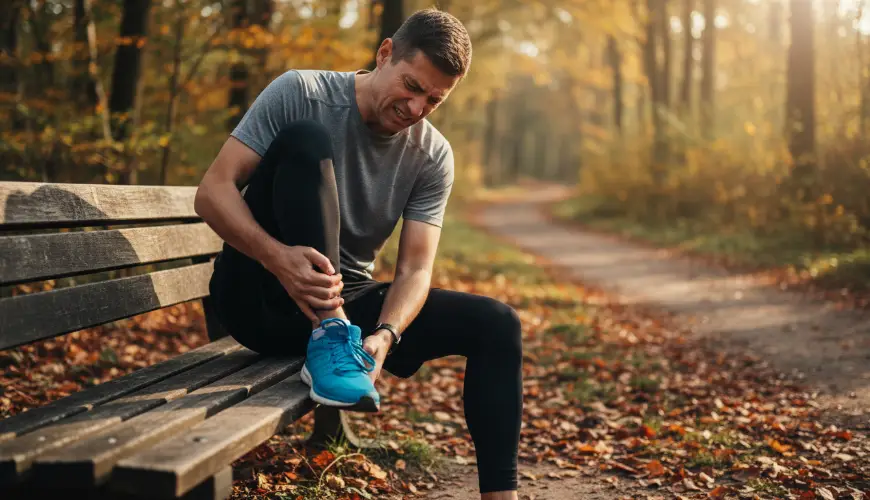
There is one type of injury that troubles thousands of active people every year, yet receives surprisingly little attention — until it strikes us directly. Achilles tendon inflammation is among the most common overuse injuries of all, and curiously not among professional athletes, but among those who exercise recreationally. Weekend warriors — people who sit at a computer all week and head out for a long run or an intense tennis match on the weekend — are the group most exposed to this problem.
The Achilles tendon is the strongest tendon in the human body. It connects the calf muscles to the heel bone and transmits enormous forces with every step — when running, the load on this tendon can equal up to eight times body weight. Yet it is surprisingly vulnerable, particularly when long periods of inactivity alternate with sudden bursts of physical activity. This is precisely what makes this injury so insidious in people who treat sport as a weekend affair.
Try our natural products

Why Weekend Warriors Are So Vulnerable
The human body is designed for movement, but also for gradually adapting to load. Tendons, unlike muscles, adapt much more slowly — their blood supply is limited and recovery takes longer. When someone sits all week, muscles relax, tendons shorten, and tissues stop preparing for exertion. Then the weekend arrives with an hour and a half of football, ten kilometres of trail running, or a two-hour mountain hike — and the Achilles tendon takes a hit it was not prepared for.
The scientific literature describes this phenomenon well. According to research published in the British Journal of Sports Medicine, Achilles tendinopathy accounts for up to 11% of all running injuries, with risk rising significantly in people with irregular training patterns. Translated into practice: it is not about how much someone runs in a year, but how quickly they increase load after a longer break.
Consider a specific example. Tomáš works in an office, is forty-two years old, and plays recreational basketball with friends every weekend. During the week he gets very little exercise — at most a walk to lunch. One weekend he decides to run five kilometres after the game — for the first time in two months. The next morning he feels a dull ache around his heel, and his foot barely functions with his first steps after waking. This is the classic onset of Achilles tendon inflammation that doctors and physiotherapists see regularly.
There are several symptoms that should put someone on alert. Morning stiffness and pain with the first steps after waking are among the most characteristic. The pain may be sharp or dull, localised just above the heel or spread more broadly along the tendon. It is also typical for the pain to ease after warming up, only to return after prolonged rest — this leads many athletes to the mistaken conclusion that everything is fine. The opposite is true: the tendon at this stage needs care, not to be ignored.
Another warning sign is tenderness when pinching the tendon between the fingers. If someone rises onto their toes and feels an unpleasant pull or pain, it is time to take notice. Swelling around the tendon or visible thickening of the tissue are already fairly advanced symptoms, signalling that the inflammatory process has been underway for some time.
What Is Actually Happening Inside the Tendon
The term "inflammation" is somewhat misleading here, because modern medicine speaks more of tendinopathy — that is, degenerative changes in the structure of tendon tissue that are not always accompanied by classic inflammation. The tendon is composed of collagen fibres arranged in parallel bundles. Under repeated overload, these fibres begin to break down, their structure is disrupted, and the body attempts to repair them — though not always successfully. The result is tissue with poorer mechanical resilience that is more susceptible to further damage.
As orthopaedic surgeon and sports medicine physician Håkan Alfredson, whose work has significantly influenced the modern approach to treating tendinopathies, has noted: "Tendons are not passive ropes — they are living structures that respond to load and need time to adapt." This perspective fundamentally changed how physiotherapists and doctors approach the problem — instead of complete rest, controlled, gradual loading is now preferred.
There are several reasons why the problem occurs, and they typically combine. A sudden increase in training load is the most common trigger, but inappropriate footwear, hard surfaces, shortened calf muscles, and weak deep stabilisation also play a role. In weekend athletes, these factors typically accumulate — the body is unprepared, the footwear is worn out, and the warm-up is rushed through in two minutes.
Age deserves particular attention. After forty, the regenerative capacity of tendons demonstrably declines, blood supply decreases, and collagen is renewed more slowly. This does not mean people in middle age should reduce their sport — quite the contrary, movement is essential for tendon health. It does mean, however, that the body needs more time to recover and is less tolerant of sudden fluctuations in load.
How to Deal With It — and What Actually Works
When pain sets in, most people's first response is either to ignore it and keep playing sport, or to stop completely and wait for it to go away on its own. Both approaches are wrong. Ignoring the pain leads to deeper damage and risks tendon rupture — a complication requiring surgery and months of rehabilitation. Complete rest, on the other hand, slows healing, because tendon tissue needs mechanical stimulation to remodel properly.
Current sports medicine recommendations agree on so-called eccentric strengthening as the cornerstone of treatment. This involves exercises in which muscles are loaded while lengthening — the simplest example being the slow lowering of the heel below the level of a step from a tiptoe position. Research from the Karolinska Institutet in Stockholm has shown that regular eccentric exercise can significantly reduce pain and restore tendon function in patients with Achilles tendinopathy, even without surgical intervention.
The key, however, is gradualness and patience. Tendons heal slowly — full recovery can take three to six months, sometimes longer. A physiotherapist can set an individualised plan that respects the current state of the tissue and gradually increases load so that the tendon strengthens without being re-injured.
Alongside exercise, adjusting the movement routine also plays a role. Weekend athletes should consider whether it might be beneficial to distribute physical activity more evenly throughout the week. Short, regular loading is far more favourable for tendons than one-off bursts of intense activity. Thirty minutes of walking or light movement every other day is more valuable for the Achilles tendon than three hours of sport once a week.
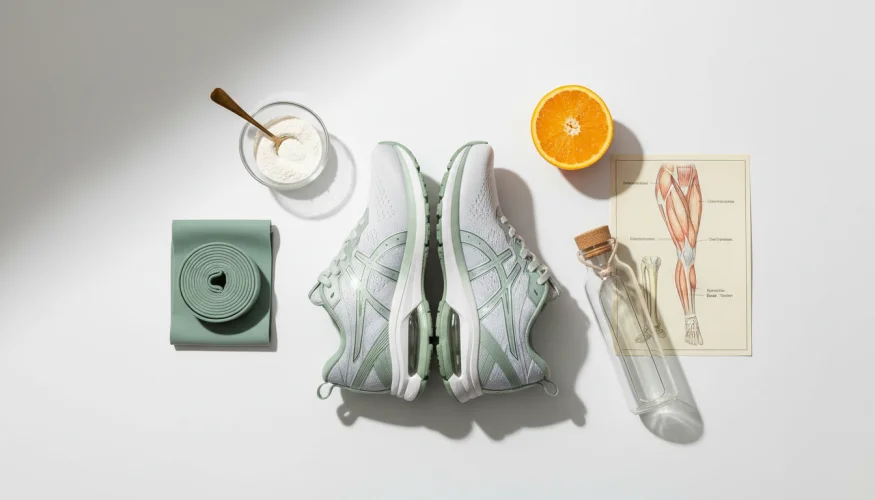
Prevention has simple foundations. Quality footwear suited to the given sport and surface is the first step — shoes that are too worn out or inappropriate significantly increase the risk of overload. Regular stretching of the calf muscles and the tendon itself helps maintain their length and elasticity. Warming up before sport should not be a mere formality — five to ten minutes of light movement genuinely changes how prepared the tissues are for loading.
Nutrition is receiving increasing attention in the context of tendon health. Collagen, which forms the basis of tendon tissue, depends on sufficient vitamin C for its synthesis. Some studies suggest that taking collagen peptides in combination with vitamin C before physical activity may support tendon recovery — though research in this area is still ongoing. Adequate hydration is another factor that tends to be underestimated, even though tendon tissue loses elasticity without sufficient fluids.
If pain persists for more than a few weeks or worsens, seeing a doctor is appropriate. An orthopaedist or sports medicine physician can assess the condition using ultrasound, which shows tendon structure and reveals any degenerative changes. In more serious cases, physiotherapeutic methods such as shockwave therapy — which stimulates blood flow and tissue healing — or injection therapy may be considered. Surgical intervention is a last resort and is only considered when other methods have failed.
The experience of Tomáš from the opening of this article fortunately has a good ending — after visiting a physiotherapist and two months of eccentric exercise, he returned to sport pain-free. He did, however, change his approach: instead of a weekend marathon of activity, he now tries to go for a thirty-minute run three times a week, warms up carefully, and replaces his shoes from time to time. Small changes, but significant ones for the Achilles tendon.
The Achilles tendon does not hurt because the body is too weak for sport. It hurts because it was given more than it was prepared for. And that is a message that should resonate with everyone who loves sport — but only finds time for it at the weekend.