

# How Walking Meditation Benefits Mental Health
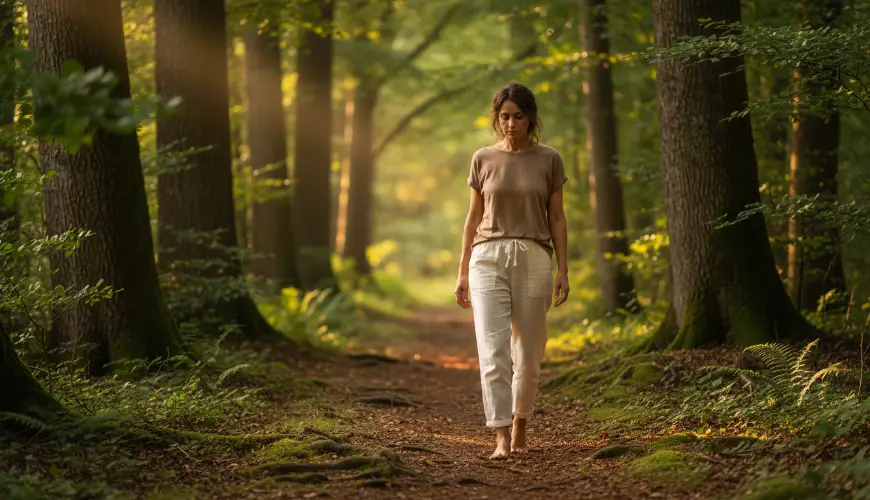
There is a widespread myth that meditation means sitting cross-legged for hours, closing your eyes, and thinking about nothing. For many people, this very idea is the reason they never try meditation, or why they give up after the first attempt. But meditation has far more forms than most of us acknowledge – and one of the most natural and accessible takes place exactly where we spend a large part of our day: while walking.
Walking meditation is no modern wellness trend. It is a practice thousands of years old, with deep roots in Buddhist tradition, but it is also found in other spiritual and philosophical systems around the world. Today, as more and more people struggle with the inability to calm their minds and sit in silence, this form of meditation is proving to be an extraordinarily practical alternative – and science is increasingly supporting it.
Try our natural products






Why simply sitting is so difficult
Before we dive into the practice itself, it is worth understanding why traditional, static meditation is so challenging for many people. It is not just about physical discomfort or back pain. The problem runs much deeper. Modern humans are accustomed to a constant stream of stimuli – notifications, messages, videos, calls. The brain has grown used to this rhythm and begins to perceive silence as a threat rather than a relief. The moment we try to sit down and "think nothing," the brain starts to resist, flooding us with thoughts about groceries, unfinished work, or an embarrassing moment from 2009.
There is also a biological dimension to this. The human body is built for movement. For hundreds of thousands of years, our ancestors walked, ran, gathered, and hunted. A sedentary lifestyle is, from an evolutionary perspective, a very recent phenomenon, and it is little wonder that after a while both body and mind begin to protest against stillness. The urge to get up and move is not a weakness or a lack of discipline – it is a natural biological response.
Walking meditation bypasses this resistance in an elegant way. It gives the body what it naturally needs – movement – while simultaneously offering the mind space for calm and presence. It is not a compromise. It is a different path to the same destination.
How walking meditation actually works
At first glance, walking and meditating at the same time might seem like a contradiction. How can movement be meditative? The answer lies in the very essence of meditation: it is not about stopping thoughts, but about redirecting attention. Meditation is training in conscious attention, the ability to be present here and now, without judgment and without distraction. And this can be practised very effectively while walking.
In Buddhist tradition, walking meditation is called kinhin (in the Zen tradition) or cankama (in Theravāda Buddhism). Monks practise it as a transition between longer sitting sessions, but also as a standalone practice in its own right. The essence is to give full attention to each step – the sensation of the foot touching the ground, the shift of weight from one leg to the other, the movement of the arms, the rhythm of the breath. The goal is not to go fast or far. The goal is to be fully present in every moment of movement.
Modern research confirms what monks have known for centuries. A study published in the academic journal Psychology of Sport and Exercise showed that mindful walking significantly reduces levels of stress and anxiety compared to ordinary, "automatic" walking. Another study from Utrecht University found that the combination of movement and mindfulness has a synergistic effect on emotional regulation and mood improvement – results were better than either meditation or movement alone.
Thich Nhat Hanh, the Vietnamese Buddhist monk and one of the most influential advocates of mindfulness in the West, put it simply: "Peace is every step." This sentence is not merely a poetic metaphor – it is literally a guide to practice.
Movement as a gateway to presence
Imagine Karolína, a thirty-three-year-old graphic designer from Brno who works from home. Every day she sits at her computer for eight to ten hours; in the evening she is exhausted yet simultaneously "over-stimulated" – she cannot stop her thoughts, sleeps poorly, and cannot relax. She tried classical meditation, but after three minutes always ended up feeling that she was doing it wrong and that it simply was not for her. Then she came across walking meditation. She started simply: every day after lunch she went outside for twenty minutes and walked mindfully through a park near her home. No headphones, no phone. Just her, movement, and attention.
After two weeks she noticed she was concentrating better. After a month she began sleeping better. She had not changed her diet, had not started exercising, had not bought any supplements. She simply walked – but mindfully.
Stories like Karolína's are not exceptional. Walking meditation is accessible to virtually anyone, regardless of age, physical condition, or prior experience with meditation. It requires no equipment, no special space, and no app. All it takes is a few minutes, a stretch of pavement or nature, and a willingness to pay attention to what is happening right now.
How to begin: a practical guide to mindful walking
Starting walking meditation is surprisingly simple, but like any practice it requires a certain intentionality. It is not enough to simply go outside and walk – we do that every day while the mind wanders wherever it pleases. The key is intention and attention.
First, it helps to slow down. Meditative walking is slower than ordinary walking – not dramatically so, but enough to be able to perceive individual steps. The ideal pace is one at which it is possible to be aware of each phase of a step: lifting the foot, moving forward, touching the ground, shifting the weight.
Attention can then be focused on various "anchors":
- The feet and contact with the ground – how the surface feels underfoot, whether it is hard or soft, warm or cold
- The breath – its natural rhythm, how it synchronises with the steps
- The body as a whole – the movement of the arms, the position of the shoulders, the feeling of air on the skin
- The surrounding environment – sounds, smells, light, without the mind sinking into evaluation or stories
When the mind wanders – and it will, always – it is enough to gently bring it back to the movement. Without self-criticism, without frustration. This repeated returning of attention is precisely the essence of the training.
The length of practice is not decisive. Ten minutes of mindful walking each day will bring more benefit than an hour of walking with the mind submerged in worries. One can begin with as little as five minutes and gradually extend the time according to one's own sense of it.
Where and when to practise walking meditation
One of the greatest advantages of walking meditation is its flexibility. It can be practised almost anywhere – in a park, in a garden, along a river, but also inside a flat if there is sufficient space. Many practitioners have come to love walks in nature, because a natural environment naturally supports the calming of the mind. Research into the Japanese phenomenon of shinrin-yoku, or "forest bathing", has repeatedly demonstrated that time spent among trees lowers cortisol levels, slows the heart rate, and improves mood.
Nevertheless, a city can also be an excellent environment for mindful walking – if approached with the right quality of attention. A busy street then becomes not an obstacle to meditation but a part of it: sounds, movement, people passing by – everything becomes an object of conscious perception rather than a source of distraction.
As for timing, the ideal is to find a time that fits naturally into one's daily rhythm. In the morning before work, at midday as a break from the screen, or in the evening as a transition between work time and personal time. Regularity matters more than the length or "perfection" of the practice.
Walking meditation and mental health
The scientific evidence for the positive impact of mindfulness on mental health is by now very robust. The American Psychological Association states that regular mindfulness practice – including mindful walking – demonstrably reduces symptoms of depression, anxiety, and chronic stress. It also improves cognitive functions such as concentration, working memory, and decision-making ability.
For people suffering from anxiety, walking meditation is particularly suitable, because movement itself helps regulate the nervous system. Physical activity triggers the release of endorphins and serotonin, while mindful attention activates the parasympathetic nervous system – the one responsible for calm and recovery. The result is a state that can be described as alert calm: the mind is present and focused, yet not tense.
People with ADHD or other difficulties with concentration also very frequently report that walking meditation works better for them than static meditation. Movement helps them "anchor" their attention rather than dispersing it. The body becomes a tool for focus, not an obstacle.
Walking meditation is therefore not merely an alternative for those who "can't manage the sitting." It is a fully valid practice with its own advantages and its own depth. And for many people it may be precisely the gateway into the world of meditation – a world that then opens up into further forms and possibilities. It begins with one step. A conscious step.