
# A Left-Handed Child Doesn't Need Correction, But Proper Care
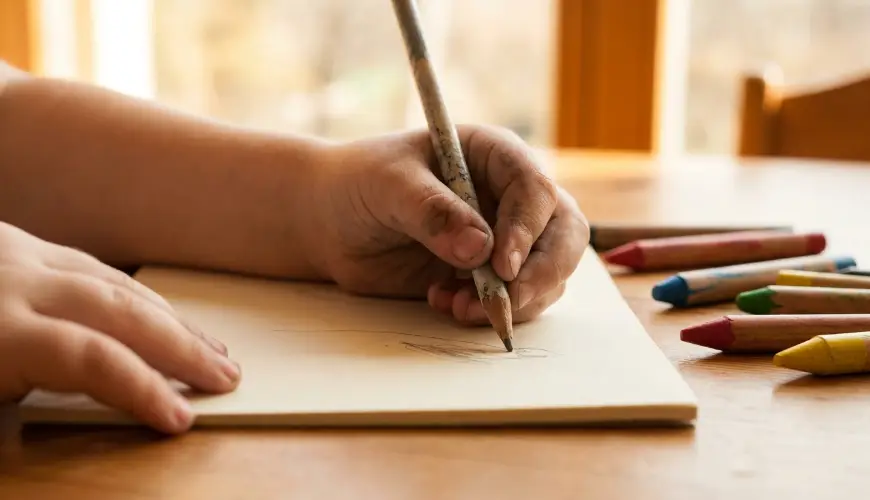
The left hand raised first, the pencil grasped from the left, a spoon approaching the bowl from the opposite side to the other children at the table – for parents of a left-handed child, these are the moments when they first realise that their child will perceive the world a little differently. And it is precisely in these moments that one of the most important chapters of parenthood begins: how to help their left-handed child feel accepted, supported and confident – rather than corrected or retrained.
Approximately 10 to 15 percent of the world's population are left-handed, and yet situations still persist in which children – consciously and unconsciously – are guided towards using their right hand. Grandparents mean well, teachers may not even notice that they are following established customs. The result, however, can be very unpleasant for the child, and in the worst case leave marks that persist long into adulthood.
Try our natural products



Why retraining left-handed children is harmful
The brain of a left-handed person functions slightly differently from that of a right-handed person. In most left-handers, the right cerebral hemisphere is dominant, which is associated with creativity, spatial thinking and intuition. Retraining a child to use their right hand is therefore not merely a matter of convenience or social convention – it is an intervention in their natural neurological configuration. As the American Academy of Pediatrics points out, hand preference develops naturally in children by the age of four and is not the result of upbringing or chance, but of genetic and neurological factors.
When a child is forced to write, draw or eat with their right hand, even though their body instinctively reaches for the left, unnecessary strain is created in the brain. The child must devote far more energy to the coordination of movement itself, rather than focusing on the content – on what they are drawing, writing or learning. The result can be difficulties with concentration, slower development of fine motor skills, and emotional frustration. The child perceives that they are doing something "wrong", even though they are in fact doing exactly what comes naturally to them.
In more serious cases, where retraining has been systematic and prolonged, stuttering, problems with spatial orientation or increased anxiety may emerge. These connections were documented as far back as the mid-twentieth century in numerous psychological studies, and today the expert community is broadly in agreement on this point: retraining left-handed children has no justification and can cause real harm.
Nevertheless, in practice we still encounter situations where a grandmother gently moves a spoon into the child's right hand, or a nursery teacher unintentionally demonstrates how to hold a pencil in a way that assumes right-handedness. This is not always a matter of ill intent – it is more a case of deeply ingrained habits in a society that has been built around the right hand for centuries.
As British psychologist and laterality researcher Dr Marian Annett once said: "Left-handedness is not a deviation from the norm – it is a different norm." And it is precisely this acceptance of difference as a natural variant, rather than a problem, that forms the foundation of a healthy approach to a left-handed child.
How to truly support a left-handed child
Supporting a left-handed child does not require anything revolutionary or complicated. In most cases, it comes down to small but consistent steps that show the child they are perfectly fine just as they are. It begins with aids and equipment, continues through communication with teachers and grandparents, and extends to the way parents talk – or do not talk – about left-handedness.
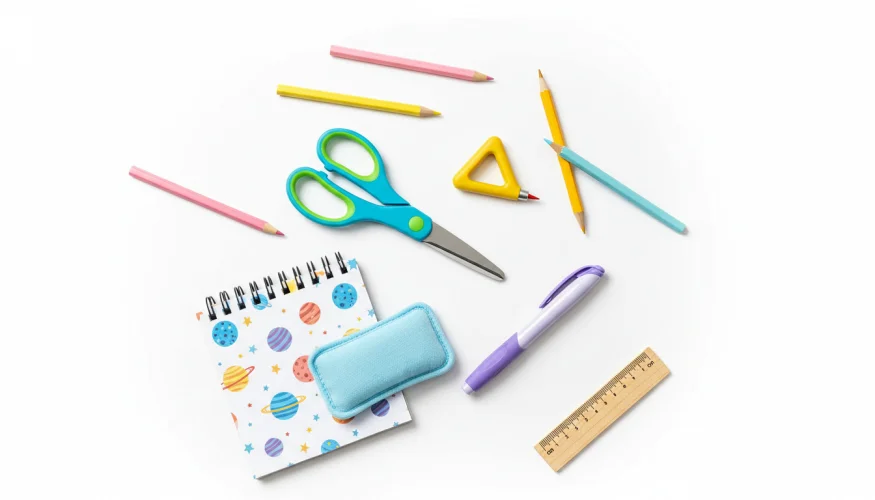
The first and very practical step is to equip the child with tools adapted for the left hand. This may seem obvious, but many parents do not even realise what a difference the right pencil, scissors or ruler can make. Standard scissors are designed for the right hand – their blades are oriented so that when cutting with the right hand, the material is pressed together. When a left-handed child picks them up, the blades push the material apart instead, making cutting laborious and the result frustrating. Specially designed left-handed scissors solve this problem elegantly. Similarly, there are pens and pencils ergonomically shaped for the left hand, spiral notebooks with the rings on the right-hand side (so the wire does not get in the way when writing), as well as special hand rests that prevent smudging of fresh ink.
Parents searching for quality left-handed aids will be pleased to know that specialist shops and online retailers focused specifically on these products already exist today. The investment in the right equipment pays back many times over in the form of a child who writes with pleasure rather than reluctance.
Another key point is the way the child holds their pencil and sits when writing. Left-handed children have a natural tendency to write in a way that allows them to see what they have just written – this is precisely the opposite problem to right-handed children, who write from the left margin and whose hand does not cover the text. A left-handed child, however, writes towards their body and risks dragging their hand through fresh ink. There are two basic techniques: hook writing (the hand is bent above the line) or writing with the paper tilted. Both are legitimate and functional – it depends on which the child finds more comfortable. What matters is that the child has the opportunity to try both options without pressure to adopt the "correct" approach.
School and the attitude of teachers play a crucial role. Parents of a left-handed child should inform the teacher right at the start of the child's school career – ideally even before the first year begins – that their child is left-handed. Most teachers today respect this fact, but it can still happen that they unintentionally demonstrate writing techniques from a right-handed perspective, or inadvertently suggest to the child that they might try using their right hand. Open communication prevents unnecessary misunderstandings and helps the child feel safer at school.
The role of siblings and peers should not be overlooked either. Children are straightforward, and left-handedness can sometimes become the target of comments or laughter. Parents should explain to their child in advance that being left-handed is natural and entirely normal – and that many famous and successful people are left-handed. To name just a few: Leonardo da Vinci, Beethoven, Barack Obama and Bill Gates are among those who have shown the world that the left hand can achieve extraordinary things. Such examples help the child build confidence and pride in their own nature.
Take as an example seven-year-old Eliška, who started first grade and noticed on her very first day that she was the only child in the class holding her pencil in her left hand. The teacher did not attempt to retrain her, but Eliška still felt awkward. Her parents noticed and that evening talked with her about what it means to be left-handed – they showed her pictures of famous left-handers, bought her a specially ergonomic pen, and arranged with the teacher for Eliška to sit at the left end of the desk so her elbow would not knock into her neighbour. Within a few weeks, Eliška loved writing. It took so little.
How to talk about left-handedness with those around you
One of the most important things parents can do is normalise left-handedness in everyday life. This means not commenting on it as something unusual, not over-explaining it to everyone the child meets, while at the same time being prepared to explain the situation calmly and matter-of-factly when it arises naturally.
Grandparents and older relatives can be the greatest challenge in this respect – not because they wish the child any harm, but because they grew up at a time when retraining left-handed children was common practice. In many countries, including Czechoslovakia, it was standard practice well into the 1960s and 1970s for teachers to tie a child's left hand behind their back or otherwise physically prevent its use. This experience left its mark on an entire generation, and some grandparents unconsciously pass it on – with the best of intentions, but the wrong approach.
Conversations with grandparents should be warm but clear. There is no need to lecture on neurology – it is enough to say: "We know things were different in the past, but we now know that retraining children is harmful. Please let Tomášek write with his left hand." Most grandparents will accept this information if it is delivered with respect and without accusation.
It is also important to monitor how the child is developing and how they feel. Some children are ambidextrous – that is, capable of using both hands with roughly equal ability. In such cases, there is no need to actively encourage either hand; the child will in time naturally settle on the one that suits them better. If parents are unsure whether their child is left-handed, right-handed or ambidextrous, they can consult a paediatrician or a child development specialist. Research published in the journal Neuropsychologia shows that hand preference stabilises by the age of six at the latest, so a certain degree of variation before that point is entirely normal.
The world is still largely built for right-handed people – from computer mice to door handles to sports equipment – but the situation is gradually improving. The range of aids for left-handed people is growing, awareness in schools is increasing, and the social stigma that has accompanied left-handedness for centuries is slowly fading. Parents who accept their left-handed child, support them and equip them with the right tools are giving them something that no pencil or notebook can replace: the certainty that they are exactly as they should be.