

# Co je parentifikace a jak ovlivňuje dospělý život ## Co je parentifikace? Parentifikace je proce
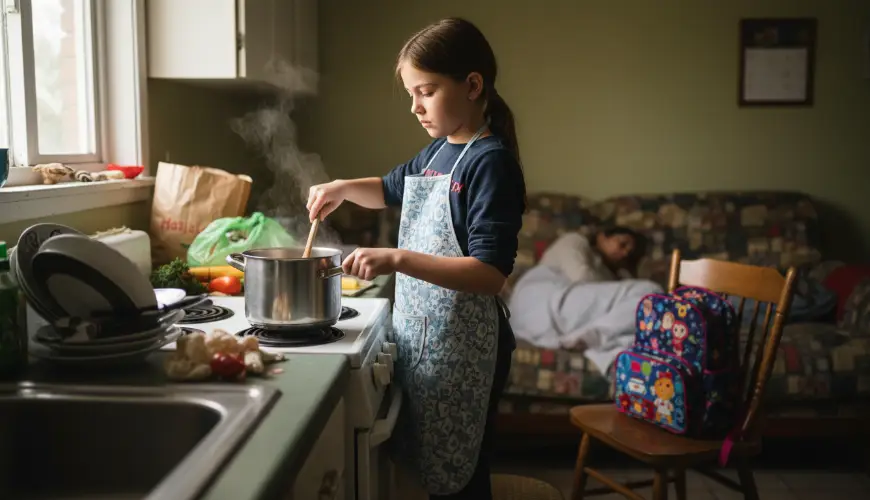
There are childhoods that look perfectly normal from the outside, but something is happening inside that shouldn't be. The child goes to school, has friends, seemingly functions – and yet carries a burden that should be carried by the adults around them. This phenomenon has a name: parentification. It is a situation where a child takes on the role of a parent towards their own parent, siblings, or the entire family – and does so so naturally that often no one even notices.
The topic of parentification has been gaining increasing awareness in recent years thanks to the development of psychology and more open public discourse about mental health. Yet it remains unknown to many people – or worse, unnamed. Many adults who served as the family's pillar of support as children don't even realise that their childhood was different from what it should have been. They simply took it as a normal part of life.
Try our natural products






What parentification actually means and how it develops
The word parentification comes from the English parentification and refers precisely to a situation where a child takes on a parental role. Psychologists define this phenomenon as a role reversal within the family – a state in which the natural hierarchical relationships are turned upside down. Instead of parents caring for the child, the child cares for the parents.
Parentification can take two forms. The first is instrumental – the child takes on the practical tasks of adults, such as cooking, shopping, paying bills, or caring for younger siblings. The second form is emotional and tends to be more insidious, because it is not immediately visible. The child becomes the parent's emotional support: listening to their problems, comforting them, regulating their moods, and essentially functioning as a therapist or partner. It is this variant that leaves deep marks.
Various circumstances contribute to the development of parentification. Most commonly, these are families where one or both parents suffer from addiction to alcohol or other substances, mental illness, chronic illness, or are going through a difficult divorce. Social factors also play a role – poverty, migration, or cultural environments where the eldest child is automatically expected to take responsibility for younger siblings. In immigrant families, for example, children very often serve as interpreters and cultural mediators for their parents, thereby taking on responsibilities that are entirely inappropriate for their age.
Consider a specific example: twelve-year-old Tereza is growing up with a mother who suffers from severe depression. Every evening she listens to her mother confide her worries and feelings of hopelessness. Tereza has learned not to talk about her own problems so as not to burden her mother. At school she is described as "mature for her age" and "responsible". No one suspects that at home she deals every day with whether her mother has enough strength to get out of bed, whether the bills are paid, and whether there is food in the house. Tereza doesn't do her homework because there simply isn't time or energy for it. And above all – she has no space to simply be a child.
There are thousands of such stories. And it is precisely their inconspicuousness that is one of the greatest problems professionals face.
How parentification marks adult life
A child who grew up as a parent to their own parents carries specific behavioural and cognitive patterns deep into adulthood. Psychological research, such as studies published in the academic journal Journal of Child and Family Studies, repeatedly shows that parentification is associated with a higher risk of developing anxiety disorders, depression, and problems in interpersonal relationships.
One of the most common manifestations is a chronic tendency to care for others at one's own expense. A person who was taught as a child that their needs are secondary carries this belief forward. In romantic relationships, this can manifest as excessive caregiving, an inability to accept help, or a tendency to choose partners who need to be "rescued". Therapists know this pattern well – it is sometimes called the rescuer or helper syndrome.
Another typical trait is difficulty expressing one's own needs and emotions. Parentified children learned to be invisible, to suppress their feelings, and to function as an emotional regulator for others. In adulthood, they often don't even know what they feel or what they need – because they never asked themselves. As American psychotherapist Lindsay Gibson aptly noted in her book on emotionally immature parents: "Children who had to grow up too soon must learn in adulthood how to be children."
Interestingly, parentification does not necessarily lead only to negative outcomes. Some researchers point to so-called adaptive parentification – a situation where the degree of responsibility assumed corresponds to the child's age and is balanced by appropriate parental gratitude and recognition. Such experiences can develop empathy, responsibility, and resilience. The problem arises when the burden is disproportionate, long-term, and the child receives no recognition for it, but instead feels guilt when they fail.
Parentified children also very often suffer from what is known as the illusion of normality – for many years they believe their situation is normal, because they have never had anything to compare it to. Only in adulthood, when they form closer relationships with peers or begin working with a therapist, do they realise that their childhood was different. This moment tends to be both painful and liberating.
It is not uncommon for these adults to also carry physical manifestations – chronic stress from childhood is stored in the body and can present as chronic fatigue, headaches, somatic complaints, or sleep difficulties. Research in the field of psychosomatics increasingly confirms how deeply early experiences are encoded not only in the psyche, but also in the body.
Parentification also has an impact on one's relationship with work and performance. Many of those who grew up as family saviours are exceptionally high-performing in their professional lives – they learned to carry a heavy load and function even under pressure. At the same time, however, they may be prone to workaholism, perfectionism, and an inability to delegate, because deep down they still believe that everything depends solely on them.

How to break this pattern and begin healing
The good news is that parentification – although it leaves deep marks – is not a destiny. Healing is possible, even if it requires time, courage, and usually professional help.
The first step is naming it. Many people live for decades without knowing that what they experienced has a name. Realising that what happened was a dysfunctional family pattern, rather than a personal failure or a natural state of affairs, is often a pivotal moment. Naming the pain is the beginning of its healing.
Psychotherapy, particularly approaches focused on working with early childhood – such as psychodynamic therapy, schema therapy, or inner child work – can help uncover and rewrite deeply rooted beliefs about what a person is allowed to need and what they deserve. The therapist in this process serves as a safe guide who helps distinguish what belonged to the parents and what belongs to the client themselves.
An important part of healing is also setting boundaries – not only with the family of origin, but also in current relationships. For people who were raised to provide boundless care for others, this is one of the most difficult tasks. Learning to say "no", accepting help, or acknowledging that they are not responsible for everyone else's happiness can be nothing short of revolutionary.
Peer support groups and the sharing of stories are also of great benefit. The awareness of not being alone in a similar situation brings enormous relief. In recent years, online communities and support groups have emerged where adults who grew up as parents to their own parents share their experiences and help each other find a path towards healthier relationships and towards themselves.
When it comes to prevention on the part of parents and professionals working with families, awareness and early recognition are key. Teachers, paediatricians, school psychologists – all of these professionals can play an important role in noticing a child who is carrying too heavy a burden. Organisations such as UNICEF or the Czech Centrum Locika, which focus on protecting children in difficult family situations, highlight how crucial early intervention is.
Parentification is not merely a private family problem – it is a social issue that deserves attention. Every child has the right to a childhood, to play, to carefree days, and to have their biggest worry be whether they'll get to play with friends today. When this right is not fulfilled, a price is paid – and often it is paid for a lifetime. That is precisely why it is worth talking about parentification, naming it, and finding ways to break patterns that would otherwise be passed down from generation to generation.