

# How to Make Fried Sauerkraut with Apple and Caraway Seeds – Not Just as a Meat Side Dish
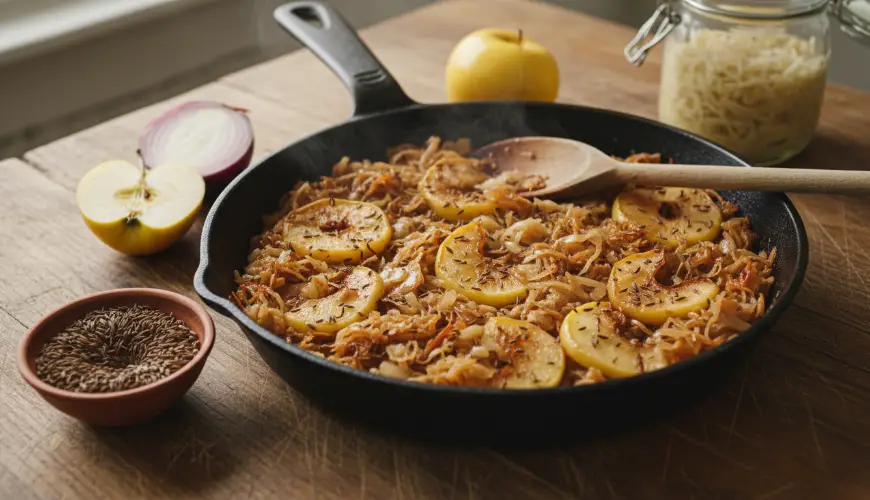
There are dishes that carry an entire history within them – the scent of grandmother's kitchen, the memory of a Sunday lunch, the feeling of home. Fried sauerkraut with apple and caraway is precisely such a dish. At first glance it may seem like an unassuming side dish, but in reality it is a small culinary miracle capable of elevating an ordinary meal into something extraordinary. And yet its preparation is surprisingly simple.
Sauerkraut is one of the fundamental pillars of Central European cuisine. Czechs, Germans, Austrians and Poles have known it for centuries, and each nation has adapted it in its own way. In Czech tradition, cabbage is most often braised or boiled, but this fried variation with added apple and caraway offers something more – crunchiness, a gentle sweetness and a deep aroma that braised cabbage simply cannot replicate. Adding apple is not merely a culinary whim. It is a considered combination that serves both the flavour and the nutritional value of the entire dish.
Try our natural products

Why is sauerkraut such a valuable ingredient?
Before we get into the preparation itself, it is worth recalling why sauerkraut is such an exceptional ingredient. Fermentation, the process by which sauerkraut is made, is one of the oldest methods of food preservation and at the same time a process that fundamentally transforms the nutritional profile of the ingredient. Sauerkraut is a rich source of vitamin C, vitamin K, folic acid and probiotics, which have a beneficial effect on the gut microbiome. According to information published by the Harvard T.H. Chan School of Public Health, fermented foods demonstrably support digestive health and may contribute to strengthening the immune system.
It is important to note, however, that heat treatment destroys some of the probiotic cultures. Fried sauerkraut is therefore not primarily a probiotic dish – its strengths lie rather in its fibre, mineral content and the characteristic flavour produced by fermentation. If you want to make full use of sauerkraut's probiotic potential, consume some of it raw or only lightly warmed. The fried version can then serve as a pleasant addition to the diet, offering a change from classic side dishes such as rice or potatoes.
The apple in this recipe serves several purposes at once. It naturally sweetens and balances the acidity of the cabbage, adds fibre, and softens during cooking to the point where it blends beautifully with the texture of the cabbage. Varieties with firmer flesh and a more pronounced flavour work best – for example Jonagold, Champion or the classic Golden Delicious. Apples of these varieties retain their shape during frying and do not turn to mush, which is crucial for the final dish.
Caraway is the third player in this flavourful trio. This spice has a deeply rooted tradition in Czech cuisine, and it is no coincidence that it is added specifically to cabbage. Caraway contains essential oils that not only impart a characteristic aroma but also aid digestion – reducing the bloating that cabbage can cause in more sensitive individuals. From this perspective, it is a combination that makes perfect sense both in terms of flavour and health.
How to prepare fried sauerkraut with apple and caraway
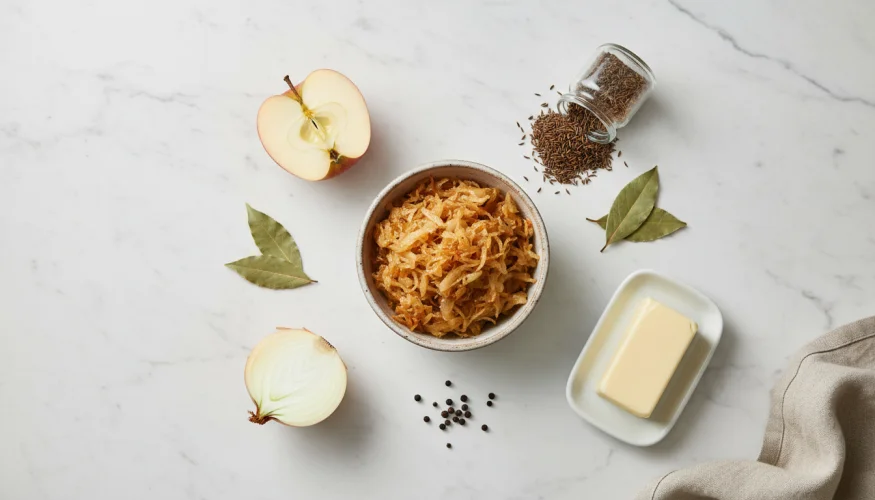
Preparing this dish requires no special culinary skills, though it is worth observing a few principles that determine the outcome. The foundation is good-quality sauerkraut – ideally homemade or purchased from a trusted producer, preferably unpasteurised, so that it retains as many nutrients as possible. Pasteurised sauerkraut from tins is of course also usable, but the difference in flavour is usually noticeable.
It is best to rinse the cabbage lightly if it is too acidic, or alternatively leave it in its original brine if you want to preserve the full sourness. It is then cut or torn into smaller pieces and drained thoroughly. Excess liquid is the greatest enemy of a crispy texture – if the cabbage is not drained sufficiently, it will steam rather than fry in the pan, and the result will be watery and lacking in character.
In a pan over medium heat, melt the fat. This is where personal preference comes into play: the classic version calls for lard or butter, which give the dish a full, traditional aroma. Those who prefer plant-based fats can reach for coconut oil or a good-quality sunflower oil with a high smoke point. The health benefits of coconut oil are a subject of expert debate, but from the perspective of thermal stability it is a sound choice.
Finely chopped onion is added to the heated fat and left to soften until translucent. Only then does the cabbage come in, fried over higher heat until it begins to brown lightly at the edges. This stage is crucial – it is precisely the caramelisation of the sugars in the cabbage that creates the characteristic deep flavour that simply surpasses the braised version. It is best to stir the cabbage as little as possible during frying, so that a crispy layer can form on the surface.
Approximately halfway through the frying time, the sliced apple is added – either in thin slices or small cubes according to preference. Along with the apple comes the caraway, salt, a little freshly ground pepper if desired, and for lovers of more pronounced flavours, a pinch of ground allspice or a bay leaf. Some cooks also add a teaspoon of sugar or honey to enhance the sweetness, but if the apple is sufficiently ripe, this is unnecessary. The whole mixture is then left to cook on low heat for a few more minutes until the apple has softened and the cabbage is beautifully golden throughout.
The result is a side dish with a complex flavour – sour, sweet, aromatic and lightly caramelised all at once. It is best served warm, but tastes equally good at room temperature, making it a practical choice even when there is no time to serve the meal immediately after preparation.
A real-life example comes from a family in the South Bohemian countryside, where fried cabbage with apple has been prepared every winter as a standard accompaniment to svíčková or roast duck. The grandmother of the household always added a little apple cider vinegar and a spoonful of homemade slivovitz to the cabbage – she said it would "open up the flavour." And she was right: the alcohol evaporates during frying but leaves behind a delicate fruity depth that takes the dish to an entirely different level.
What to serve fried cabbage with and how to incorporate it into your diet
Fried sauerkraut with apple and caraway is such a versatile side dish that it pairs well with a surprisingly wide range of main courses. The most classic combination is of course roast pork – whether a chop, neck or shoulder. The cabbage complements fattier meat beautifully, as its acidity naturally lightens the dish and aids the digestion of fats. It is no coincidence that this combination has survived centuries and continues to hold its place on Czech restaurant menus.
The cabbage works equally well as a side dish for roast chicken, duck or goose. Poultry and sauerkraut form one of the most harmonious pairings in Central European cuisine. As the food writer and journalist Michael Pollan wrote: "The food we cook for others is the deepest form of care." And this side dish – carefully prepared, fragrant with caraway and apple – is one of the most beautiful ways to express that care.
For vegetarians and vegans, fried cabbage with apple is an excellent accompaniment to baked potatoes, tempeh or various vegetable patties. The plant-based version prepared with coconut oil or olive oil loses very little in terms of flavour compared to the traditional version with lard – especially if the cook is not afraid of spices and is willing to fry the cabbage thoroughly.
The cabbage can also be prepared in advance and will keep in the refrigerator without any problem for three to four days. When reheated in a pan, its flavour actually improves slightly as the tastes meld together more fully. From this perspective, it is an ideal dish for those who like to prepare food ahead of time and want a quick and nutritious side dish ready for an everyday cooked lunch or dinner.
An interesting option is also to use the fried cabbage as a filling for wrap tortillas or as part of a warm salad with roasted root vegetables – carrots, parsnips or beetroot. These combinations are less traditional, but they demonstrate just how flexible an ingredient sauerkraut truly is. Fermented foods in general have been experiencing a renaissance in recent years, not only in home cooking but also in global gastronomy – their depth of flavour and health benefits are increasingly appreciated.
Fried sauerkraut with apple and caraway is therefore not merely a nostalgic nod to the past. It is a living, adaptable dish that can accommodate modern eating habits without losing any of its essential character. All it takes is a good pan, quality sauerkraut and a little patience – and the result speaks for itself.