

Warts on the sole of the foot, or verruca, and how to treat it properly

Anyone who has ever encountered it knows how unpleasant it can be – a small, hard growth on the sole of the foot that makes its presence known with every step. A plantar wart, medically known as verruca plantaris, is one of the most common skin problems for which people visit dermatologists. Yet there are still many myths and uncertainties surrounding it. Where does it actually come from? How should it be properly treated? And can it even be prevented?
A verruca is not merely a cosmetic problem. Although it may appear to be nothing more than an aesthetic nuisance at first glance, it is in fact a viral skin infection caused by the human papillomavirus, or HPV for short. Specifically, HPV types 1, 2 and 4 are most commonly involved in the development of plantar warts – these are entirely different from the types associated with sexually transmitted diseases. The virus enters the skin through minor abrasions or cracks and causes uncontrolled cell division in the surface layer of the skin – the epidermis. The result is a characteristic growth with a rough, sometimes mosaic-like surface.
Interestingly, not everyone who comes into contact with the virus will necessarily develop a wart. The state of the immune system plays a key role. Children and adolescents are more susceptible than adults, as are people with weakened immune systems or those who suffer from excessive foot sweating. Moist environments are particularly favourable for viruses – which is also why verrucas spread so easily in swimming pools, gym showers and public bathing areas.
Try our natural products




How to recognise a verruca and why it should not be underestimated
A plantar wart differs from a common callus at first glance, even though many people confuse the two. A callus develops from mechanical pressure and friction, whereas a verruca has a viral origin. If you look closely at the sole of the foot, you will see characteristic small black dots in the case of a verruca – these are blocked blood capillaries. The natural lines of the skin (dermatoglyphs) are interrupted at the site of the verruca, whereas with a callus they continue uninterrupted. This simple test can help distinguish between the two conditions even without a visit to the doctor.
The painfulness of a verruca depends on its location. If it is situated at a point of greatest pressure – such as under the heel or at the base of the toes – every step can be genuinely uncomfortable. This is because a verruca grows inward into the skin, rather than outward like warts on the hands, and the pressure of walking literally pushes it deeper. Some people describe the sensation of walking on a pebble that they cannot see anywhere.
There is also the so-called mosaic verruca, which is a cluster of several smaller warts in one place. This form tends to be more resistant to treatment and can cover a fairly large area of the sole. Without professional care, it has a tendency to spread and transfer to the surrounding skin.
Underestimating verrucas is certainly unwise. Although most of them disappear on their own – in children this occurs in approximately 65% of cases within two years, as stated in a review by the British Association of Dermatologists – spontaneous resolution is less likely in adults and the infection can spread to other parts of the body and to other members of the household. Moreover, a chronic painful verruca can affect the way a person walks and cause secondary problems with the ankles, knees or even the spine.
Treating a plantar wart: from the pharmacy to dermatology
When it comes to treating a verruca, there are surprisingly many options – and they differ in both availability and effectiveness. None of them is one hundred percent reliable, as the outcome depends on many factors: the size and age of the verruca, the patient's immune response and the consistency with which the treatment protocol is followed.
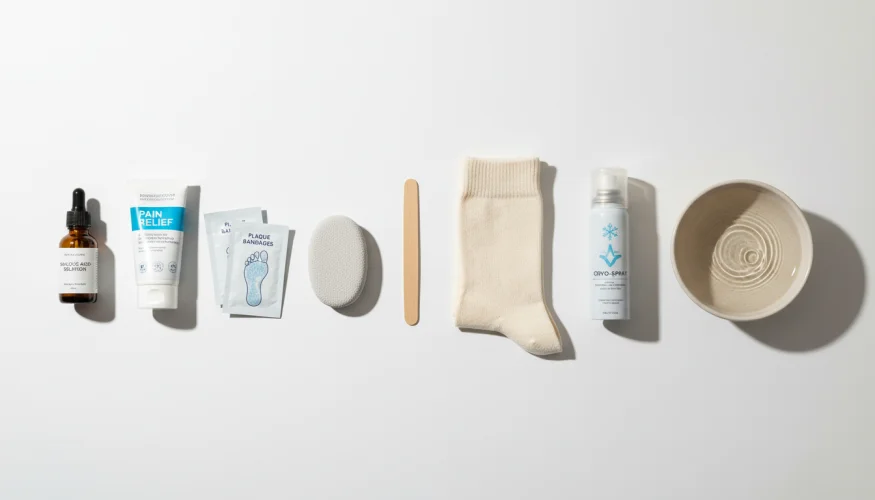
The most accessible method involves over-the-counter preparations containing salicylic acid. This works by gradually removing infected skin cells layer by layer. The preparations are available in the form of solutions, gels or plasters, and their regular use – typically over a period of several weeks to months – can produce good results. The key to success is consistency: before each application, the verruca must be soaked in warm water and the dead skin mechanically removed with a nail file or pumice stone. Only then can the active ingredient penetrate deeply enough.
Another popular approach available from pharmacies is cryotherapy for home use – a freezing spray that causes localised frostbite of the tissue. Although this method is faster than salicylic acid, it is less effective than professional cryotherapy performed by a dermatologist using liquid nitrogen. Professional freezing reaches temperatures as low as −196 °C, whereas home sprays typically only reach around −57 °C – a difference that has a real impact on treatment outcomes.
This is precisely why, when home treatment fails, a visit to a dermatologist is the next step. A dermatologist can offer several methods:
- Liquid nitrogen cryotherapy – the most commonly used method, typically requiring repeated sessions at two to four-week intervals
- Laser therapy – targets the blood supply of the verruca and gradually destroys it from within
- Electrocoagulation – uses electric current to remove infected tissue
- Immunological treatment – stimulates the local immune response using various agents, such as candida antigen or diphenylcyclopropenone
- Surgical removal – less common today due to the risk of scarring and the possibility of recurrence
As the prominent British dermatologist William Cunliffe once said: "The best treatment for a wart is the one that suits the patient and that they will follow consistently." This idea holds true to this day – there is no single universal method for everyone.
In recent years, there has been increasing discussion of so-called occlusion therapy, in which the verruca is covered with adhesive tape (most commonly electrical tape or special occlusive tape) for several days at a time. The theory is that maceration of the skin occurs alongside stimulation of the immune system. Studies on the effectiveness of this method have produced mixed results, but some patients – particularly children – have had good experiences with it, and the method is entirely safe.
There are also natural approaches that some people try as a complement to their main treatment. Tea tree oil, garlic and apple cider vinegar are the most commonly mentioned alternatives. There is little scientific evidence for their effectiveness, but in the case of mild forms of verruca they may have a supportive effect. They should certainly not replace proven treatment for persistent or painful warts, however.
An interesting case is the situation where a person notices that their verrucas suddenly disappear on their own after a serious illness or after childbirth – that is, after a period of weakened immunity. The body simply "remembers" the virus and the immune system deals with it. This is indeed the reason why modern treatment is increasingly moving towards strengthening the body's own immune response rather than purely mechanical or chemical removal.
Prevention: how to avoid a plantar wart
Treating a verruca can be a lengthy and sometimes frustrating process. Prevention is therefore truly the best approach – and fortunately it is not particularly complicated.
The basic rule is not to walk barefoot in public places – in swimming pools, showers, changing rooms or on beaches. Flip-flops or beach sandals are indispensable in these environments. The HPV virus that causes verrucas is highly resilient and survives on moist surfaces for a surprisingly long time. This is precisely why swimming pools and public showers are such hotspots for the spread of infection.
Equally important is general foot care. The virus penetrates dry, cracked or irritated skin far more easily than healthy, undamaged skin. Regular moisturisation of the feet, using quality socks made from natural moisture-wicking materials and changing footwear when sweating excessively – all of these measures reduce the risk of infection. The Mayo Clinic overview of viral warts states that transmission can also occur through indirect contact via shared towels, socks or shoes.
If a verruca appears in the household, it is important to prevent its spread to other family members. The infected person should not share towels or socks, should disinfect the shower after use and ideally wear slippers at home. Children, in whom verrucas occur most frequently, should definitely not scratch or squeeze the warts – doing so spreads the virus to the surrounding skin and to the hands.
General strengthening of the immune system plays a greater role in prevention than most people realise. Sufficient sleep, a balanced diet rich in vitamins C and D, regular exercise and stress management – all of these contribute to the body's ability to fight the virus before it has a chance to cause problems. People with chronic illnesses or undergoing immunosuppressive treatment should be particularly vigilant and seek professional help at the slightest suspicion of verrucas without delay.
Plantar warts are a problem that affects millions of people worldwide, but with a little knowledge and patience they are manageable. Whether you opt for home treatment with salicylic acid or visit a dermatologist, the most important thing is not to underestimate the situation and not to give up too soon – successful verruca treatment requires time and consistency. And if the wart returns even after apparently successful treatment, there is no reason to panic – recurrence is fairly common with verrucas and does not mean that the treatment failed, but simply that the virus persisted in the body longer than it appeared.