

# How to Handle Car Travel with a Small Child Without Stress Traveling by car with a small child ca
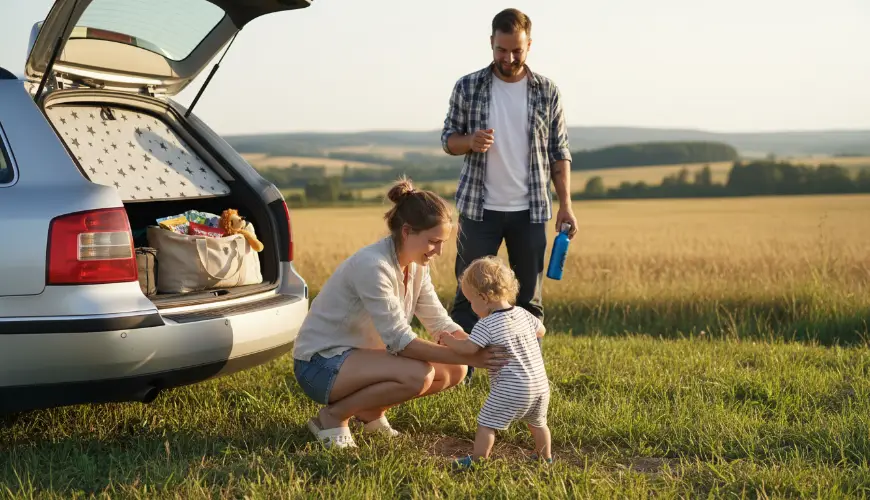
Every parent who has at least once embarked on a longer trip with a toddler or infant knows exactly what this is about. A journey that would normally take two hours can stretch to four, with most of that time spent at a rest stop trying to calm a crying child, change a nappy in conditions worthy of an improvised camp, or quickly heat up some baby food. And yet – millions of families set off by car with small children every year, and many of them manage surprisingly well. How is that possible? The answer lies primarily in preparation, realistic expectations, and a few tried-and-tested tricks that experienced parents pass on.
Travelling with a small child by car is not just about getting from point A to point B. It is a small logistical operation that begins long before you start the engine. And it is precisely that preparation which determines whether you will look back on the trip with a smile or with horror.
Try our natural products





Preparation is the key to success
Experienced travelling parents agree on one thing: the better you prepare in advance, the fewer surprises await you on the road. This does not mean you need to plan every minute – it is more about thinking ahead about the child's needs and adapting the entire journey accordingly.
The first step is choosing the right departure time. Many families swear by early morning departures while it is still dark, or conversely by a late afternoon departure, when small children naturally fall asleep. A sleeping child is, from a car travel perspective, the ideal travelling companion – and that is not cynicism, but simple reality. If you manage to time the journey to coincide with the child's usual sleep period, you will save yourself an enormous amount of stress. Parents of small children know this well: one hour of peaceful driving while the child sleeps equals three hours of driving while they are awake and have long since grown restless in the car seat.
The safety aspect is absolutely fundamental and cannot be overlooked. Every child must travel in a car seat appropriate for their age, weight and height. Czech legislation and European Union recommendations are clear on this matter – correct use of a car seat reduces the risk of serious injury to a child in an accident by up to 70%. The car seat must be correctly installed, ideally checked by a specialist, and the child must always be properly secured in it – even on short distances.
In addition to the car seat, it is worth paying attention to the space inside the car itself. Loose objects in the cabin can be dangerous during sudden braking. Everything you take with you should either be in the boot or safely stowed – not simply placed on the back seat next to the child.
Preparation naturally also concerns supplies. Sufficient food and drink appropriate for the child's age, spare clothing (at least two sets – you know why), enough nappies, wet wipes within reach of both the driver and passenger, bags in case of travel sickness, and of course a favourite toy or comfort object the child cannot do without. That is precisely what parents most often forget to pack and then desperately search for at a rest stop.
What to do when the child does not sleep in the car
Not every child falls asleep in the car. Some children, on the contrary, cannot stand being confined in a car seat for more than twenty minutes and make this known in a way that is extremely distracting for the driver. What can be done?
The key is distraction – but the kind that is safe and age-appropriate. For infants and very small children, auditory stimuli tend to be most effective: soothing music, white noise, or recordings of natural sounds. There are specialist apps as well as physical devices that play these sounds. Older toddlers will appreciate simple toys attached to the car seat, board books, or fabric toys. Screens and tablets are a lifesaver for many parents on longer journeys – if you decide to use them, do not forget age-appropriate headphones and content downloaded offline in advance, as motorway signal is not always reliable.
Regular stops are an absolute necessity, not a luxury. Experts and paediatricians recommend stopping every two hours so the child can stretch their legs, you can take a breath, and the whole family can get some fresh air. These recommendations apply equally to adult drivers – fatigue at the wheel is one of the main factors in road accidents. A stop does not need to be long, but it should allow the child to move around – even twenty minutes on a grass verge at a rest area works wonders.
Isabelle, mother of three-year-old Tomáš, describes her approach as follows: "We stopped trying to get through the journey as quickly as possible. Instead, we plan stops as part of the trip. We found a rest area with a children's playground where Tomáš can burn off energy, then he gets back in the car and usually falls asleep. The journey takes an hour longer, but we all arrive in good shape."
This approach – the journey as part of the experience, rather than a necessary evil – changes the entire perspective of travelling with children. Instead of fighting against time, it becomes an outing in itself.

The child's health and wellbeing while travelling
Travelling by car also brings health aspects worth keeping in mind. Motion sickness affects a large number of children, most commonly those between the ages of two and twelve. The symptoms are well known: pallor, sweating, nausea and eventually vomiting, most often at the least convenient moment.
Preventive measures include the child's correct seating position – looking forward out of the window, rather than to the side or backwards, helps the brain process movement signals more effectively. Fresh air in the car, regular breaks and a light meal before the journey are further tried-and-tested methods. Heavy, fatty foods immediately before departure are a bad idea – as is reading or watching a screen for children prone to motion sickness. If your child suffers from motion sickness repeatedly, consult your paediatrician about suitable options – there are both medications and natural alternatives such as ginger.
It is also important to think about hydration. In the car, especially in summer, children can easily overheat and become dehydrated. Sun shades for the windows are a small investment with a significant effect – they protect the child from direct sunlight and also keep the temperature inside the car at an acceptable level. Light, breathable clothing made from natural materials such as cotton or bamboo is ideal for summer travel – the child will not sweat in it and will not feel uncomfortable. Indeed, for adults too, comfortable clothing made from natural materials significantly affects how well we cope with long periods of sitting.
Do not forget sun protection either – UV radiation can damage sensitive children's skin even through glass, particularly during longer journeys. A good-quality sunscreen with a high protection factor applied before getting into the car is a simple solution.
If you are travelling with an infant who is still fully breastfed, remember that breastfeeding in a moving car is dangerous – the child must always be in the car seat. Plan stops for breastfeeding in advance, and bring a sufficient supply of breast milk in a flask or a portable bottle warmer if you are bottle-feeding.
The practical side of things also includes nappy changing. A portable changing mat that fits in any bag is an absolute essential. Rest stops do not always have a changing table – and if they do, it may not be in the best condition. Having your own mat and a supply of disinfectant ensures you can handle the situation anywhere.
A large part of the stress when travelling with a small child stems from being unprepared for unexpected situations. What if the child falls ill? What if a storm hits and you have to sit in a traffic jam for an hour? What if you take a wrong turn and the GPS leads you into a field? Having a basic first aid kit in the car tailored to the child's needs – a thermometer, fever medication approved by your paediatrician, plasters, a disinfectant – is just as important as having a charged phone. Because according to World Health Organization data, prevention and preparedness are the foundation of healthy travel with children.
Parents' stress also transfers to children far more than most of us realise. Children are sensitive to adults' emotions, and a nervous, tense atmosphere in the car is unpleasant for them – and they react to it exactly as any anxious person would: with irritability, crying and refusal to cooperate. Conversely, a calm, playful approach from parents can turn even a complicated situation into an adventure. "Travelling with children shows you who you really are," say experienced parents – and there is a great deal of truth in that.
Planning a route with the child in mind, rather than in spite of them, is a philosophy that changes family travel for the better. Look up interesting rest stops with play equipment, parks or interesting points of interest in advance – the Kudy z nudy website offers inspiration for family trips across the Czech Republic and will help you find places where children can enjoy even a brief stop. The journey thus becomes part of the experience, rather than merely an unpleasant necessity before the longed-for holiday.
Travelling by car with a small child without stress is not a utopia – it is the result of a combination of good preparation, realistic expectations and a willingness to adapt the pace and plan to the needs of the whole family. Parents who manage it with ease generally reveal no secret magic: they simply stopped trying to travel as if they had no children and started travelling as a family. And that, it seems, is the greatest difference of all.