

# What Really Happens to Compostable Bags After Use
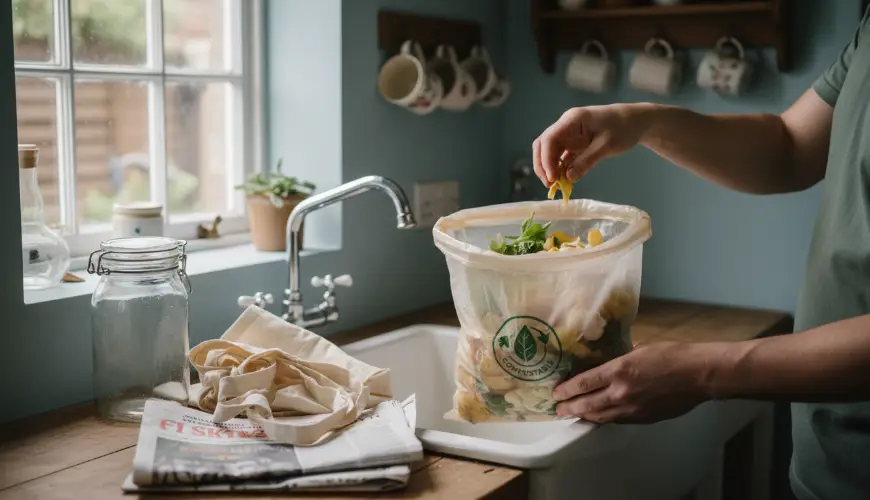
It seems like the ideal solution - you buy a bag labeled as compostable, use it, toss it in the organic waste or compost bin, and your conscience is clear. But the reality is considerably more complex and surprisingly disappointing for many people. Compostable bags very often end up exactly where they shouldn't be - in a landfill. And this is despite being marketed as an ecological alternative to conventional plastic.
Interest in a more sustainable lifestyle has grown significantly in recent years. People sort their waste, seek out nature-friendly products, and willingly pay more for goods that promise a smaller ecological footprint. Manufacturers respond to this demand, and the market fills with products bearing enticing labels like "biodegradable," "compostable," or "eco-friendly." But behind these words lie important conditions that you typically won't find on the packaging - and that is the heart of the problem.
Try our natural products

What does "compostable" actually mean?
Before we dive deeper into the topic, it's important to understand what the word "compostable" truly means. According to European standard EN 13432, a compostable material must break down by at least 90% within 12 weeks under specific conditions - namely, industrial composting. The key word here is "industrial." Industrial composting facilities operate at temperatures of around 55–60°C, with specific humidity levels and controlled aeration - conditions that a home composter or garden compost heap simply cannot reliably provide.
This means that a certified compostable bag may not break down at all in a home composter, or may only partially decompose, leaving behind microplastics or material residues that don't belong in the soil. The British organisation WRAP, which focuses on waste management, has long warned that a large proportion of compostable packaging ends up in the wrong waste stream precisely because consumers are not sufficiently informed about the correct way to handle it.
And what happens when you throw such a bag into regular waste? It ends up in a landfill or incinerator. In a landfill without access to oxygen, biological materials decompose anaerobically - that is, very slowly and producing methane, which as a greenhouse gas is more than 80 times more potent than carbon dioxide over a 20-year horizon, as stated by the US Environmental Protection Agency (EPA). In other words, a compostable bag buried in a landfill can paradoxically be worse for the climate than conventional plastic.
Imagine Markéta, a thirty-year-old mother from a town in the Central Bohemian Region, who carefully sorts her waste and tries to run an eco-friendly household. She bought a pack of compostable bags for organic waste, diligently collected kitchen scraps in them, and put everything in the brown bin. But her local composting facility doesn't accept compostable bags - it requires organic waste to be placed directly without packaging or wrapped in newspaper. Markéta's bags were therefore sorted out from the organic waste and thrown into general waste. The whole ritual was pointless, even though her intentions were entirely right.
This story is not an exception. It is the everyday reality of thousands of households across the Czech Republic, where the infrastructure for processing compostable materials simply cannot keep pace with the rate at which these products are entering the market.
Greenwashing or genuine effort? Where does the line lie?
The word greenwashing has been used more and more frequently in recent years, and in the context of compostable bags, its use is very much warranted. Greenwashing is the practice whereby companies present their products as more eco-friendly than they actually are, whether intentionally or through negligence in communicating the conditions of use. The European Commission presented a proposal for a Green Claims Directive in 2023, aimed at better protecting consumers from misleading environmental claims by manufacturers. This step indicates that the problem is real and systemic.
This does not mean, however, that every manufacturer of compostable bags acts dishonestly. Many companies genuinely invest in developing materials that are functional alternatives to plastic - under the right conditions. The problem lies in the gap between laboratory certifications and the real world of waste management. As British environmental journalist George Monbiot once aptly put it: "The greenest product is the one that is never made." This provocative thought compels us to consider whether we are seeking genuine solutions or merely cleansing our consciences.
Compostable bags are most commonly made from corn starch, sugarcane, or cellulose. Their production does not require petroleum like conventional plastic, but it still consumes agricultural land, water, and energy. If such a bag then ends up in a landfill, its environmental benefit approaches zero - or is even negative. A study published in the academic journal Journal of Cleaner Production showed that the life cycle of compostable packaging is more favourable than that of conventional plastic only when it actually goes through an industrial composting process. Otherwise, its emissions are comparable or worse.
The situation in the Czech Republic is symptomatic of the wider Central European context. A network of industrial composting facilities does exist, but their capacities and approaches to accepted materials vary significantly from region to region. While some cities have composting facilities that accept compostable packaging, others strictly refuse it because it compromises the quality of the resulting compost or extends processing time. Meanwhile, consumers have no way of finding out what rules apply in their specific municipality without actively researching - and most people simply don't do that.
Interestingly, even in countries with more developed infrastructure, such as Germany or the Netherlands, debates continue about whether compostable packaging belongs in the organic waste system at all. Some experts hold the view that a cleaner solution is to focus on reusable packaging and waste reduction at source, rather than building complex systems for processing single-use compostable products.

So what can be done about it?
Accepting the fact that compostable bags are not automatically an ecological solution can be frustrating - especially for those who genuinely care about sustainability. But this frustration is useful precisely because it forces us to think about the problem more deeply.
The first step is to find out how your specific municipality or city handles organic waste. Most local authorities or waste collection companies have this information available online or are willing to provide it upon request. If your composting facility accepts compostable bags, using them makes sense. If not, it is better to place organic waste directly in the bin or use newspaper.
The second step is to read labels critically. The label "biodegradable" does not mean the same as "compostable," and "compostable" does not mean that the product will break down in a home composter. Look for specific certifications - such as the "OK compost HOME" or "TÜV Austria" logos, which guarantee decomposability even under home conditions. There are fewer such products on the market so far, but they do exist.
The third and perhaps most important step is to reconsider the entire approach to single-use packaging. A compostable bag is still a single-use product that requires energy to produce and specific conditions for disposal. Alternatives such as fabric bags for bread, glass containers for food, or composting bins without bags are more ecologically and economically advantageous in the long run.
The fourth recommendation relates more to the collective level - putting pressure on manufacturers and policymakers to simplify the system. As long as the market is flooded with misleading labels and the infrastructure for processing compostable materials remains fragmented, individual consumer efforts will continue to run up against systemic obstacles. European legislation is slowly moving in this direction, but the pace of change is slow.
The whole story of compostable bags is actually a mirror of a broader dilemma in modern ecology: how difficult it is to distinguish genuine progress from its appearance. Good intentions are not enough - what matters is what actually happens to a product at the end of its life. And if the answer is "landfill," then even the greenest label on the packaging changes nothing.
Fortunately, the number of people asking the right questions is growing. Consumers increasingly demand transparency, non-profit organisations are mapping greenwashing, and regulators are tightening the rules on environmental claims. Compostable bags are not necessarily a bad idea - they are simply too often a poorly applied idea. And understanding this distinction is the first genuine step towards turning an eco-label into a truly ecological act.