

# How to Get Rid of Dog and Cat Hair from Laundry and the Washing Machine Pet hair on clothes and i

Everyone who shares a home with a dog or cat knows that daily struggle. A favourite hoodie disappears overnight under a layer of golden Labrador fur, dark trousers transform into a furry carpet before you even make it to work, and the beloved sofa looks as though an entire pack has been wintering on it. Pet hair on textiles is one of the most common household woes for animal lovers – and at the same time one of the most underestimated. Few people realise how much the right approach matters, not only when doing laundry, but also in everyday care of clothing and household textiles.
The problem is not merely aesthetic. Animal hair can become deeply entangled in fabric fibres, where it resists ordinary washing and conventional vacuuming. In the washing machine it can cause unexpected complications – from clogging the filter and damaging the pump to transferring hair from one item of laundry to another. So if anyone has been trusting that tossing hairy clothes into the washing machine will sort the problem out on its own, they are probably in for an unpleasant surprise.
Try our natural products

Why animal hair is so tricky
To understand why the battle against pet hair is so demanding, it is enough to look at its structure. Unlike human hair, dog and cat hair is equipped with tiny scales that hook into textile fibres like barbs. The finer and fluffier an animal's coat, the deeper the penetration into the fabric that threatens. Cat hair is particularly insidious – it is thinner than a human hair, so it settles more easily even in tightly woven fabrics such as jeans or cotton pillowcases.
Static electricity generated by rubbing clothing or vacuuming literally attracts hair and holds it in place. That is why laundry taken out of the tumble dryer is sometimes covered in even more hair than before – the heat and movement inside the drum multiply the static charge. This physical phenomenon explains why conventional methods fail and why a systematic approach is necessary.
It is also interesting to note that different materials behave differently. Synthetic fabrics such as polyester or nylon tend to attract and retain hair due to a higher static charge, while natural materials such as cotton or linen are somewhat more forgiving. Wool and fleece, on the other hand, are virtually magnets for hair – every owner of a thick-coated dog knows this well. As British veterinarian and writer Pete Wedderburn once observed: "A dog is not just an animal, it is a way of life – and part of that life is hair everywhere."
How to remove hair from clothing and household textiles
Before laundry ends up in the washing machine, it is worth spending a few minutes on preparation. Mechanical removal of hair before washing is key – not only to get the laundry cleaner, but also to protect the washing machine itself. There are several tried-and-tested methods that work reliably and require no special equipment.
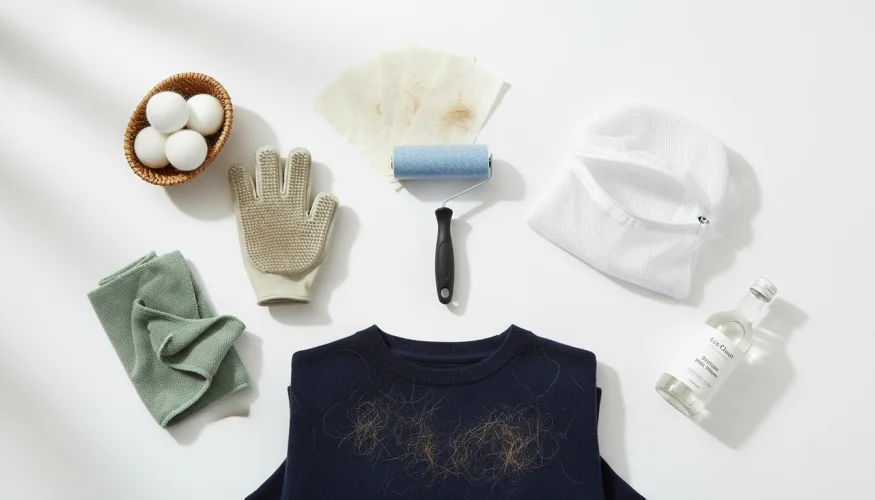
The simplest tool is a lint roller. It can quickly and effectively remove most loosely sitting hair from the surface of clothing and upholstery. For larger areas such as sofas, carpets or car seat covers, special rubber brushes or gloves designed specifically for removing animal hair are ideal. These tools work on the principle of friction – the rubber surface creates small balls of hair that can then be easily picked up. A dampened rubber glove or even an ordinary kitchen sponge with a rough side produces a similar effect.
A lesser-known trick is using a dry microfibre cloth – thanks to its structure, it attracts and captures hair electrostatically. It works excellently on smooth surfaces such as wooden floors or leather upholstery. For textiles and carpets, a brush with short stiff bristles is effective, as is a special vacuum cleaner attachment for pet hair that combines mechanical and suction action.
For clothing that cannot easily be brushed or rolled, the old trick of a damp hand works well – simply moisten your palm and run it over the fabric. The hair clumps together into small tufts that can be easily removed. Special washing gloves or mittens that work in the same way are an alternative.
Household textiles – bed linen, throws, blankets and cushions – deserve special attention. These tend to be the most affected, as animals spend hours on them. Before washing, it is advisable to shake bedding outside or to put it in the tumble dryer for a few minutes without heat – the movement loosens hair from the fibres, making it easier to fall out. Studies by the American Cleaning Institute confirm that mechanical pre-treatment before washing significantly increases the effectiveness of the wash itself and protects the washing machine from excessive strain.
Pet hair in the washing machine: how to protect the appliance and the laundry
This is the part that is talked about least, yet it is perhaps the most important. Dog and cat hair in the washing machine can cause serious problems. During washing, hair is released from fabrics but has nowhere to go – instead it settles on the washing machine filter, in the pump, or becomes caught on other items of laundry. The result is clothing that is covered in hair from other items after washing, and in worse cases, a damaged washing machine.
The first rule is regular cleaning of the washing machine filter. Most modern washing machines have an accessible filter located at the bottom of the appliance – cleaning it should be part of routine maintenance, and if there is a pet in the household, it should be done more frequently than usual. A neglected filter not only reduces washing efficiency but can lead to pump failures, which are not cheap to repair.
The second useful aid is laundry bags or special washing bags designed to capture pet hair. These act as a fine sieve – they catch hair that is released from fabrics during washing and prevent it from spreading further. There are also special washing machine additives available that soften the water and reduce static electricity, causing hair to cling less to fabrics and to leave more easily with the waste water.
A real-life example: Jana, the owner of two cats and a Border Collie, puzzled for a long time over why her laundry was still full of hair after washing. She solved the problem with a combination of two steps – she started using a pet hair laundry bag and cleaning the washing machine filter once every two weeks. The result was immediate: the laundry was cleaner, the washing machine quieter, and the filter was capturing a surprising amount of hair that would otherwise have ended up back on the clothing.
The choice of wash programme also plays an important role. Shorter programmes with fast drum rotation are not ideal for hairy laundry – the hair does not have time to release and leave with the water. Longer programmes with lower spin speeds, on the other hand, give hair more time to loosen. Adding half a cup of white vinegar to the fabric softener compartment helps to release hair from fibres while naturally softening fabrics – without chemicals and without any smell, which disappears completely after washing.
If the household has a tumble dryer, this is actually an advantage. Drying in the drum at a low temperature before washing is one of the most effective ways to loosen hair from fabrics – the warm air and movement cause hair to fall out and be caught in the dryer filter. The filter can then be cleaned and the laundry put in the washing machine with significantly less hair on it.
Reusable laundry balls – whether made from wool or silicone – are a sustainable and eco-friendly solution. During washing they mechanically loosen hair from fibres and at the same time reduce drying time. Compared to single-use products they are kind to the environment and, in the long run, to the wallet too. For environmentally conscious households with pets, they represent one of the most practical investments.
Prevention is of course always better than dealing with the consequences. Regular combing and brushing of dogs and cats significantly reduces the amount of hair that makes its way into the home and onto textiles. Special brushes capture loose fur right at the source, before it has a chance to colonise the sofa or a favourite jacket. Vets recommend brushing as part of daily care, especially during the moulting season, which for most breeds occurs twice a year – in spring and in autumn.
Textile throws and blankets on seating furniture are another practical solution – they serve as a sacrificial layer that captures most of the hair and can be easily washed. The choice of material for the throws matters here: fabrics with a smooth surface, such as microfibre or cotton sateen, shed hair much more easily than coarsely woven fabrics or fleece.
Pet owners deserve a home that is not only comfortable for the animal but also manageable for the people. With a little system, the right tools and regular care, the battle against pet hair can be won to the point where it stops being a battle and becomes just one of the routine parts of running a household – much like vacuuming or dusting. And honestly, a few hairs on a jumper are really just a quiet reminder that someone at home is always happy to see you walk through the door.