
Proven tricks to prevent bathroom mirror fogging
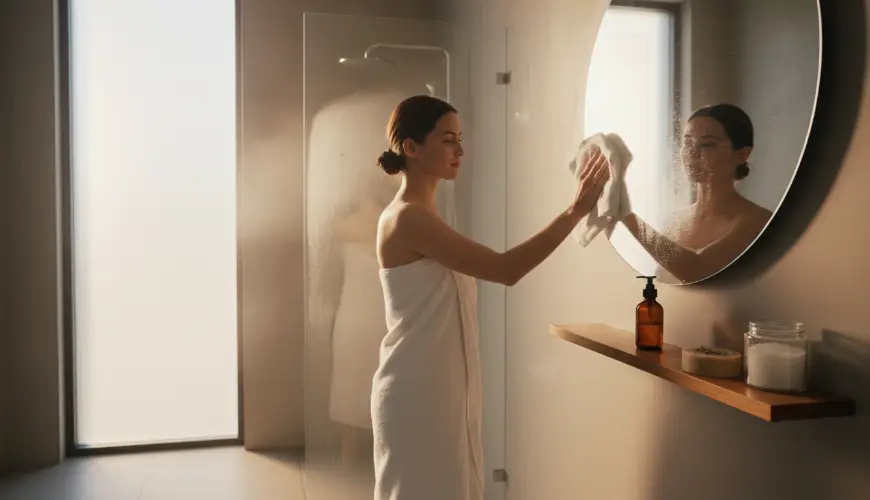
Every morning the same scenario – a shower, steam, and a mirror shrouded in a thick layer of condensation. Before you have time to shave or put on makeup, you first have to wipe the mirror with a towel, wait for the fog to clear, or open the window and invite freezing air into the bathroom. Mirror fogging in the bathroom is one of those everyday minor annoyances that, while trivial, can be genuinely irritating. The good news is that there are several ways to prevent this phenomenon – and most of them require no complex installation or major expense.
Try our natural products

Why does a mirror fog up in the first place?
Before we get to solutions, it's worth understanding what's actually happening. When you shower or bathe in hot water, the air in the bathroom fills with water vapour. The mirror naturally has a lower temperature than the surrounding air, and as soon as the warm, humid air comes into contact with the cool glass surface, the water vapour condenses and forms a thin layer of tiny droplets. The result is that characteristic matte film that makes it impossible to see anything in the mirror. This is an entirely natural physical phenomenon – condensation – and the key to reducing it is either to lower the humidity of the air in the bathroom, or to keep the mirror surface sufficiently warm.
This understanding is important because different methods tackle fog in different ways. Some work with the temperature of the glass, others create a thin hydrophobic layer on the mirror surface that prevents droplets from taking hold, and others focus on reducing the overall humidity of the space. The ideal approach is usually a combination of several methods at once.
Let's picture an everyday scenario: Markéta gets up at six every morning, showers, and then rushes off to work. Every morning she loses precious minutes waiting for the mirror to clear, or wiping it repeatedly. It is precisely for people like her that the following tips are a genuine lifesaver.
Home tricks to prevent mirror fogging
One of the simplest and most accessible solutions is using soap or shaving cream. Simply apply a small amount to the mirror, spread it across the entire surface, and then gently wipe it off with a dry cloth. An invisible layer remains on the glass that prevents condensation droplets from taking hold. This trick is well known among divers, who use it on their masks – and it works surprisingly well in the bathroom too. The effect lasts for several days, after which the process needs to be repeated.
Glycerin mixed with water works in a similar way. A solution of approximately one part glycerin to three parts water is sprayed or applied to the mirror and wiped dry. Glycerin is a natural substance, gentle on surfaces and safe for health, and it creates a thin protective film. For those who prefer eco-friendly solutions without chemicals, this is an excellent choice.
Another popular home remedy is toothpaste. Apply a small amount to a damp cloth, wipe it across the mirror, leave it to work for a moment, and then wipe dry. Toothpaste contains mild abrasives and softening agents that treat the glass surface in a similar way to specialist products. The result may not appeal to everyone, as the application is a little more labour-intensive, but the effect tends to be surprisingly long-lasting.
Vinegar also has a role to play. White distilled vinegar diluted with water serves as an excellent glass cleaner and can also help reduce the degree of fogging. It is not quite as effective as glycerin or soap, but as part of regular cleaning it contributes to the overall cleanliness of the surface, on which condensation is less likely to cling.
For those who don't want to experiment with home remedies, there are commercial anti-fog sprays and products on the market specifically designed for mirrors and glass surfaces. These products are typically formulated to make their effect last as long as possible, and they are very easy to apply. Simply spray, wipe, and you're done. Many of them are also safe for various types of surfaces and leave no streaks.
Technical solutions for a more comfortable bathroom
If you want to tackle the problem systematically and once and for all, it's worth considering investing in a heated mirror. These mirrors have a built-in electric heating element that keeps the glass surface at a temperature higher than that of the surrounding air. This simply prevents condensation from occurring – the water vapour has nothing to condense on, because the glass is warmer than the air. Heated mirrors are now available in a wide range of design styles, and their installation is no more complex than that of a standard mirror with an electrical connection. It is an investment that quickly pays off in terms of everyday comfort.
Another technical solution is proper bathroom ventilation. A good fan or ventilation system can remove excess moisture during showering, significantly reducing the amount of water vapour in the space. According to experts in the field of building physics, the relative humidity in a bathroom should not exceed 70% on a long-term basis, and ideally should remain below 60%. Modern fans with a humidistat switch on automatically as soon as humidity exceeds a set threshold, and switch off again once the air is dry. This solution protects not only the mirror, but the entire bathroom from mould and moisture damage.
An open window – if the bathroom has one – has a similar effect to ventilation. Simply open it slightly before showering so that air circulation prevents steam from building up. In winter months this is not ideal from a thermal comfort perspective, but in combination with other methods it can help significantly.
A less well-known but highly effective option is the use of a dehumidifier. Compact dehumidifiers are now available at affordable prices and work excellently in the small space of a bathroom. They remove excess moisture from the air, thereby reducing the overall potential for condensation on all cool surfaces – not just the mirror, but also tiles, doors, and windows.
Anti-fog mirror films are also an interesting alternative. These are thin transparent films with a hydrophobic or hydrophilic treatment that are applied directly to the mirror surface. Hydrophilic films work by spreading the condensation water into a thin, even layer that is transparent, rather than allowing droplets to form a foggy film. Hydrophobic films, on the other hand, cause droplets to slide down the surface without clinging to it. Both options are relatively inexpensive, easy to apply, and simple to replace.
As the renowned design pioneer Dieter Rams once said: "Good design solves problems without creating new ones." And it is precisely this spirit that should guide the choice of solution for a fogging mirror – simple, functional, with no side effects.

Small habits with a big impact
In addition to products and technical aids, everyday habits also play an important role. Showering in cooler water significantly reduces the amount of steam produced – the smaller the difference between the temperature of the water and the air, the less condensation forms. Not everyone will welcome this, especially in winter, but even a slight reduction in water temperature can have a noticeable effect.
It also helps to shower with the door or window slightly open, if the layout of the flat allows for it. Air then circulates more freely and steam does not accumulate in an enclosed space. Some people swear by the trick of wiping the mirror with a dry towel before showering and then airing out the bathroom immediately afterwards – the combination of both steps significantly shortens the time during which the mirror remains fogged.
Regular mirror cleaning is another factor that is often underestimated. Dirt, soap residue, and limescale on the glass surface create a rough surface on which condensation clings more easily. Clean, smooth glass is naturally more resistant to fogging. Using alcohol-based cleaners or specialist glass cleaners not only keeps the mirror gleaming, but also helps protective layers from anti-fog products last longer.
It is worth noting that combining several approaches produces the best results. An anti-fog spray alone will help, but if the bathroom suffers from poor ventilation and the air is permanently saturated with moisture, no product will work miracles. Conversely, a well-ventilated bathroom with a regularly cleaned mirror treated with a glycerin solution can be virtually problem-free throughout the year.
Mirror fogging is therefore a problem with clear physical causes and equally clear solutions. Whether you opt for an inexpensive home trick with soap, invest in a heated mirror, or simply improve the ventilation in your bathroom, the result is always the same – mornings spent in front of a clean, clear mirror instead of waiting in vain for the fog to clear. And that is, after all, a small but daily pleasure well worth having.