

Try dandelion root instead of your morning coffee

Every morning, millions of people wake up with a single thought – a cup of coffee. The characteristic aroma of roasted beans, the bitterness of the first sip, and the pleasant warmth spreading through the body are almost a ritual for many. But what if there were an alternative that offered a similar experience, yet without caffeine, without jitteriness, and with a whole range of additional health benefits? More and more people around the world are discovering dandelion root as a coffee substitute – and the results are surprising them.
Most of us know the dandelion as an unwanted garden nuisance, a yellow flower that stubbornly pushes through every crack in the pavement or lawn every spring. Few people realise, however, that beneath the ground it conceals one of the most interesting natural treasures that Central European nature has to offer. Dandelion root – botanically Taraxacum officinale – has centuries of use in traditional medicine and herbalism behind it, and today it is coming to the forefront of modern nutrition and healthy lifestyles.
Try our natural products


What is hidden in dandelion root?
To understand why dandelion root lends itself so well as a coffee alternative, we need to look at what it actually contains. The root is rich in inulin, a type of prebiotic fibre that feeds beneficial bacteria in the gut and supports a healthy microbiome. It also contains bitter compounds called taraxacin and taraxacerin, which stimulate digestion and bile production, as well as B vitamins, vitamin C, potassium, iron, calcium, and zinc. This is therefore a nutritional profile that many commercial dietary supplements would envy.
Inulin plays a key role here. During the roasting process, inulin in the root is partially converted into fructose, producing a mildly sweet, earthy, and slightly bitter flavour that is surprisingly similar to coffee. This natural chemical process is the reason why roasted and ground dandelion root, when prepared in a pot or through a filter, creates a dark beverage whose appearance and aroma can confuse even an experienced barista. It is not merely a marketing trick – the similarity to coffee is grounded in real biochemistry.
Interestingly, dandelion root was historically used as a coffee substitute during times of war or economic crisis. During the Second World War, for example, when access to coffee beans was restricted, people in various parts of Europe prepared drinks from roasted chicory and dandelion roots. What was once a necessity has today become a conscious choice.
Take Markéta, a thirty-year-old graphic designer from Brno, who suffered from recurring insomnia and anxiety. Her doctor recommended that she reduce her caffeine intake, but she could not imagine a morning without a warm dark drink in her hand. She began experimenting with dandelion coffee – at first sceptically, then with growing enthusiasm. "I expected it to taste like grass," she says. "But it was earthy, slightly bitter, and surprisingly satisfying. After two weeks, I realised I didn't miss the caffeine at all – what I had missed was the ritual." Markéta's story is not an isolated one.
Why are people looking for coffee alternatives?
Coffee is undoubtedly one of the most popular beverages in the world and has a wide range of proven health benefits – from antioxidants to a reduced risk of certain diseases. Nevertheless, there are groups of people for whom regular coffee consumption can be problematic. Pregnant women should limit their caffeine intake, as recommended by the World Health Organization, which sets 300 mg of caffeine per day as the safe upper limit. People with acid reflux, anxiety disorders, sleep disturbances, or a sensitive digestive tract often struggle with coffee.
Caffeine is a powerful substance, but its drawbacks are well documented. It can cause palpitations, disrupt sleep, raise cortisol levels, and trigger anxiety in sensitive individuals. Some people also gradually build up a tolerance and require ever-larger doses to achieve the same effect – a classic mechanism of mild dependence. This is precisely why interest in caffeine-free alternatives is growing – alternatives that preserve the ritual of a warm drink but without the unwanted side effects.
Dandelion root naturally contains no caffeine whatsoever. This means it can be enjoyed at any time of day or evening without disrupting sleep. At the same time, its bitter compounds stimulate digestion in a manner similar to coffee, and many users describe a sense of gentle alertness – not from caffeine, but from the overall effect of the bioactive compounds on the body.
Another reason people are turning to dandelion coffee is the growing interest in local and sustainable products. Dandelions grow practically everywhere in the temperate zone, are available without complex logistics, and their harvesting does not burden the ecosystems of distant countries. At a time when more and more consumers are thinking about the carbon footprint of their diet, a local herb gathered from a nearby field is a very appealing choice. Research shows that local foods generally have a significantly lower environmental impact than imported goods – and that is an argument that resonates strongly today.
How to prepare dandelion coffee and where to find it?
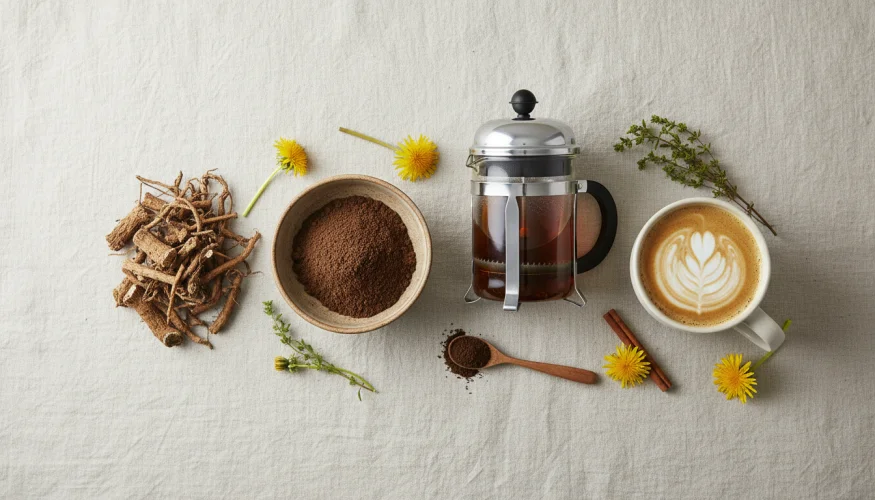
Preparing dandelion coffee is simpler than it might seem. The roots are ideally harvested in autumn, when they are richest in inulin, then cleaned, cut into small pieces, and slowly roasted in an oven at approximately 150–180 °C until they turn golden and begin to release a characteristic nutty aroma. The roasted pieces are then ground – either in a coffee grinder or a regular blender – and the resulting powder is prepared in the same way as filter coffee or a French press.
For those who have neither the time nor the inclination to wander meadows with a basket, there is an increasingly wide range of quality ready-made products on the market. Dried and roasted dandelion root is now available in many specialist health food shops or eco-friendly online stores. It is important to choose products from certified organic farming, ideally without added substances or flavourings – pure root speaks for itself.
When preparing the drink, a few simple rules apply: approximately one to two teaspoons of ground root per cup of hot water, poured over with boiling water and steeped for four to five minutes. The resulting beverage can be flavoured with plant-based milk, honey, or a pinch of cinnamon. The combination of dandelion root with coconut or oat milk and a touch of cardamom in particular creates a drink that many describe as a "caffeine-free golden latte" – warming, aromatic, and surprisingly complex.
In terms of taste, it is fair to say that dandelion root is not a perfect copy of coffee. It is less intense, less acidic, and has a more distinctive earthiness. But for many, that is precisely its charm – it is its own, unique drink that deserves to be judged on its own merits, not merely as a "substitute". As British herbalist Sebastian Pole puts it: "Herbs are not substitutes. They are partners on the journey to health."
The health benefits of regularly consuming dandelion root are the subject of growing scientific interest. Studies published in journals such as Evidence-Based Complementary and Alternative Medicine suggest that dandelion root extract may have anti-inflammatory effects, support liver and gallbladder function, and positively influence blood sugar levels. Research in this area is still ongoing, and scientists note that most studies have so far been conducted on cell cultures or animal models – nevertheless, the results are promising and justify the interest in this herb.
The effect of dandelion root on digestion deserves particular attention. Prebiotic fibre inulin acts as food for beneficial gut bacteria, particularly the genera Lactobacillus and Bifidobacterium, which play a key role in the immune system, mood, and overall health. At a time when science is delving ever deeper into the connection between the gut microbiome and the brain – the so-called gut-brain axis – regular consumption of prebiotics appears to be one of the smartest steps a person can take for their health.
It is important to mention possible limitations as well. Dandelions belong to the Asteraceae family, and people who are allergic to ragweed, chrysanthemums, or daisies should exercise caution, as cross-allergic reactions may occur. Furthermore – owing to its strong influence on bile production – dandelion root is not suitable for people with gallbladder disease or gallstones without prior consultation with a doctor. As with any herb, the principle holds: nature is powerful, and therefore it must be approached with respect and knowledge.
The trend of setting aside coffee in favour of herbal alternatives is not merely a passing fashion. It is part of a broader shift in the way people think about what they put into their bodies – with greater emphasis on naturalness, locality, sustainability, and conscious consumption. Dandelion coffee plays the role of a modest yet surprisingly convincing hero in this story. It is accessible, ecological, beneficial to health, and – for those who give it a chance – genuinely tasty.
Perhaps it is time to look at that "garden nuisance" through slightly different eyes. Behind every little yellow flower lies a root waiting for the opportunity to speak – and it has far more to say than might appear at first glance.