
# Organizing Medications and Home Medicine Cabinets Without Chaos
Few people think about their home medicine cabinet until they actually need it. Yet it is precisely at the moment when someone in the family develops a fever in the middle of the night, or a child scrapes their knee at the playground, that it becomes clear whether the home medicine cabinet is truly functional — or just an overstuffed drawer full of expired tablets and mysterious unlabelled ointments. Organising medicines and the medicine cabinet at home is a topic that seems trivial until it becomes urgent.
And yet it is a surprisingly simple matter — all it takes is a bit of system, the right storage, and regular review. The result is peace of mind and the assurance that in an emergency, you know exactly where to find everything, and that what you find is actually usable.
Try our natural products






Why chaos in the medicine cabinet is not just an aesthetic problem
According to data from the World Health Organization, the improper use of medicines and mix-ups between products are among the most common causes of domestic accidents that could easily have been prevented. And it is not just about extreme cases. Everyday reality looks more mundane: someone takes an expired ibuprofen because they did not notice the expiry date, or gives a child an adult dose because they read the wrong packaging. Such situations arise precisely when the medicine cabinet is disorganised and nobody has checked it for a long time.
Consider a family with two children where each member takes different medicines — the father takes allergy medication, the mother takes thyroid medication, the older child has a prescribed cough syrup, and the younger one occasionally receives antipyretics. If all these products are thrown together in one box without any order, the risk of mix-ups or overlooking an expired date is real. Proper organisation of the home medicine cabinet in such a case is not a luxury, but a basic safety measure.
At the same time, a well-organised medicine cabinet saves money. When you know what you have at home, you avoid buying duplicate products unnecessarily. And conversely — you know in good time what you are missing and can restock before you urgently need it.
Where the medicine cabinet should be and what it should look like
One of the most widespread mistakes is storing medicines in the bathroom. It seems logical — the bathroom is, after all, the hygiene centre of the home. However, the humidity and temperature fluctuations typical of bathrooms accelerate the degradation of medicinal products and shorten their actual effectiveness, even if the expiry date has not formally passed. Medicines should be stored in a dry, cool, and dark place, ideally in a closed cabinet or box out of reach of children and away from direct sunlight.
Suitable locations include, for example, a lockable cabinet in the bedroom, a shelf in a pantry, or a dedicated medicine box placed at height in the kitchen. The key is that the location is accessible to adult members of the household, but not to young children. If there are children or seniors with cognitive difficulties in the household, investing in lockable storage is definitely worthwhile.
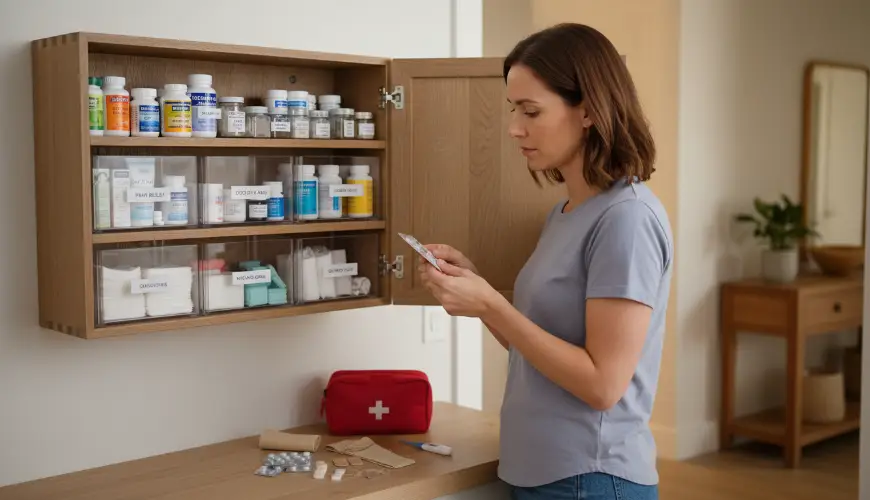
As for the storage itself, it does not need to be anything complicated or expensive. Popular solutions include transparent boxes with compartments or sets of smaller containers where medicines can be divided into categories. Clarity is key — the ideal medicine cabinet is one in which you can find what you are looking for within thirty seconds, even half-asleep.
How to sort medicines so that everyone has an overview
There are several sorting systems, and each household can choose the one that suits it best. The most effective approach is typically a combination of two methods: sorting by type and sorting by user.
Sorting by type means that pain medicines are kept together, digestive medicines are separate, first aid supplies (plasters, bandages, disinfectant) have their own section, and long-term prescription medicines are separated from over-the-counter products. This system works well in households where all family members are healthy and only take medicines occasionally.
In households where someone takes several chronic medicines, sorting by user tends to work better. Each household member has their own compartment or box containing all their products. This arrangement significantly reduces the risk of mix-ups and also makes it easier to check whether a given person has actually taken their medicine — particularly for seniors or children.
Regardless of the chosen system, several universal rules apply. Every medicine should be in its original packaging with a legible name and expiry date. Loose tablets without packaging or a package leaflet are a safety risk and should be disposed of. Package leaflets are worth keeping, even if they seem unnecessary — in case of doubt or overdose, they are a valuable source of information for emergency responders.
A practical addition is a simple list of the medicine cabinet's contents, which can be stuck inside the lid of the box or on the cabinet door. Such a list does not need to be detailed — an overview of categories is sufficient, along with a note indicating where medicines requiring refrigeration are stored (in the fridge).
As American pharmacist and home safety author Vince Covino once noted: "The best medicine cabinet is not the biggest one, but the one you can navigate." This idea applies universally — an overstuffed box full of unidentifiable products is worse than a modestly stocked but well-organised set of basic medicines.
Regular review: the step most often skipped
Even the best-organised medicine cabinet loses its purpose if nobody checks it regularly. Experts recommend reviewing the contents of the medicine cabinet at least twice a year — a practical trick is to link this to the change to summer and winter time, so you do not forget.
During the review, several things need to be checked. First and foremost, expiry dates — thoroughly, for every product. Then the condition of the packaging and the medicines themselves: tablets that have changed colour or are crumbling, or ointments with an unusual smell, are a sign that the product needs to be discarded regardless of the date. The review should also include checking the supply of dressing materials — plasters lose their adhesiveness, and sterile bandages may have expired.
Never dispose of expired medicines in regular household waste or flush them down the drain. Medicinal substances contaminate soil and water sources and represent an environmental burden. The correct approach is to hand expired medicines in at a pharmacy — this service is free of charge in the Czech Republic, and pharmacies are legally obliged to accept expired medicines and ensure their ecological disposal. More information on the proper disposal of medicines is provided by, for example, the State Institute for Drug Control.
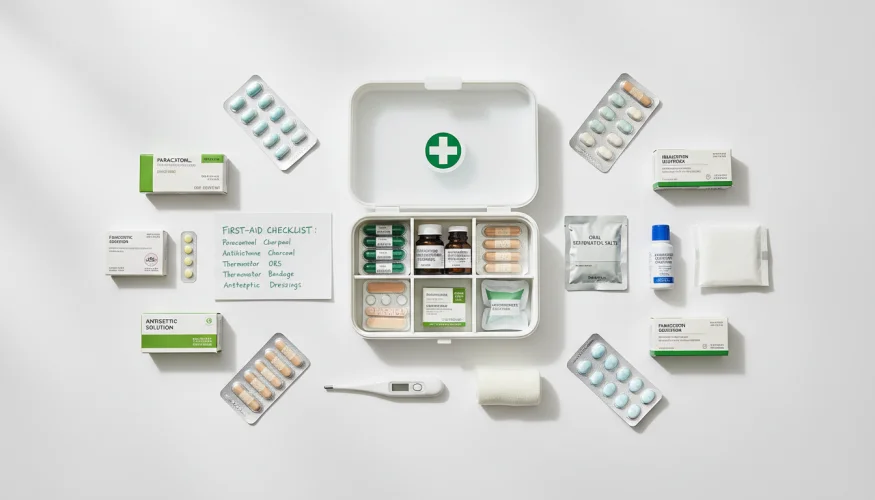
The review is also a good time to replenish supplies that have been used up or are approaching their expiry date. According to recommendations from general practitioners, the basic contents of a home medicine cabinet should include:
- pain and fever medicines (paracetamol, ibuprofen)
- products for digestive complaints (activated charcoal, electrolyte solutions, anti-diarrhoeal medicines)
- antihistamines for allergic reactions
- disinfectant and sterile wound dressings
- plasters of various sizes and an elastic bandage
- a thermometer and, for households with seniors, a blood pressure monitor
- any prescription medicines regularly taken by household members
Digital tools and modern approaches to organisation
Nowadays, there are also digital tools that can make managing home medicines easier. A simple option is a spreadsheet on your phone or a shared document in the cloud, recording medicines, their location, and expiry dates — particularly practical for larger households or families where several people take turns managing the medicines.
For seniors or people with more complex medication regimens, medicine dispensers with compartments for individual days and times of day are available on the market. These aids significantly reduce the risk of missing or double-dosing, and are affordable. More advanced electronic dispensers even alert the user with an audible signal when it is time to take a medicine.
Organising medicines at home thus becomes part of a broader approach to healthcare — conscious, considered, and sustainable. Just as people think about what they eat, what cosmetic products they use, or what materials their clothing is made from, it makes sense to think about how they handle medicines, which are part of the daily life of most households.
The home medicine cabinet is not just a drawer full of tablets. It is a safety net for the whole family — and like any net, it works best when it is regularly checked, kept in order, and everyone knows where to find it. Devoting an hour to it once every six months is an investment that may pay off at the moment you least expect it.