
Simple stretching of the back of the legs while sitting on the ground
Pain in the back of the thighs or a feeling of shortened muscles after a full day of sitting at a computer – many of us know this feeling. Yet there is a simple way to address this problem without a gym, expensive equipment, or hours spent exercising. Seated floor stretching for the back of the legs is one of those exercises that looks unassuming, but its effect on the musculoskeletal system is surprisingly profound. All you need is a mat, a quiet corner of a room, and a little patience.
The back of the thighs is an area that people pay far less attention to during exercise than, for example, the abdomen or shoulders. Yet the muscle group known by the English term "hamstrings" – namely the biceps femoris, semitendinosus, and semimembranosus – plays a key role in every step, while sitting, and when bending forward. If these muscles are shortened or overloaded, this manifests not only as pain in the back of the thighs, but often also as lower back pain, knee instability, or even posture problems.
Try our natural products






Why are the muscles at the back of the thighs so often shortened?
The modern lifestyle is a true enemy in this regard. According to World Health Organization data, the average person spends a large part of the day sitting – in a car, in an office, while eating, in front of the television. During prolonged sitting, the hamstrings are in a constantly shortened position, which the brain eventually evaluates as their "natural" state. The result is progressive shortening, which then manifests during walking, sports, or simple forward bending.
Consider Markéta, a thirty-five-year-old accountant who works eight hours a day at a computer. One morning she gets out of bed and feels a dull ache stretching from her sit bones to her knees. Her doctor explains that it is shortened hamstrings combined with mild overloading of the lumbar spine. The solution? Regular stretching – ideally in a seated floor position, where the body has stable support and there is no risk of overloading the spine through improper standing technique.
Shortened muscles at the back of the thighs do not only trouble office workers. Paradoxically, athletes also encounter them – especially runners, cyclists, or footballers – who load these muscles one-sidedly without sufficient compensation. Regular stretching is therefore important for everyone, regardless of age or level of physical activity.
Stretching in a seated floor position has several practical advantages over standing or lying down. The centre of gravity is low, the pelvis is stable, and there is no risk of overstretching or losing balance. At the same time, the intensity of the stretch can be very precisely adjusted and one can perceive exactly where the muscle is working. This is why physiotherapists and yoga instructors recommend this position as a foundation for working on lower limb flexibility.
How to correctly stretch the back of the legs in a seated floor position
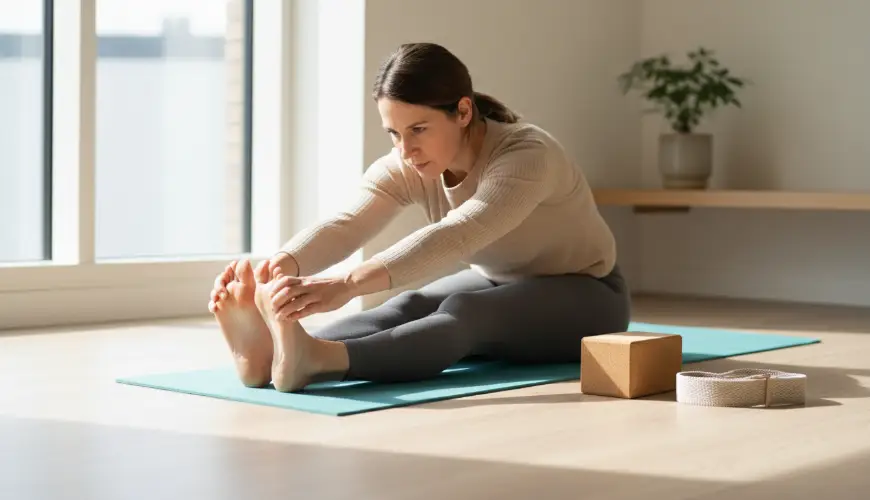
Before getting into the actual stretching, it is good to know that there are several variations, and each targets the muscles slightly differently. The simplest and most well-known is the so-called seated forward bend with legs extended – in yoga referred to as Paschimottanasana. The body sits upright on a mat, legs extended in front, feet flexed (toes pointing toward the ceiling), and the movement proceeds from the hips forward, not by rounding the back.
This is precisely where most people make a fundamental mistake: instead of bending from the hips, they round the spine and appear to be stretching, even though they are actually loading only the back. The correct movement begins with tilting the pelvis forward, while the back remains as straight as possible for as long as possible. Only when the pelvis has reached its range of motion can the spine naturally round. The goal is not to touch the knees with the forehead – the goal is to feel the stretch in the back of the thighs.
Another popular variation is stretching one leg at a time. In this case, one leg remains extended, the other is bent at the knee, and the foot rests against the inner thigh of the extended leg. This position allows for better isolation of the stretched muscle and is also more accessible for people with limited flexibility. Physiotherapists particularly recommend this variation for those who are just beginning to stretch or are recovering from an injury.
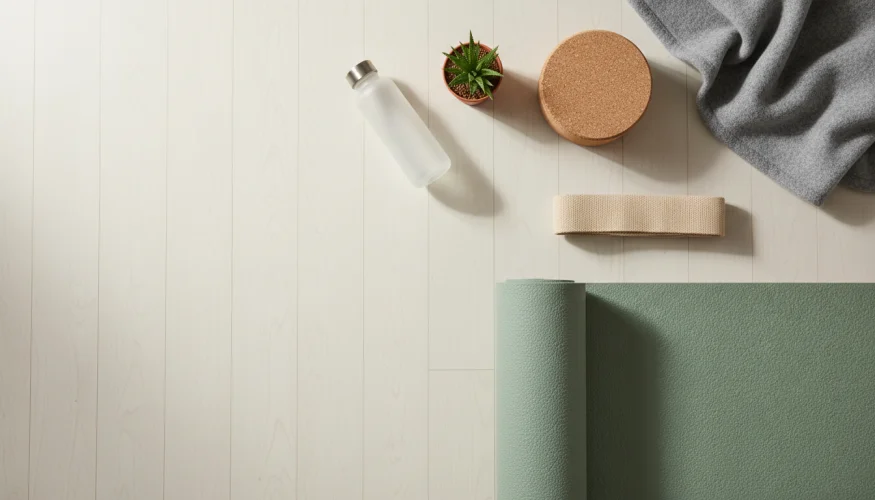
There is also a variation using a prop – such as a yoga strap, towel, or scarf. Simply loop it over the foot of the extended leg and gently pull the ends toward you. This allows for a deeper stretch even without sufficient flexibility. This technique is particularly suitable for older adults or people following orthopaedic surgery, for whom maintaining control over the intensity of the stretch is important. As physiotherapist and movement therapy author Kelly Starrett says: "Flexibility is not a gift, it is a skill – and like any skill, it can be trained."
Breathing also plays an important role when stretching in a seated floor position. Many people instinctively hold their breath and tense their entire body the moment they feel an uncomfortable pull. This is precisely the opposite effect of what we want to achieve. Conscious, slow exhalations help muscles relax and allow the body to go into a deeper stretch without force. It is recommended to hold each position for at least 30 to 60 seconds and to repeat the stretch two to three times on each side.
The duration and frequency of stretching depends on individual goals. To maintain existing flexibility, three to four times per week is sufficient. If the goal is to improve flexibility, experts recommend stretching every day – ideally in the evening, when muscles are warm and relaxed. Morning stretching is also possible, but it is advisable to precede it with a brief warm-up, as cold muscles are less pliable and more prone to injury.
It is also important to mention what stretching is not. It is not a painful procedure in which one must "grind out" every centimetre of movement. An uncomfortable pull is normal and desirable – sharp, stabbing, or radiating pain is a signal that something is wrong and it is necessary to stop. The American Academy of Orthopaedic Surgeons warns that overstretching muscles can lead to microtraumas that manifest over time as chronic injury.
Stretching the back of the legs in a seated floor position also has a direct impact on everyday body function. People with good hamstring flexibility bend forward more easily when picking up objects from the floor, have more stable walking patterns, and suffer less from lower back pain. Research published in the academic journal Journal of Physical Therapy Science confirms a direct link between hamstring flexibility and lumbar spine pain – shortened muscles at the back of the thighs pull the pelvic bone backward, causing a so-called posterior pelvic tilt, which overloads the lumbar vertebrae.
Interestingly, seated floor stretching has a positive effect not only on physical health, but also on mental wellbeing. The position close to the ground is associated in many cultures with calm, meditation, and settling of the nervous system. A few minutes spent in quiet stretching on a mat can function as a form of active meditation – time when a person pays attention to their body and disconnects from the digital noise of the day.
For those who want to incorporate stretching into their daily routine, here are some practical tips:
- In the morning after waking – a short five-minute stretch before breakfast starts the body and prepares the muscles for the day.
- A break at work – even a brief stretch seated on a carpet in the office or at home while working remotely helps break up prolonged sitting.
- In the evening before bed – relaxed muscles contribute to better sleep quality and reduce night-time cramps.
- After sport – stretching after running, cycling, or other aerobic exercise speeds up recovery and reduces muscle soreness.
Another advantage of seated floor stretching is its absolute accessibility. It requires no special equipment, no gym membership, and no prior exercise experience. All you need is a square metre of floor space and comfortable clothing. It is precisely this simplicity that makes this exercise an ideal foundation for anyone who wants to start taking care of their body – whether a teenager, a senior, an athlete, or someone returning after a long illness.
With long-term and regular stretching, visible results can be expected after approximately four to six weeks. Flexibility does not improve overnight, but gradually – and it is precisely this gradualness that guarantees a lasting effect. The body "remembers" new ranges of motion and the muscles accept a longer resting length as their new standard. Markéta from our example, after six weeks of daily stretching, got rid of her thigh pain and found that she could bend forward and reach the floor without difficulty – something she had previously been unable to do without pain.
Stretching the back of the legs in a seated floor position is therefore much more than just an exercise for those who want to be as flexible as dancers. It is an investment in musculoskeletal health, prevention of back pain, and a way to restore to the body the natural functionality that the modern sedentary lifestyle gradually takes away. And all of this without spending a single euro on equipment or a fitness centre membership.