

Rh negative mother doesn't have to be afraid of pregnancy

Most expectant mothers first encounter the term Rh factor at their first gynecological appointment during pregnancy. Yet this is information that can have a fundamental impact on the course of the entire pregnancy and on the health of the unborn child. If you've learned that you have an Rh-negative blood type, you've probably had a lot of questions. What does it actually mean? Is it dangerous? And what now?
The Rh factor is a protein found on the surface of red blood cells. People who have it are described as Rh positive – and they make up approximately 85% of the world's population. The remaining roughly 15% lack this protein and are described as Rh negative. The absence of the Rh factor itself has no effect on a person's health in everyday life – it is simply a genetically determined trait that is inherited from parents. A problem can arise at the moment when an Rh-negative woman becomes the mother of a child with Rh-positive blood.
Try our natural products





Why does the Rh factor matter specifically during pregnancy?
The key to understanding the whole situation is what is known as Rh incompatibility, meaning the incompatibility of the blood types of the mother and the foetus. If the mother is Rh negative and the father of the child is Rh positive, there is a probability that the child will inherit the father's Rh-positive blood. In such a case, the mother's immune system may encounter a foreign protein – the Rh factor from the child's blood – and begin producing antibodies against it. This process is called Rh sensitisation, and its consequences can be serious, particularly in subsequent pregnancies.
It is important to understand that in a first pregnancy, the risk is relatively low. The blood of the mother and foetus does not normally mix – they are separated by the placenta. However, a small amount of blood can be transferred during childbirth, miscarriage, ectopic pregnancy, amniocentesis, or another invasive procedure. If this occurs and the mother's immune system produces antibodies, in a subsequent pregnancy these antibodies are capable of crossing the placenta and attacking the red blood cells of an Rh-positive foetus. This can lead to a condition known as haemolytic disease of the newborn, which in severe cases is life-threatening for the child.
Consider the situation of Markéta, a thirty-year-old woman from Brno, who only found out about her Rh-negative factor during her first pregnancy. Her doctor assured her that the first pregnancy was progressing without complications, but emphasised that it was essential to receive a preventive injection after delivery. Markéta received the injection, and when she became pregnant for the second time, everything went smoothly. It is precisely thanks to timely prevention that many families manage to get through the whole situation without a single complication.
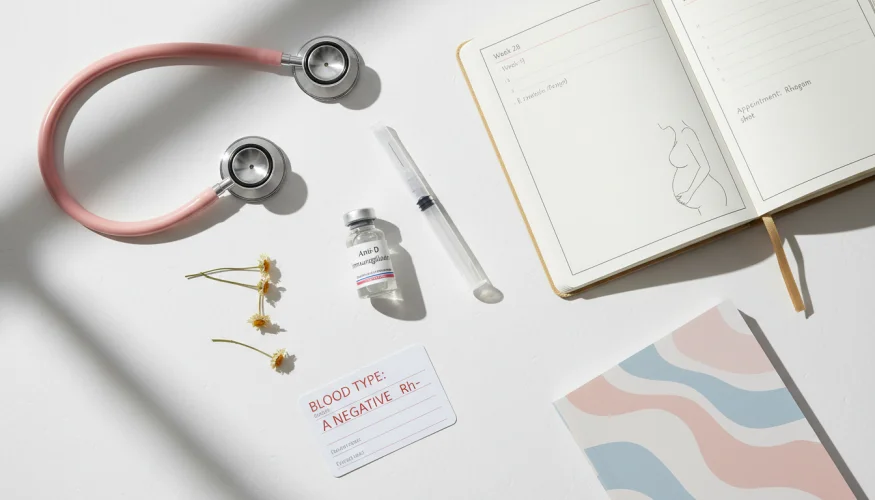
Fortunately, modern medicine offers very effective protection. The key tool is anti-D immunoglobulin – an injection that prevents the immune system of an Rh-negative mother from beginning to produce antibodies against the Rh-positive blood of the child. This injection is given as a preventive measure, typically around week 28 of pregnancy and within 72 hours after the birth of an Rh-positive child. It is also given after every miscarriage, ectopic pregnancy, or invasive examination in which mixing of the mother's and foetus's blood could occur.
What to expect and how care for an Rh-negative pregnant woman works
Once a doctor determines that a mother is Rh negative, monitoring the Rh factor becomes a standard part of prenatal care. At the very beginning of the pregnancy, a blood test is carried out to determine whether the mother has already developed antibodies or not. If she has not, the situation is favourable and doctors will proceed with the preventive administration of anti-D immunoglobulin at the designated time. If antibodies are present – for example due to a previous pregnancy that was not properly managed – the doctor will arrange closer monitoring of the foetus and choose an appropriate course of action depending on the situation.
During pregnancy, the level of antibodies in the blood of sensitised women is regularly monitored. If their concentration is high, further examinations of the foetus are carried out – for example, ultrasound measurement of blood flow through the cerebral vessels of the child, which can reveal signs of anaemia. In the most serious cases, it is possible to perform an intrauterine blood transfusion directly to the foetus before birth. While this is a demanding procedure, it saves lives in the hands of experienced specialists.
As the World Health Organization states, haemolytic disease of the newborn caused by Rh incompatibility is rare in developed countries today, thanks to the preventive administration of anti-D immunoglobulin. This is good news – and at the same time clear evidence of the crucial role that proper and timely prenatal care plays.
It is natural that news of an Rh-negative blood type during pregnancy raises concerns. Nevertheless, it is important to know that the vast majority of Rh-negative mothers give birth to healthy children – and this applies repeatedly. The condition is careful monitoring and following the doctor's recommendations. The key word in the whole situation is prevention, and today, thanks to modern medicine, this is very accessible.
Women sometimes ask whether it is necessary to find out the partner's Rh factor. The answer is unequivocal: yes, it can be very useful. If the child's father is also Rh negative, the child cannot have Rh-positive blood and the whole question of incompatibility disappears. If the father is Rh positive, it depends on whether he is homozygous for this trait (carries two copies of the gene for Rh positivity) or heterozygous (carries one copy of Rh positive and one of Rh negative). In the first case, the child will always be Rh positive; in the second case, the probability is 50-50. This information can be determined by genetic testing, although it is not routinely required.
It is also interesting that the Rh-negative blood type is represented differently in different populations. While in Europe Rh-negative individuals make up approximately 15–17% of the population, in Asia their proportion is significantly lower – around 1%. The highest incidence of Rh-negative blood type has been recorded among the Basques, where it reaches up to 35%. This is a fascinating genetic phenomenon whose origins scientists have not yet fully explained, as mentioned, for example, by the Stanford Blood Center.
The Rh-negative blood type brings not only challenges – it is also important to mention that these individuals are highly valued blood donors. Their blood can be given to Rh-negative recipients without the risk of adverse reactions, and is therefore always very much in demand. If you are Rh negative and considering donating blood, know that your blood is exceptionally valuable.
As for the practical steps that every Rh-negative pregnant woman should take, they can be summarised as follows:
- Find out your Rh factor as early as possible – ideally before a planned pregnancy or immediately upon discovering it
- Inform your gynaecologist and ensure that the Rh factor is included in your documentation
- Undergo a test for the presence of antibodies at the beginning of pregnancy
- Attend the preventive anti-D immunoglobulin injection at the designated time around week 28
- Do not overlook any bleeding episode, fall, or invasive procedure – in such a case, always inform your doctor immediately
- After childbirth or miscarriage, make sure that the anti-D immunoglobulin injection was administered in time
As the world-renowned obstetrician and pioneer of modern prenatal care Ian Donald once remarked: "Pregnancy is not an illness, but it requires wisdom, attention and care." These words apply doubly to Rh-negative mothers, who have one more reason to give prenatal care the attention it deserves.
It is also good to know that the psychological wellbeing of the mother plays a significant role in the whole process. Concerns and stress are understandable, but unnecessary anxiety does not help the situation. If you feel that the information from your doctor is not sufficient, or you want to better understand what is happening in your body, do not be afraid to ask questions, seek a second opinion, or turn to a specialised foetal medicine centre. Knowledge is the best weapon against fear.
Nowadays, non-invasive prenatal testing (NIPT) is also available, which can determine the Rh factor of the foetus from the mother's blood sample as early as the first trimester of pregnancy. This enables even more precise individualisation of care – if the foetus is Rh negative like the mother, the preventive anti-D immunoglobulin injection is not necessary. This option is currently available mainly at specialised centres and is not always covered by health insurance, but its availability is gradually expanding.
Pregnancy with an Rh-negative blood type need not be a source of fear. With good information, careful prenatal care, and modern medical options, it is a situation that is entirely manageable. Thousands of Rh-negative mothers give birth to healthy children every year – and there is no reason why it should be any different for you. The important thing is not to face your questions alone and to entrust yourself to the care of specialists who will guide you safely through your entire pregnancy.