
A car seat and stroller deserve thorough care
Every parent knows it. Just a few months of use and what was once a gleaming clean stroller or car seat becomes its own ecosystem full of crumbs, stains from fruit purees, milk residue, and occasionally things whose origin you'd rather not identify. But while most of us can manage a quick wipe with a damp cloth, truly deep cleaning a car seat and stroller is a chapter unto itself – and a topic that deserves far more attention than parents typically give it.
It's not just about appearance. It's about a child's health, safety, and the longevity of products that families invest considerable sums in. Deep cleaning is not an unnecessary luxury – it's part of childcare that is all too often postponed indefinitely.
Try our natural products
Why bacteria and allergens multiply in strollers and car seats faster than we think
Baby equipment is exceptionally prone to contamination from a hygiene standpoint. A car seat spends hours in the enclosed, heated environment of a car, where heat, moisture, and organic residue from food or saliva combine into conditions that microorganisms find perfectly hospitable. A stroller, meanwhile, travels through parks, shops, lifts, and pavements, collecting dirt from the outdoor environment. A child sits, lies, eats, and sleeps in these devices every day – and yet has an immature immune system that is far more sensitive to the presence of bacteria, mould, or dust mites than an adult's immune system.
Research in the field of domestic hygiene repeatedly shows that textile surfaces in enclosed, poorly ventilated spaces can harbour dust mites, mould, and bacteria far more intensively than, say, floor carpets. And the fabric padding of a car seat or stroller meets almost all the criteria: it is textile, comes into contact with bodily fluids, is exposed to temperature fluctuations, and only rarely undergoes thorough disinfection. Parents who regularly deep clean these products are protecting their children from potentially serious health risks, including allergic reactions or respiratory problems caused by dust mites.
A practical example: the mother of a three-year-old boy from Brno noticed that her son had begun suffering from recurring bouts of coughing and a runny nose, despite otherwise being healthy. An allergist, after examination, pointed to a possible sensitivity to dust mites. A closer look at the family's equipment revealed that the car seat had not been deep cleaned even once in two years of use. After a thorough cleaning and regular maintenance, the boy's symptoms improved significantly. This story is, of course, not scientific evidence, but it illustrates how easily overlooked a source of problems can be and how real its health impact can be.
A simple equation applies: the sooner and more regularly deep cleaning is carried out, the less effort each individual cleaning session requires. Ingrained stains from purees or dried milk are considerably harder to remove after a week than after two days.
How to deep clean a car seat and stroller properly and safely
One of the most common mistakes parents make when cleaning is using inappropriate cleaning products. Strong chemical preparations that work brilliantly on kitchen worktops or bathroom tiles can damage the textile surfaces of a car seat, compromise the structure of the harness straps, or leave chemical residues that then come into direct contact with a child's skin. Car seat and stroller manufacturers generally explicitly warn that safety harnesses must not be cleaned with aggressive chemicals, as these can reduce their strength and resilience in the event of an impact.
The correct deep cleaning procedure always begins with reading the manufacturer's instructions. Every model has its own specifics – different materials, different methods of removing covers, and different recommended procedures. As a general rule, removing and washing fabric covers at the temperature recommended by the manufacturer is the fundamental first step. Most modern strollers and car seats have covers designed to be removed and machine washed, but the washing temperature is usually limited – typically to 30 or 40 degrees – to preserve the shape and properties of the material.
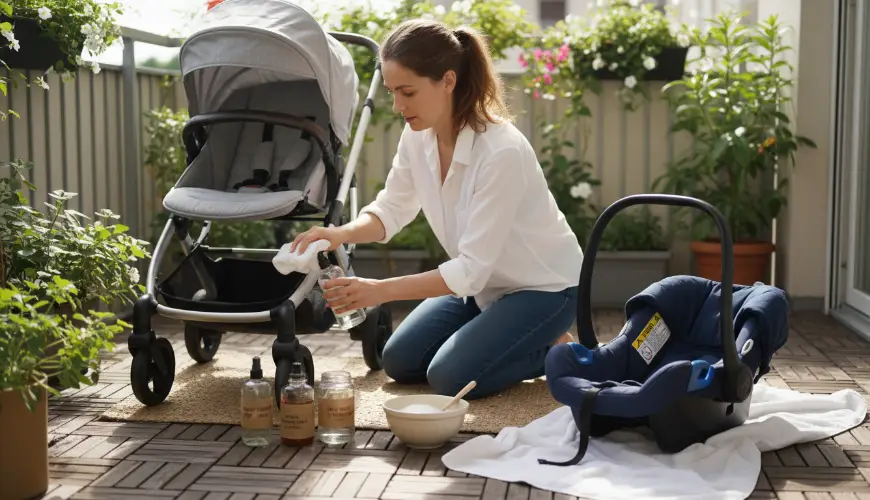
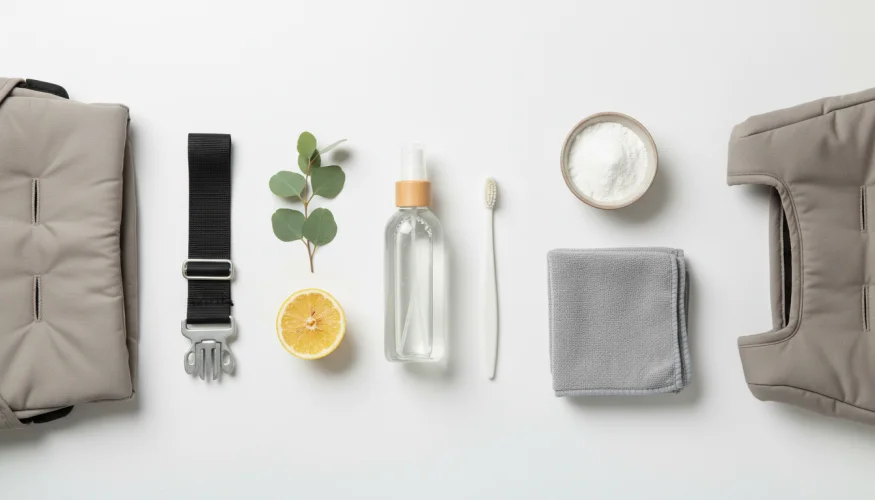
The stroller frame itself or the plastic of the car seat is best cleaned with a gentle soapy solution or natural cleaning agents based on bicarbonate of soda and vinegar. These substances are effective against organic dirt, leave no harmful residues, and are gentle both on the product's surfaces and on the environment. For disinfection, products labelled as safe for baby equipment can be used – there are now a number of ecologically certified products on the market that meet strict standards for contact with children's skin.
Special attention should be paid to grooves, joints, and hidden parts of the structure, where dirt accumulates most intensively. An old toothbrush is an indispensable tool in this regard – it reaches places that no cloth or sponge can access. Stroller wheels, joints, and folding mechanisms are the areas parents most commonly skip during cleaning, even though it is precisely there that mud, sand, and organic material accumulate, which can cause sticking or wear of the mechanisms.
As the British paediatric association NHS has rightly noted: the cleanliness of the environment in which a child spends time is one of the fundamental pillars of infection prevention in early childhood. Although this guidance relates to general hygiene, its logic naturally extends to everyday equipment such as strollers and car seats.
After cleaning, thorough drying of all parts before reassembly is essential. Damp textiles or plastic components enclosed within an assembled product create an ideal environment for mould growth – and that is precisely what the entire cleaning process is aimed at avoiding. The ideal solution is air drying, preferably outdoors in a dry, well-ventilated environment or in a well-ventilated room.
The question of cleaning frequency depends on the child's age, eating habits, and the intensity of product use. As a general guideline, surface cleaning should take place at least once a week, while deep cleaning with cover removal is advisable approximately once every one to three months. During periods of illness or after more significant soiling (emergency nappy changes, vomiting, spilled food), immediate action is naturally called for regardless of any schedule.
When choosing cleaning products, the ecological dimension of the whole matter is also worth mentioning. Traditional chemical cleaners are not only potentially harmful to the child, but their production and disposal also place a burden on the environment. Natural alternatives – such as preparations based on plant-derived surfactants, free from fragrances and synthetic dyes – are now available in many specialist shops and match traditional chemicals in terms of effectiveness, or even surpass them in terms of gentleness. Choosing ecologically friendly cleaning products is therefore also a responsible choice with regard to the environment in which your children will one day live.
A specific category involves situations where a family is buying or selling a used car seat or stroller. The second-hand baby equipment market in the Czech Republic is very active and economically understandable – quality strollers or car seats cost thousands of crowns and their period of intensive use lasts only a few years. Deep cleaning before selling or after buying is an absolute necessity in such cases. Nobody can know the conditions in which a product was used, what animals were present in the previous owners' home, or whether it was exposed to mould or other contaminants. Thorough deep cleaning of a purchased second-hand car seat or stroller is a basic hygiene requirement without which it should not be given to a child to use.
Parents who wish to explore the topic of baby equipment hygiene in greater depth can turn, for example, to the recommendations of the American Academy of Pediatrics (AAP), which addresses not only the safety aspects of car seats but also their proper maintenance. Although this is an American source, the principles of hygiene and safety are universal and apply equally well in the Czech context.
Caring for a stroller and car seat is ultimately just one part of a broader approach to parenting that combines safety, health, and sustainability. Products that are well cared for last longer, function more reliably, and are safer. A stroller whose wheels are regularly cleaned and mechanisms lubricated will not fall apart after a year of intensive use. A car seat with clean, unscratched surfaces and firm straps free from chemical damage fulfils its safety function exactly as the manufacturer intended.
Deep cleaning a car seat and stroller is therefore not merely a hygiene ritual – it is a form of respect for the child, an investment in their health, and at the same time a practical step that extends the lifespan of items the family owns. And at a time when sustainable consumption and a mindful approach to possessions are becoming genuine values, caring for what we already have is perhaps more important than the pursuit of something new.