

Bouldering for Women Beginners and Tips on How to Start Without Fear --- Bouldering je forma lezen
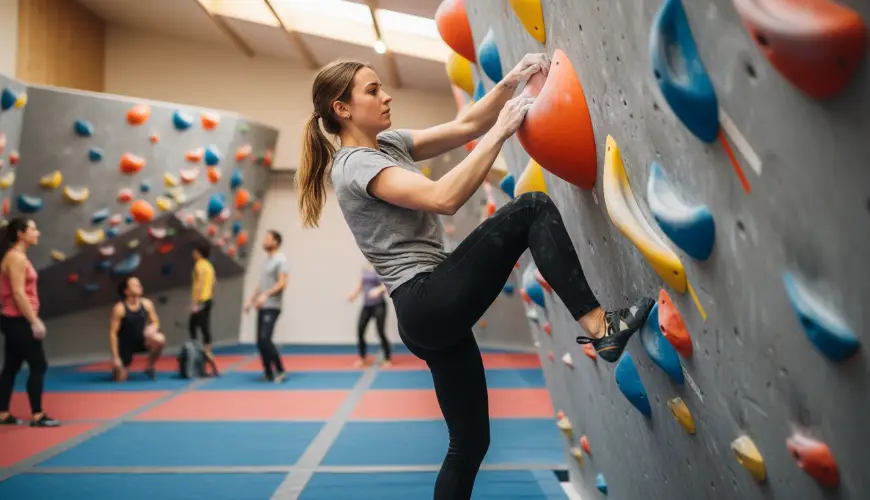
There is a sport that has been conquering Czech cities at a literally rock-solid pace in recent years – and you don't need mountains, expensive equipment, or years of training to get started. Bouldering, or climbing on low walls without a rope, has become a phenomenon that is attracting an ever-growing number of women of all ages. Yet many of them hesitate at the door of the bouldering gym, convinced that climbing is the domain of muscular men in tight t-shirts. Nothing could be further from the truth.
Bouldering is essentially a three-dimensional puzzle. Each route – called a "problem" in the climbing world – is a unique combination of movement, balance, strength, and strategy. It is precisely this mosaic-like nature of the sport that makes it a discipline where women very often outperform men who rely solely on brute strength. Technique, flexibility, and the ability to read movement are qualities that naturally play to women's advantage.
Try our natural products





Why thousands of women have fallen in love with bouldering
Getting started with bouldering is surprisingly simple. Unlike traditional rock climbing, you don't need a partner, a rope, or complex knot training. All you need is comfortable clothing, rented climbing shoes, and chalk for your hands – and you're ready to go. Most bouldering gyms in the Czech Republic offer introductory lessons for beginners, or at least a basic orientation from staff, so you don't have to worry about being thrown in at the deep end without knowing how to swim.
Take Klára, a twenty-three-year-old student from Brno, who visited a bouldering gym for the first time with her friend purely out of curiosity. "I thought it would be incredibly hard and I'd feel embarrassed," she says. "But after an hour I completed my first problem, and the feeling was completely addictive." Today she climbs three times a week and says that bouldering has changed not only her fitness, but also the way she thinks about obstacles in everyday life.
This experience is far from unique. Bouldering has a unique ability to reward immediately – every completed problem brings a concrete, tangible sense of achievement. The brain releases endorphins, confidence grows, and you naturally come back for another dose of that satisfying feeling of victory. Psychologists refer to this phenomenon as a "flow state" – a state of complete immersion in an activity where time passes differently and the mind sheds its everyday worries.
It is worth noting that bouldering was included in the Olympic Games in Tokyo in 2020, which generated enormous media interest. The sport's popularity has been growing rapidly ever since, with women making up an increasingly large share of the new climbing community. According to data from the international climbing federation IFSC, the number of registered female climbers has more than doubled over the past ten years.
Bouldering also brings remarkable physical benefits that are a welcome bonus for beginner women. It strengthens the entire body – the back, shoulders, forearms, as well as the core and legs. It improves coordination, balance, and body awareness. And yet it bears no resemblance to conventional gym workouts. Most female climbers don't even notice that they are "exercising" – they are too absorbed in solving the movement puzzle in front of them.
First steps in a bouldering gym: What to expect
Entering a bouldering gym for the first time can be a little overwhelming – colourful holds hang everywhere, people climb seemingly effortlessly on overhangs, and the air smells of chalk. But don't be put off. Everyone who climbs there was once a complete beginner.
The difficulty system in bouldering gyms is typically indicated by colours or numbers. The easiest problems are designed for literally anyone – they assume no prior strength or experience. Beginner climbers should spend their first visits exclusively on the lowest difficulty level, focusing on understanding basic movement rather than tackling challenging problems.
One of the most common mistakes beginners make is trying to climb with their arms. Climbing is actually primarily about footwork – the legs carry the body's weight while the hands serve mainly to maintain balance. Once you understand this fundamental principle and start applying it consciously, everything becomes easier. Experienced climbers even say: "Climbing is walking up a vertical wall." And there is a great deal of truth in that.
It is also important to overcome the initial fear of falling. Bouldering walls are low – typically up to four or five metres – and thick crash pads underneath safely absorb any fall. The correct falling technique can be learned in a few minutes: fall onto a flat back, don't reach your hands out in front of you. Most gyms explain this technique as part of the introductory orientation.
The community in bouldering gyms is generally very welcoming and willing to help. It is not at all unusual for a more experienced climber to spontaneously offer you a tip on a particular problem – this custom is called "beta" in the climbing world and is a perfectly accepted part of the sport's culture. Beginner women thus very quickly become part of a naturally forming community, which is one of bouldering's greatest draws.
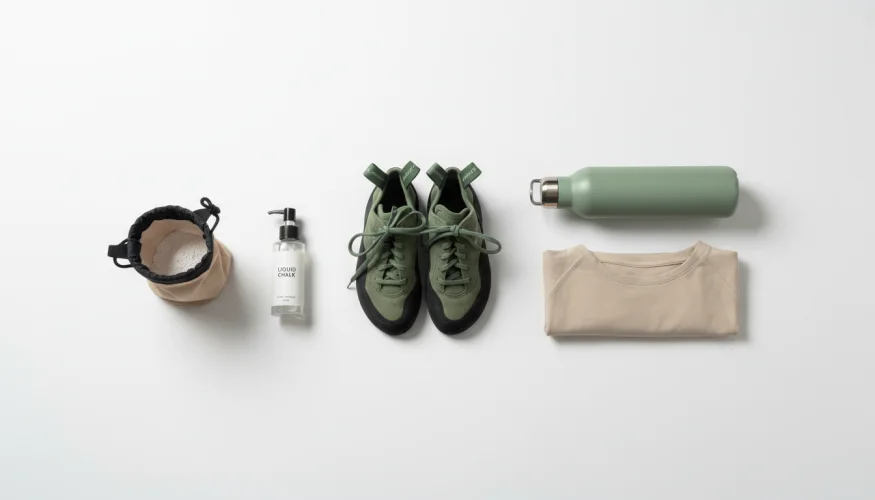
As for equipment, there is truly no need to invest in your own straight away. Climbing shoes can be rented at the gym, and chalk is usually included in the entry fee or available right at the wall. However, if bouldering captures your interest and you become a regular climber, your own climbing shoes are the first worthwhile investment. Properly fitting shoes significantly improve grip on holds and overall climbing comfort. When choosing a pair, it is worth seeking advice at a specialist shop – climbing shoes should fit more snugly than regular footwear, but not painfully so.
The mental side of bouldering: More than just a physical challenge
Bouldering is not merely a physical sport. It is also an intensive mental workout, and it is precisely this dimension that sets it apart from most other physical activities. Every problem requires analysis, planning, and the ability to adapt in real time. When a route doesn't work on the first attempt, you need to stop, think, and try a different approach.
This aspect of bouldering has demonstrably positive effects on mental health. A study published in the journal PLOS ONE found that climbing as a form of psychomotor therapy significantly reduces symptoms of depression – in some cases more effectively than conventional physical activity. The ability to focus on the present moment that climbing demands functions as a natural form of mindfulness.
For beginner women, it is important to know that frustration is part of the process. Bouldering will teach you to deal with failure in a healthy way – a problem that doesn't go today may go easily tomorrow. Both body and mind adapt faster than you might expect. And the moment you finally complete a problem you have been working on for a week is one of the most satisfying feelings the sport has to offer.
The legendary climber Lynn Hill, the first person in the world to free climb the famous Nose route on El Capitan, once said: "Climbing has taught me that limits exist only in our minds." These words ring doubly true for women who are just venturing into bouldering and are wrestling with doubts about their own abilities.
The social dimension of the sport is another reason why bouldering works so well for women. Unlike individual sports such as running or swimming, bouldering takes place in a communal space where friendships form naturally. Many bouldering gyms organise special events for women – so-called "ladies' nights" or workshops aimed exclusively at beginner female climbers. These events create a safe space where women can ask questions, experiment, and make mistakes without feeling watched.
A healthy lifestyle and bouldering go naturally hand in hand. Female climbers gradually begin to notice how their eating habits affect their performance – the body needs sufficient protein for muscle recovery, complex carbohydrates for energy, and adequate fluid intake. It is not about restrictive dieting, but about a natural shift towards a more mindful approach to what we eat. Similarly, an interest in recovery follows – quality sleep, stretching, and care for the hands, which are the most heavily used part of the body in bouldering.
When it comes to training frequency, a simple piece of advice applies to beginners: less is more. Two to three times a week with adequate rest between sessions is an ideal start. The body needs time to adapt – tendons and ligaments strengthen more slowly than muscles, and it is precisely the overloading of these structures that is the most common cause of injury among overly enthusiastic newcomers who climb every day.
Bouldering for beginner women is not about being the best or the fastest. It is about discovering your own limits, about the joy of movement, and about noticing small progress each week – a slightly stronger grip, a more confident step onto a hold, a problem completed that seemed impossible a month ago. And it is precisely this gradual transformation, both physical and mental, that is the reason why bouldering becomes a lifelong passion for many women, rather than just a passing trend.