

Morning stretching while still in bed benefits both body and mind

Getting out of bed in the morning can be a literal struggle for many people. The alarm goes off, the body resists, and the mind still wanders somewhere between dreams and reality. Yet this transitional moment — lying in bed and slowly waking up — holds unexpected potential. Morning stretching right in bed is a simple ritual that requires no equipment, no gym, and no extra time — and yet it can fundamentally influence how the entire day begins and unfolds.
This is not a trendy wellness fad or a passing craze. It is a physiologically grounded practice that respects the natural needs of the human body after hours of immobility. During sleep, muscles relax, joints loosen, and the entire musculoskeletal system rests. A sudden transition from a horizontal position to full movement can be a shock to the body — and that is precisely why it makes sense to slow down this transition and consciously support it.
Try our natural products




What happens to the body during sleep and why it matters
To understand why morning stretching in bed makes sense, it is useful to grasp what happens to the body overnight. During sleep, body temperature drops, metabolism slows, and muscles enter a state of deep relaxation. The intervertebral discs, which bear the pressure of the body's full weight throughout the day, rehydrate overnight — absorbing fluid and increasing in volume. This is why people are a few millimetres taller in the morning than in the evening, before gravity and movement compress the discs again.
This nocturnal regeneration is excellent news for the spine and joints, but it comes with one condition: the body needs time to recover from this state and prepare for movement. Muscles are literally "cold" upon waking and less elastic, the nervous system is not yet fully operational, and movement coordination has not reached its daily peak. This is scientifically confirmed by research published in the Journal of Physiology, which has long examined the issue of muscle function and its dependence on temperature and activation.
This is precisely why suddenly leaping out of bed and immediately rushing to the bathroom or the coffee machine is a suboptimal approach. The body deserves a transitional ritual — and stretching in bed is the most natural one possible.
Consider a concrete example. Jana works as a teacher, wakes up at six every morning, and for years suffered from morning stiffness in her lower back and cervical spine. A physiotherapist recommended that she spend five to ten minutes doing simple movements in bed before getting up. After three weeks of regular practice, she described significant relief — not only physical but also psychological. She said mornings no longer made her feel like a "broken robot," and she began the day with a sense of being in control of her body. Her experience is far from unique.
What morning stretching in bed looks like in practice
The good news is that morning exercise in bed is neither complicated nor time-consuming. It requires no mat, no sportswear, and no prior experience with yoga. All you need is a bed, the willingness to give yourself a few minutes, and a basic awareness of which parts of the body need the most attention.
It is most commonly recommended to start with the spine, as it bears the greatest load throughout the day and benefits most from morning care. A simple movement — drawing both knees to the chest and gently holding them with the hands for twenty to thirty seconds — releases the lumbar region and activates the deep spinal stabilisers. This can be followed by a trunk rotation: knees remain drawn in, arms are spread out, and they are slowly lowered to one side while the head turns in the opposite direction. This movement is remarkably effective at releasing tension in the thoracic spine, where many people accumulate chronic tension from prolonged sitting.
Another popular element of morning stretching is working with the hips. The hip joints are the body's major movement hubs, and their stiffness manifests not only during walking but also as lower back or knee pain. A simple stretch — crossing one leg over the other in a figure-four position and gently pressing the knee outward — can be performed comfortably while lying on your back and provides immediate relief.
The feet and ankles should not be forgotten either. After a night of rest, they are stiff, and waking them up — for example by rotating the ankles or spreading the toes — prepares the entire lower body for contact with the ground. The ankles and feet are the foundation of the entire musculoskeletal system, yet they receive remarkably little attention.
Finally, it is time for the cervical spine and shoulders, where tension accumulates in the vast majority of adults. Slow lateral head tilts, gentle shoulder rolls, and neck stretches are movements that can be performed both lying down and sitting on the edge of the bed. The entire sequence can take as little as five minutes, yet its effect is immediately noticeable.
As the famous physiotherapist and pioneer of movement therapy Moshe Feldenkrais said: "Movement is life. Without movement, life is unthinkable." And what better way to begin a day full of movement than by consciously awakening your own body before your feet even touch the floor?
The psychological dimension of the morning ritual
It would be a mistake to view morning stretching in bed as a purely physical matter. It has a significant psychological dimension that has been attracting increasing attention from researchers and mental health professionals in recent years.
Conscious morning stretching is a form of mindfulness — being present in the body and in the moment. At a time when most people reach for their phone before they are properly awake and immediately plunge into news, emails, and social media, five minutes of quiet movement in bed represents a rare island of calm. It is a moment of communicating with oneself — noticing where something pulls, where tension is felt, how one feels today.
This approach to the morning supports what psychologists call "interoception" — the ability to perceive the internal signals of one's own body. People with well-developed interoception are generally more resilient to stress, better at regulating emotions, and have a greater sense of control over their lives. It is no coincidence that many successful people — from elite athletes to creative thinkers — describe morning physical rituals as a key element of their day.
There is also a very practical aspect: morning stretching in bed signals to the brain that the day is beginning intentionally and consciously, not reactively. This small shift in mindset can influence the entire course of the day — from productivity and mood to the ability to handle unexpected situations.
There is one detail worth mentioning that many people overlook: the quality of the mattress and pillow directly affects the position in which the body spends the night, and therefore how stiff it will be in the morning. Investing in ergonomic bedding is not a luxury but a form of prevention — and combined with morning stretching, it forms the foundation of truly regenerative sleep.
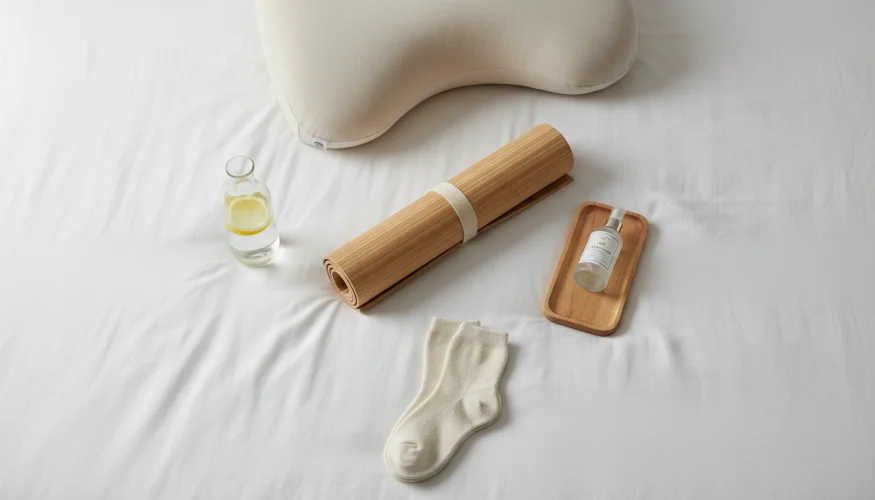
Morning stretching in bed naturally complements other elements of a healthy lifestyle — adequate hydration immediately upon waking, a mindful breakfast, and movement throughout the day. It is not an isolated trick, but part of a broader approach to self-care that is sustainable precisely because it requires no dramatic changes or great sacrifices. All it takes is starting where every day begins — in bed, with open eyes and a willingness to give your body a few minutes of attention.
Those who try it regularly for at least two weeks will very likely find that mornings have stopped being the enemy. And that is a change well worth those five minutes.
For those who wish to support their morning ritual with quality products — whether ergonomic sleep accessories, natural fabrics, or body care items — Ferwer.cz offers a wide selection from the world of healthy living that naturally aligns with this approach to mornings.