

How capsule coffee makers and their waste are destroying the planet
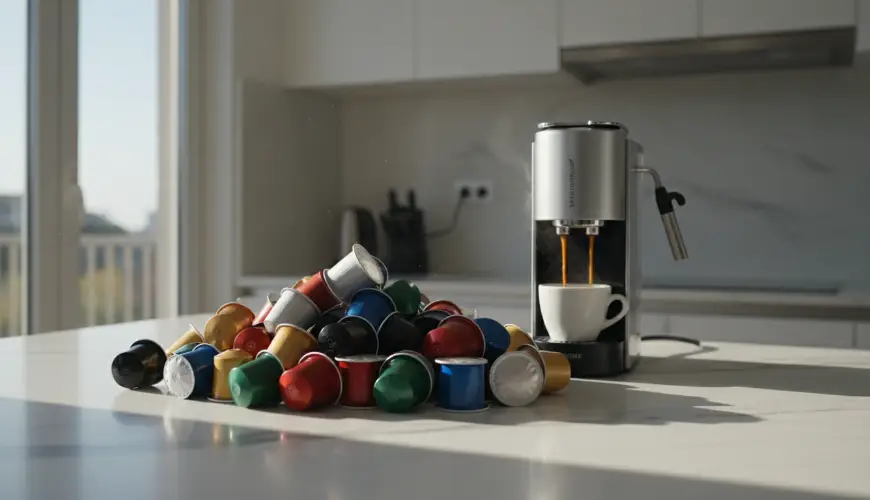
Every morning, millions of people around the world place a small aluminum or plastic capsule into their coffee maker, press a button, and thirty seconds later have a hot cup of coffee in hand. It's convenient, quick, and the result is usually delicious. But behind this seemingly innocent morning routine lies a problem that rarely gets discussed — a mountain of waste that grows every day, the true scale of which most consumers have no idea about.
Capsule coffee makers have become one of the best-selling kitchen appliances in the world over the past twenty years. By some estimates, more than fifty billion coffee capsules are sold annually — a number so astronomical that it's hard to wrap our heads around. If these capsules were lined up end to end, they would wrap around the globe several times over. And yet the vast majority of them end up in the bin, from where they travel to a landfill or incinerator.
Try our natural products


Why are capsules so problematic?
The apparent simplicity of the capsule system conceals a design paradox. In order for the capsule to withstand the pressure of hot steam, protect the coffee from moisture, and preserve its aroma, it must be made from multiple layers of materials — a combination of aluminum, plastic, and foil that are firmly bonded together. This multi-layer construction is precisely why recycling capsules is so difficult. Standard sorting facilities are unable to efficiently separate these materials, so the entire capsule ends up as general waste — even if the customer carefully rinses it and tosses it into the recycling bin.
Take a concrete example from everyday life: a family that has two cups of coffee a day from a capsule machine consumes approximately 730 capsules per year. That's nearly three-quarters of a kilogram of plastic and aluminum waste from just one household. Multiply this figure by millions of households across Europe and you arrive at a number that takes your breath away. And that's not even counting the packaging the capsules come in — the cardboard boxes and cellophane wrappers.
The situation is further complicated by the fact that different manufacturers use different types of capsules that are not mutually compatible. This means that even if a customer wanted to use a take-back scheme or recycling program, they need to know exactly what type of capsule they have and where to take it. This system — whether intentionally or not — is set up to be too complicated for the average consumer, and the result is that most capsules simply end up in the bin.
But the problem doesn't end with the capsule itself. Capsule coffee makers produce waste throughout their entire lifecycle — from the extraction of raw materials for capsule production, through their transportation, to the disposal of the machine itself, which has an average lifespan of only a few years. Electronic waste from discarded coffee machines is among the fastest-growing categories of waste in the world, as highlighted by the UN report on electronic waste, for example.
It is worth noting that John Sylvan, one of the inventors of the Keurig system — one of the most widespread capsule systems in the US — later publicly regretted his invention. "I wish I'd never invented it," he said in an interview with The Atlantic. That single sentence says more than many environmental studies.
What lies behind manufacturers' "eco-friendly" solutions
Capsule coffee maker manufacturers are well aware of the problem and in recent years have introduced various initiatives designed to make their products appear more environmentally friendly. Nespresso, for example, launched a used capsule collection program whereby customers can drop off capsules at collection points or send them back by post. This sounds promising — but in practice, the actual recycling rate turns out to be considerably lower than the marketing materials suggest. Research by Which? in the UK found that a large proportion of capsules handed in to recycling programs still end up in landfill or in incinerators, because sorting facilities lack the capacity and technology to handle them any other way.
Equally problematic are the so-called compostable capsules that have appeared on the market as an alternative to aluminum and plastic versions. The concept sounds appealing — a capsule that breaks down in the ground after use. But the reality is more complicated. Most of these capsules require an industrial composter with precisely controlled temperature and humidity in order to decompose properly. They do not break down in a home compost heap or in nature the way consumers might hope, and in the standard waste system they cause confusion because they cannot be recycled alongside plastics or aluminum. Greenwashing — the deliberate misrepresentation of a product's environmental value — is unfortunately a very widespread phenomenon in the capsule coffee segment.
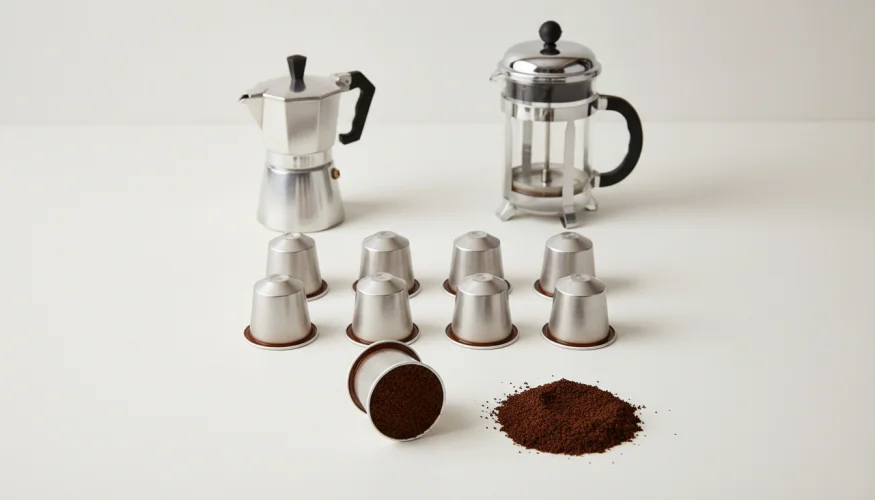
And yet truly sustainable alternatives do exist, and they are not at all complicated. Traditional methods of coffee preparation — the French press, the moka pot, pour-over coffee, or espresso from a lever machine — produce a fraction of the waste compared to capsule systems. A ground-coffee machine, when well maintained, can last for decades, while a capsule machine is replaced on average every four to six years. Ground coffee is also typically fresher, tastier, and — surprisingly to many — cheaper. The price of coffee in a capsule, calculated per kilogram, is several times higher than the price of comparable ground coffee.
One might argue that convenience has its price and that everyone has the right to choose how they prepare their coffee. That is, of course, true. But the problem is that the true cost of capsule coffee is not reflected in the price on the label — it is paid by the environment, by future generations, and by communities living near landfills. The externalities of environmental impact are systematically shifted outside the consumer's shopping basket.
It is interesting to observe how consumer behavior changes when people learn specific figures. Surveys repeatedly show that a large proportion of capsule coffee machine users simply did not know about the environmental impact of their machine — and once they found out, they began to consider making a change. Awareness is therefore a key tool, which is why it is important to speak openly about these issues.
There are several concrete steps that any consumer can take if they want to move away from capsule waste:
- Switching to traditional coffee preparation — the French press, AeroPress, or moka pot are affordable, long-lasting, and produce minimal waste
- Choosing reusable capsules — for those who want to keep the convenience of a capsule machine, reusable stainless steel capsules are available that can be filled with your own ground coffee
- Participating in certified recycling programs — if a customer decides to stick with a capsule system, they should actively use collection points and verify how the given program actually works
- Choosing certified brands — some smaller roasters offer capsules with genuine compostability certification or take-back programs with transparent reporting
Reusable capsules are a solution that deserves closer attention. They work simply: the customer buys a stainless steel or durable plastic capsule once, fills it with ground coffee of their own choosing, uses it, then rinses it and fills it again. All single-use packaging is eliminated, the customer has control over the quality and origin of the coffee, and the cost per cup drops significantly. The only investment is the initial purchase of the reusable capsule, which pays for itself after just a few dozen uses.
Thinking about coffee differently
Changing habits is never easy, especially when it comes to something as ritualistic as a morning coffee. Nevertheless, it is worth reflecting on what we actually expect from our coffee. Do we simply want to quickly deliver caffeine to our bodies, or do we want to enjoy a moment of calm and conscious experience? If it's the latter, then traditional coffee preparation offers an added value that a capsule machine is inherently unable to provide — engagement, attention, and a small ritual that can transform an everyday routine into something more meaningful.
Sustainable consumption does not mean giving up pleasure — it means thinking about how to achieve it with less impact on the world around us. And coffee is an excellent example of this, offering a whole spectrum of options from the simplest to the sophisticated, with the more environmentally friendly ones very often being the tastier and more economical ones too.
Capsule system manufacturers invest enormous resources in marketing and building customer loyalty. Their environmental initiatives are a step in the right direction, but they are still far from sufficient to offset the true impact of their products. Change must come both from manufacturers — in the form of genuinely innovative and recyclable solutions — and from consumers who are willing to reconsider their habits. Regulation by governments and the European Union, introducing binding standards for packaging recyclability, could play a key role in this regard, as suggested by the European Commission's Circular Economy Action Plan.
Capsule waste is in many ways a symbol of a broader problem of our time: the tendency to prioritize immediate convenience over long-term consequences. The good news is that alternatives exist, are accessible, and are in many respects better. All it takes is a decision to choose them — ideally before we reach for another capsule tomorrow morning.