
Oxymel is a traditional vinegar-honey drink full of herbs from great-grandmothers
There are recipes that survive centuries, and oxymel undoubtedly belongs among them. This simple yet fascinating drink made from vinegar and honey with the addition of medicinal herbs has been experiencing a genuine renaissance in recent years – and no wonder. At a time when people are increasingly seeking natural alternatives to synthetic preparations and returning to the roots of traditional folk medicine, oxymel serves as a reminder that the wisdom of our great-grandmothers was not mere superstition, but genuine knowledge passed down through generations.
The word oxymel itself comes from Greek – oxys means sour and meli means honey. Literally, therefore, "sour honey." This combination first appears in written sources from ancient Greece, where it is mentioned by Hippocrates himself, the father of modern medicine. It was later elaborated upon by Galen, and the Arab physician Avicenna included it in his monumental work The Canon of Medicine. Across cultures and centuries, the recipe changed very little: apple cider vinegar or another natural vinegar, quality honey, and herbs whose selection depended on the intended effect and local conditions. Whatever grew in the meadow behind the house went into the pot – and the results were surprisingly effective.
Try our natural products

What exactly oxymel is and how it works
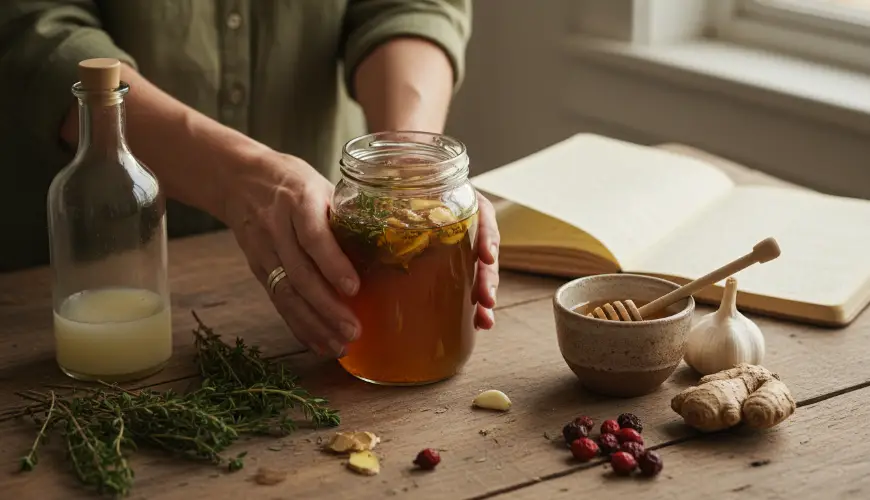
In its simplest form, oxymel is a mixture of vinegar and honey in various ratios, to which fresh or dried herbs are added. The most common ratio is one part vinegar to one part honey, with the herbs left to macerate for several days to several weeks. The result is a thick, aromatic syrup or liquid that is diluted with water and consumed in small doses. The precise composition, however, varies according to tradition, region, and specific intention.
Why vinegar and honey in particular? This pairing is no coincidence. Apple cider vinegar contains acetic acid, which has demonstrably antimicrobial properties, as well as enzymes, amino acids, and trace minerals. Honey, especially unpasteurised honey of local origin, is a natural source of antioxidants, flavonoids, and antibacterial substances – including hydrogen peroxide produced through enzymatic activity. When these two ingredients are combined, they create an environment in which the active compounds from herbs are extracted very effectively and simultaneously preserved. This is not laboratory chemistry, but the chemistry of nature – and it works remarkably efficiently.
The herbs added to oxymel can be practically anything – it depends on what we wish to achieve. Thyme and sage support the respiratory tract, garlic and ginger strengthen the immune system, valerian root or lemon balm contribute to calming the nervous system. A classic recipe that appears in various forms throughout Europe is the so-called "fire cider" – a combination of garlic, ginger, horseradish, chilli, and citrus in apple cider vinegar with honey. This preparation has been beloved by generations of housewives during the cold season and is today being rediscovered by enthusiasts of natural medicine around the world.
It would, however, be misleading to claim that oxymel is a miraculous cure for everything. Scientific research in this area is still growing, and although studies confirm many beneficial properties of the individual ingredients – whether the anti-inflammatory effects of honey documented by research or the antimicrobial potential of apple cider vinegar – the overall effect of oxymel as a complex preparation remains an area where science and tradition are only beginning to find common ground.
Our great-grandmothers knew it first
But let us return to the Czech village at the turn of the nineteenth and twentieth centuries. Housewives of that time did not visit the pharmacy at every cold – the pharmacy was far away, expensive, and not always accessible. Instead, they reached into the pantry, where clay jugs of macerates stood alongside jars of honey from their own bees and bottles of vinegar maturing from the summer apple harvest. When influenza came, they brought their children a hot drink made from honey, vinegar, and thyme. When someone suffered from digestive troubles, they added a spoonful of homemade vinegar syrup with fennel to a glass of water. These recipes were not passed down in books, but orally – from mother to daughter, from grandmother to granddaughter.
This is not sentimental idealisation of the past. It is a documented fact that the traditional folk medicine of Central Europe worked with principles that modern science is gradually confirming. Fermented foods, herbal macerates, natural preservation methods – all of this was part of everyday life long before the pharmaceutical industry became the dominant force in healthcare.
As French microbiologist Louis Pasteur aptly noted: "Chance favours the prepared mind." And our great-grandmothers were prepared – with their stores, their knowledge, and their trust in what nature had to offer.
Today, a growing number of people are returning to this heritage, and not only for health reasons. There is also a desire for authenticity, for connection with tradition, for a conscious approach to what we put into our bodies. Home production of oxymel is straightforward enough that anyone can manage it – you need neither special equipment nor expert knowledge. All you need is quality ingredients, a clean jar, and a little patience.
Take, for example, Martina, a woman in her forties from the South Bohemian Region, who began making oxymel during the pandemic. Initially out of curiosity, inspired by an old notebook belonging to her grandmother. The recipe was simple: apple cider vinegar from a local orchard, linden honey from a neighbouring beekeeper, and a handful of fresh thyme from the garden. After four weeks of maceration, she had a small bottle of dark, aromatic syrup, which she added to warm water every morning. "I don't know whether it's just a placebo, but I got through the winter without a single illness," she says with a smile. Placebo or not – her experience is far from unique.
How to prepare oxymel at home
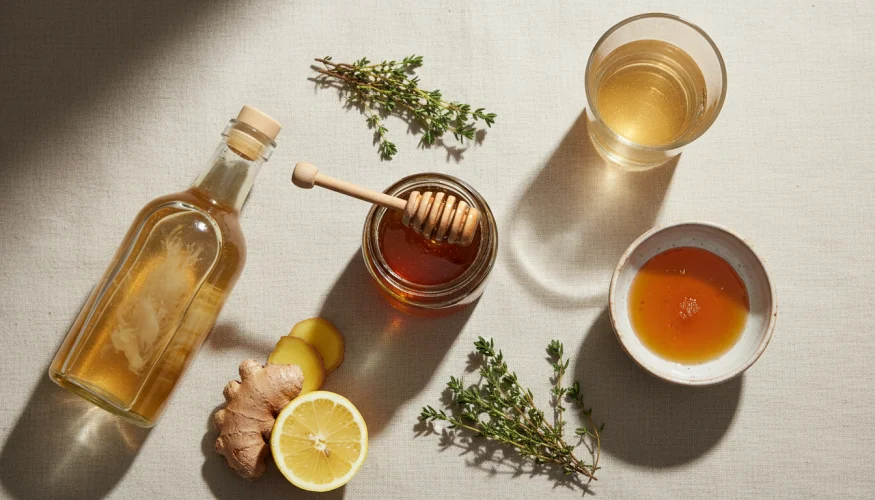
Home production of oxymel is genuinely straightforward. The basic process involves filling a clean jar with herbs – fresh or dried – pouring a mixture of apple cider vinegar and honey over them, and leaving the jar to stand in a dark place at room temperature. The exact procedure varies by recipe, but the general principles are as follows:
- The ratio of vinegar to honey is most commonly 1:1, but can be adjusted to taste – more honey for a sweeter variant, more vinegar for a more pronounced flavour
- Herbs should fill roughly one third of the jar so that the macerate is sufficiently strong
- The maceration period ranges from two weeks to two months; the longer, the more intense the flavour and effect
- Storing the finished oxymel is best done in the refrigerator, where it will keep for several months
Once the maceration period has elapsed, the mixture is strained and the resulting syrup is kept in a sealed jar. The daily dose is typically one to two teaspoons diluted in a glass of water – cold or warm, but never boiling, so as to preserve the live enzymes in the honey.
The key to a good result is the quality of the ingredients. Unpasteurised, raw honey is essential – pasteurisation causes honey to lose most of its enzymes and living components. Likewise, unfiltered apple cider vinegar with the so-called "mother" (the visible cloudiness of live cultures) is significantly more valuable than industrially processed vinegar from a supermarket shelf. Where possible, opt for local products – honey from a Czech beekeeper and vinegar made from domestic apples are the best choice both in terms of quality and in terms of supporting the local economy.
The choice of herbs then depends entirely on you and what you are looking for. For strengthening the immune system during the winter months, garlic, ginger, rosehip, and echinacea are excellent choices. For digestive support, reach for fennel, caraway, or mint. For calming and sleep support, lemon balm, chamomile, or valerian have proven their worth. Combinations are virtually unlimited – indeed, it was precisely in combinations that the strength of our great-grandmothers' traditional recipes lay.
Oxymel, moreover, need not be limited to medicinal or preventive use. In recent years, a growing number of chefs and bartenders have been discovering it as an interesting ingredient – it is added to salad dressings, marinades, and non-alcoholic cocktails. Its sweet-and-sour flavour with herbal notes can surprise and enrich even seemingly simple recipes. The gastronomic world is thus rediscovering something that traditional cuisine has always known.
It is fascinating to observe how things come full circle. Oxymel never disappeared – it simply retreated into the background for a time, drowned out by advertisements for effervescent tablets and syrups with artificial flavourings. Today it is returning in full force, not only to home kitchens but also to expert discussions about natural medicine and fermented foods. The World Health Organization has long emphasised the value of traditional medicine and calls for its more systematic research and integration into modern healthcare – a call that gives oxymel and similar preparations an entirely new context.
Our great-grandmothers had no access to randomised clinical trials or electron microscopes. What they did have was something else entirely – experience verified across generations, careful observation, and a deep knowledge of what grew around them. And the fruits of their work, preserved in recipes such as oxymel, are worth taking seriously. Not blindly, not uncritically, but with an open mind and a willingness to listen to wisdom that has survived centuries – and will in all likelihood survive the centuries to come.