

Flattened baby's head or plagiocephaly and how to prevent it

Every parent wants their child to be healthy and happy. So it can be worrying to see a flattened or asymmetrical baby's head. Plagiocephaly – flattening of an infant's head – is today one of the most commonly diagnosed conditions in young children, and its incidence has increased significantly in recent decades. Yet in most cases, it is a condition that can be successfully treated, and if caught early, leaves minimal or no lasting consequences.
Before parents start worrying unnecessarily, however, it is worth understanding what actually causes a baby's flattened head, why this phenomenon occurs, and what can reasonably be done about it.
Try our natural products






What plagiocephaly actually is and why it develops
The word plagiocephaly comes from Greek – plagios means oblique and kephalé means head. It literally refers to an oblique or asymmetrical skull. A newborn's skull is not a solid bone, but consists of several bony plates connected by soft tissues called sutures and fontanelles. This ingenious biological design allows the baby to pass through the birth canal while also providing room for rapid brain growth in the first months of life. Yet this softness and pliability of the skull is also the reason why it can relatively easily change shape under the influence of external pressure.
Most commonly, we speak of so-called positional or postural plagiocephaly, which occurs when a baby repeatedly lies or sleeps in the same position and pressure on one part of the head causes it to flatten. This form has nothing to do with brain growth or the child's intelligence – it is purely a shape problem of the skull. A less common variant is symmetrical flattening of the back of the head, referred to as brachycephaly, and there is also true structural plagiocephaly caused by premature fusion of the cranial sutures, known as craniosynostosis, which requires surgical treatment.
But why has positional plagiocephaly increased so dramatically over the past thirty years? The answer is surprisingly simple and directly related to saving lives. Since 1992, when the American Academy of Pediatrics launched the "Back to Sleep" campaign, the incidence of sudden infant death syndrome has decreased by more than fifty percent. The recommendation to sleep on the back has saved thousands of children's lives, but has also meant that babies spend much more time in the supine position – and with that came an increase in positional head flattening. Parents thus face an apparent paradox: doing what is safe while also preventing undesirable side effects.
Other factors also play a role. Premature babies have softer bones and are more susceptible to flattening. Twins or triplets have less space in the womb. Torticollis – shortening or tension of the neck muscles – causes the baby to preferentially turn its head to one side, which then leads to unilateral flattening. Torticollis is in fact one of the most common associated conditions that accompany or cause plagiocephaly.
How to recognise a flattened head and when to seek specialist advice
Many parents notice the flattening of the head themselves, usually in the first weeks or months of the baby's life. When we look at a baby from above, a normally shaped head resembles a symmetrical oval. With plagiocephaly, one side may be flattened, the ear may be shifted forward, the forehead may be asymmetrical, or the entire skull may appear slightly deformed. With brachycephaly, the flattening is uniform at the back and the head may look unusually wide or flat.
If parents notice any asymmetries or deviations from a symmetrical shape, it is appropriate to discuss this with a paediatrician. It is important not to underestimate even seemingly minor findings, because the earlier the condition is identified, the better. The brain and skull grow fastest in the first year of life – approximately half of the total brain volume develops by six months of age – and this window is also the best opportunity for successful treatment.
When plagiocephaly is suspected, the paediatrician will usually perform a physical examination, assess the child's neck mobility, and may recommend consultation with a physiotherapist or orthotist. Imaging methods such as X-ray or CT are only indicated when craniosynostosis is suspected, as positional plagiocephaly is a clinical diagnosis that does not require radiation exposure.
As leading American paediatric neurosurgeon Mark Dias said: "The brain is completely normal in positional plagiocephaly. The only problem is the shape of the skull, and this is a condition that can be significantly improved in most cases using conservative methods."
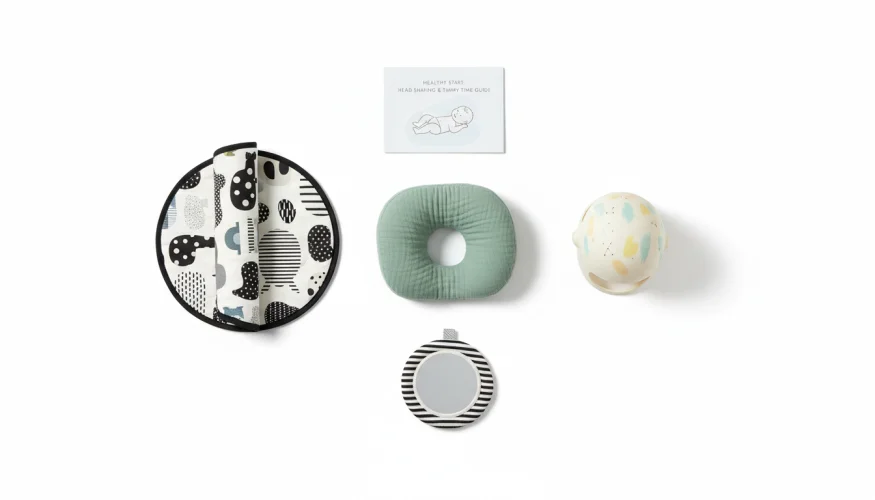
How to treat and prevent plagiocephaly
The good news is that positional plagiocephaly is in most cases treatable without surgical intervention, especially when treatment begins early. The cornerstone of treatment is so-called repositioning therapy – consciously alternating positions and reducing pressure on the affected part of the head.
Time spent on the tummy plays a key role, referred to in English as "tummy time". This is the time when the baby is placed on its tummy while awake and under parental supervision. This position not only reduces pressure on the back of the head, but also strengthens the neck, shoulder and back muscles that the child will need for later rolling, crawling and walking. Experts recommend starting tummy time from the very first days after returning from the maternity hospital, initially just for a few minutes a day and gradually increasing the duration. The American Academy of Pediatrics recommends reaching a total of thirty minutes of tummy time per day by the baby's third month of age.
A practical tip for parents who struggle with tummy time: many babies initially dislike this position and protest. It helps to place the baby on the parent's chest, on a firm surface with a colourful toy or mirror in front of their face, or to use the position on the parent's forearm. The more tummy time is made into fun and part of natural interaction, the better the baby will accept it.
Another important measure is alternating the position of the head during feeding, carrying and sleep. If the baby prefers turning its head to one side, turning to the other side can be encouraged by placing toys, light sources or the parent themselves on the opposite side. When carrying the baby in arms, it is advisable to alternate sides. During bottle feeding, sides can be alternated similarly to breastfeeding.
Regarding special pillows or positioning aids, their use should be discussed with a doctor. No pillow aid should be used while the baby is sleeping – a safe sleep environment must remain the priority. There are, however, specially shaped pads for use when the baby is awake, which can help distribute pressure.
Physiotherapy plays a crucial role especially when plagiocephaly is associated with torticollis. Shortened or tense neck muscles can be released through special exercises that the physiotherapist teaches parents to perform at home. These are gentle stretching techniques that are painless and, when performed regularly, very effective.
In cases of moderate to severe plagiocephaly, or when conservative treatment is not working, helmet therapy comes into play – wearing a specially made orthopaedic helmet custom-made for the individual baby. The helmet works on the principle of guided growth: in areas where the skull is flattened, it provides free space for growth, while in areas where the skull protrudes, it gently limits pressure. The baby typically wears the helmet twenty-three hours a day for three to six months, ideally between the fourth and twelfth month of age. The results of helmet therapy are very good when timed correctly, although the treatment is time-consuming and expensive and is not always covered by health insurance.
Parents sometimes ask whether plagiocephaly "goes away on its own". In mild forms, the shape of the head can indeed improve significantly with the baby's growth and increasing physical activity, especially once the child begins to sit, crawl and stand independently. More severe forms without treatment, however, may persist into adulthood and can cause facial asymmetries, problems with glasses or hats, and in some cases difficulties with bite alignment or ear infections.
Prevention of a baby's flattened head actually begins before any flattening becomes apparent. Consciously alternating positions from the very first days of life is the simplest and most effective investment in the healthy development of a baby's head shape. Parents who regularly practise tummy time, alternate sides during feeding and carrying, and ensure that the baby does not spend too much time in car seats, bouncers or rockers outside the car, significantly reduce the risk of positional flattening developing.
Interestingly, car seats and various infant rockers are one of the less discussed risk factors. Many parents today leave babies sleeping in a car seat outside the car, because the baby falls asleep peacefully in it. However, the hard curved surface exerts constant pressure on the back of the head and with prolonged use can contribute to flattening. A car seat is a safety device for the car – and if the baby falls asleep in the car, that is fine. It should not, however, serve as an alternative to sleeping in a cot.
The whole story of plagiocephaly is in a sense a story about how modern childcare brings new challenges that previous generations did not know. Our grandmothers and great-grandmothers did not hear much about plagiocephaly – partly because it was not widely discussed, and partly because babies spent more time in various positions and less time in seats and rockers. Today, on one hand, we have much safer sleeping conditions, and on the other hand, a new task: actively caring for the shape development of a baby's head. And that is ultimately a task that every parent can manage, given the right information and support.