
# How to Do Regular Stretching That Actually Works
Most people associate the concept of exercise with a sweaty T-shirt, lifting dumbbells, or running in the park. Stretching tends to be something that gets rushed through with a few quick movements before a workout, or it's forgotten entirely. Yet regular stretching is one of the most important things we can do for our bodies – regardless of age, fitness level, or athletic ambitions. Surprisingly, it's not just about muscle flexibility, but about the overall state of the body, sleep quality, injury prevention, and even mental well-being.
Imagine Mrs. Jana, an elementary school teacher who spends hours on her feet every day, then gets in her car, sits down at the computer at home, and falls asleep on the couch watching TV in the evening. Back pain had accompanied her for years, occasionally she'd get a sharp pain in her neck, and she woke up in the morning stiff as a board. No medication, no massage helped in the long term. It wasn't until she followed a physiotherapist's recommendation and started dedicating fifteen minutes a day to simple stretching that the situation changed dramatically within a few weeks. The pain subsided, her sleep improved, and Jana says she feels ten years younger. Her story isn't exceptional – it's rather typical of thousands of people who underestimate the power of such a simple activity.
Try our natural products

Why Stretching Is More Important Than We Think
Modern lifestyle is literally shortening us. We sit at work, sit in the car, sit at home. Muscles that aren't regularly stretched gradually shorten and lose their elasticity. Shortened muscles then pull bones and joints into unnatural positions, leading to pain in the back, cervical spine, knees, and hips. According to Harvard Medical School, stretching is essential for maintaining flexibility, which is key to preserving a full range of motion in the joints. Without it, muscles become short and tight, and when we suddenly need them – for instance during a sudden movement or lifting a heavy object – they're unable to extend sufficiently, which increases the risk of muscle damage.
The connection between stretching and a healthy body is much deeper than it might seem at first glance. It's not just about muscles and joints. Regular stretching improves blood circulation, because stretching muscle fibers promotes blood flow to the tissues. Better blood flow means faster recovery, more efficient delivery of oxygen and nutrients to cells, and faster removal of metabolic waste products. This is why we feel refreshed and energized after stretching, even though we haven't actually exerted any great physical effort.
The connection between stretching and the nervous system is also interesting. Slow, mindful stretching activates the parasympathetic nervous system – the part of the autonomic nervous system responsible for relaxation and recovery. In practice, this means that regular stretching lowers cortisol levels, the stress hormone, and helps the body switch from "fight or flight" mode to rest mode. It's no coincidence that yoga, which is essentially a sophisticated stretching system, is one of the most effective tools against chronic stress and anxiety.
As the famous orthopedist and sports medicine physician Dr. James Andrews said: "Flexibility is the foundation on which all movement stands. Without it, every step is a risk." And he's right – a body that can't move freely through its full range compensates. Compensations lead to improper movement patterns, those lead to overload, and overload leads to pain or injury. It's a chain reaction that can be easily interrupted by regular stretching.
Another often overlooked aspect is the effect of stretching on proper posture. Shortened chest muscles and weak upper back muscles – a typical consequence of working at a computer – pull the shoulders forward and create a rounded back. Stretching the chest muscles and hip flexors in combination with activating the back muscles can correct this imbalance. And proper posture isn't just an aesthetic matter – it affects breathing, digestion, and self-confidence.
Interestingly, stretching has a demonstrable effect on sleep quality as well. A study published in the Journal of Physiotherapy showed that people who regularly performed stretching exercises before bed fell asleep faster, slept more deeply, and felt more rested in the morning. The explanation is logical – stretching releases muscle tension that we carry from the entire day and signals to the body that it's time to rest.
How to Stretch Correctly and Effectively
Stretching might seem like the simplest thing in the world – you just reach out and you're done. But it's precisely in its simplicity that the trap lies. Incorrect stretching can be not only ineffective but even harmful. The basic rule is that stretching should never hurt. You should feel a pull, mild tension in the muscle, but not sharp pain. Pain is a signal that you're going too far, and the body responds with a defensive reflex – the muscle contracts even more, which is the exact opposite of what you want to achieve.
There are two basic types of stretching that are worth distinguishing. Dynamic stretching involves controlled movements that gradually increase the range of motion – for example, arm circles, lunges with torso rotation, or leg swings. This type is ideal as a warm-up before athletic performance because it warms the muscles and prepares them for exertion. Static stretching, on the other hand, means assuming a position and holding it for a certain period of time, usually 20 to 30 seconds. Static stretching is most suitable after training or as a standalone activity, for example in the evening before bed.
Breathing is also crucial. Many people automatically hold their breath while stretching, which increases muscle tension and reduces the effectiveness of the exercise. The correct approach is to breathe slowly and deeply, trying to gently deepen the stretch with each exhale. Exhaling activates the parasympathetic nervous system and helps the muscles relax. It's a simple trick, but its effect is surprisingly significant.
Another common mistake is stretching cold muscles. Muscles that haven't been warmed up are less elastic and more prone to injury. Before static stretching, it's therefore good to move around lightly for at least a few minutes – a brisk walk, marching in place, or a few squats will do. Warm muscles respond to stretching much better, and the results are significantly improved.
Consistency and patience are also important. Flexibility isn't gained overnight. It's a gradual process that requires consistency. It's better to stretch every day for five to ten minutes than once a week for an hour. The body gets used to the regular stimulus and gradually begins to respond with a greater range of motion. Most people notice a significant improvement after three to four weeks of regular stretching.
When it comes to specific stretching exercise tips that cover the whole body and are suitable for practically everyone, it's worth mentioning a few proven positions:
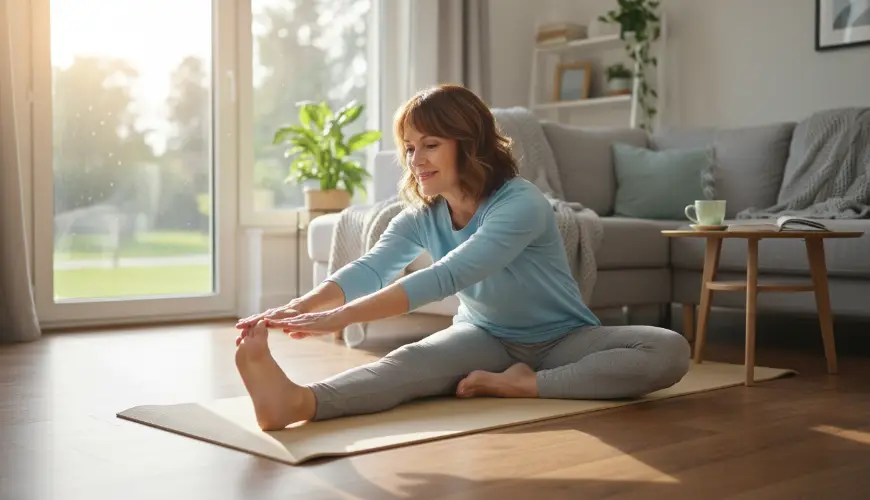
- Seated hamstring stretch – the so-called forward fold – is a classic that relieves the lower back and stretched hamstrings.
- Hip flexor stretch in a deep lunge is absolutely essential for anyone who sits a lot, because these muscles tend to be extremely shortened in sedentary people.
- Chest stretch in a doorframe, where you rest your forearms against the frame and lean slightly forward, is a simple but incredibly effective exercise against rounded back.
- Supine torso rotation, where the knees lie to one side and the upper body turns to the other, beautifully releases the lumbar spine.
- And finally, cervical spine stretching – slow lateral head tilts toward the shoulders and gentle rotations – is a lifesaver for anyone who spends hours in front of a monitor.
As for a short daily stretching routine, nothing complicated is needed. Just set aside ten to fifteen minutes in the morning or evening and go through the following sequence:
- Head circles and cervical spine lateral tilts (1–2 minutes)
- Shoulder and chest muscle stretching in a doorframe (2 minutes)
- Seated forward fold to stretch the hamstrings (2 minutes)
- Deep lunge to stretch hip flexors, both sides (2–3 minutes)
- Supine torso rotation on both sides (2 minutes)
- Child's pose from yoga to release the entire back (1–2 minutes)
This sequence covers the main problem areas and can be done even in a small space, without any equipment. The key is to do it every day – even if not always perfectly, even if sometimes only in a shortened version. The body will get used to it and will start asking for its dose of stretching on its own.
By the way, stretching doesn't have to be just a morning or evening ritual. Short stretching breaks during the day are also very beneficial, especially for people with sedentary jobs. Just stand up every hour, stretch, do a few lateral bends and rotations. It takes two minutes, and the effect on productivity, concentration, and physical well-being is surprisingly significant. Some progressive companies are even introducing stretching breaks as part of their corporate culture, because they've found that employees who stretch regularly have fewer health problems and are more productive.
It's also worth mentioning that stretching is an activity that beautifully complements any other form of exercise. Whether you run, go to the gym, swim, or cycle, regular stretching will improve your performance and reduce the risk of injury. Professional athletes often dedicate as much time to stretching and mobility as to training itself – and that's no coincidence. They know that a flexible body is a resilient body.
In closing, one thing is worth reflecting on. In a culture that celebrates intensity – hard workouts, high performance, constant forward momentum – stretching is an act of wisdom. It's a decision to slow down, listen to your body, and give it what it truly needs. You don't have to be a yogi, you don't have to touch your toes. Just start where you are and do a little more each day. Your body will repay you in ways you might not expect – better sleep, less pain, more energy, and the feeling of being at home in your own skin.