

# How to Travel Less by Car Without Major Restrictions
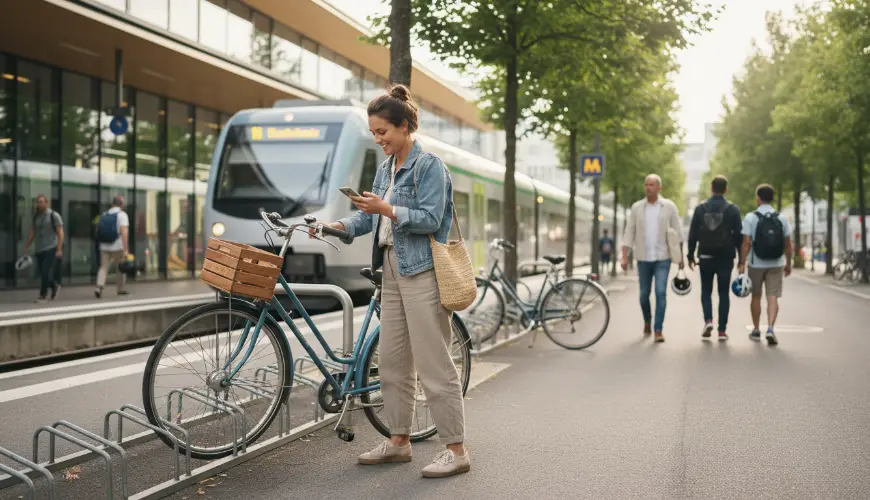
Modern life and the car have become so intertwined that many people cannot imagine a single day without keys in hand. Yet it only takes one glance at the morning congestion on the bypass road, or at a fuel bill, to make a person wonder whether it all has to be this way. Reducing dependence on the car does not mean giving up comfort or freedom – it is more about a smarter approach to how we spend our time and how we move through the space we know well.
According to data from Eurostat, the Czech Republic is among the European countries with above-average use of personal vehicles. The average Czech spends dozens of minutes behind the wheel every day, even on shorter routes that could be managed on foot or by bicycle. Yet studies show that journeys of less than five kilometres make up a large proportion of all trips – and these are precisely the ones most easily replaced.
The whole shift towards a less car-dependent life does not require a dramatic life overhaul. It is more about a series of small decisions that gradually become habits. It starts, perhaps, with a person realising how many journeys they make simply out of inertia – because the car is parked outside, because it is quick, because that is what they have always done.
Try our natural products





Planning is a foundation, not a restriction
One of the biggest obstacles preventing people from driving less is the belief that alternatives are complicated. The bus runs at the wrong time, the bike needs repairing, ridesharing looks complex. But in most cases it is simply a matter of initial unfamiliarity with the system – once a person understands how things work, it stops being an obstacle.
The key is planning slightly ahead. Someone who checks connections the evening before a working day will often find that the train or bus offers more than expected – time to read, peace and quiet, no searching for parking. Apps like Mapy.cz or Google Maps now offer multimodal route planning, where a person can choose a combination of walking, public transport and train so precisely that driving no longer seems like the obvious winner.
Consider a specific example: Jana lives in a small town near Brno and commutes to work by car every day, even though a train runs every thirty minutes and the stop is five minutes from her home. The main reason was habit and the belief that the train would be crowded and she would arrive late. When she tried it once, she found that the journey took ten minutes longer, but instead of traffic stress she had time to finish reading the news or simply relax. Today she drives only once or twice a week.
There are many such people around us. And it is precisely that small experiment – trying it differently just once – that tends to be the first step towards change. Meanwhile, nothing stops anyone from keeping a car at home for situations when it is genuinely needed.
Combining trips also plays a major role. Instead of three separate outings during the day – to the shop, the post office and the doctor – it is enough to plan a single circuit. It sounds obvious, but in practice this can reduce the number of car journeys by a third or even more. Sharing rides with colleagues or neighbours heading in the same direction works in a similar way – in the Czech Republic there are platforms such as BlaBlaCar that make this easier even for regular commutes.
Cycling, walking and electric mobility as natural allies
There is no need to choose between a car and nothing. A whole spectrum of options exists, covering different distances, weather conditions and physical circumstances. The bicycle remains an underestimated mode of transport for many people – not a sport, not a weekend pastime, but simply a way of getting from point A to point B.
Electric bikes have dramatically expanded the range of people for whom a bicycle is a realistic alternative in recent years. Hills are no longer an obstacle, a distance of ten or fifteen kilometres is no longer physically demanding, and a person arrives at work without breaking a sweat. According to the Czech Electromobility Association, sales of electric bikes in the Czech Republic are growing significantly each year, precisely because they appeal to groups who never considered a conventional bike – older people, commuters, parents with children.
Walking is even more straightforward. Distances of up to two kilometres take a healthy person fifteen to twenty minutes on foot. Yet it has become the norm to get in the car even for such short trips. Paradoxically, many people pay for gym memberships or go running in the park to get exercise – when everyday walking would provide it naturally and for free.
For longer distances or more demanding terrain, public transport comes into its own. Czech trains have undergone significant modernisation in recent years, and while the system is far from perfect, for many routes the train is faster than a car – especially when time spent searching for parking and sitting in queues is factored in. The combination of train and bicycle, known as bike and ride, works excellently in many towns and cities, making it easy to cover the last few kilometres from the station without difficulty.
Of course, there are situations where the car simply wins – a large shopping trip, an outing with children, a journey to a remote location with no public transport connections. And that is perfectly fine. The goal is not to eliminate the car entirely, but to use it consciously and only when it genuinely makes sense. As urban planning expert Jan Gehl, whose work has influenced the redesign of dozens of cities around the world, has said: "Cities are not designed for cars. They are designed for people." And these words apply equally to the way we think about our own journeys.
Fewer cars, more money and better health
The financial side of the argument tends to be persuasive even for those who are less moved by environmental reasoning. The car is the second largest household expense after housing – encompassing insurance, road tax, servicing, tyres, fuel and depreciation. The average Czech household spends tens of thousands of crowns a year on running a car. Every journey avoided is literally money saved.
Those who switch to a combination of cycling, public transport and occasional ridesharing can, in the best case, sell the car entirely or manage with just one vehicle in the family instead of two. The savings can then amount to hundreds of thousands of crowns over several years. This money can go towards travel, pension savings, or perhaps better food and products for a healthy lifestyle – investments that have a long-term impact on the wellbeing of the whole family.
The health benefits are equally straightforward. Regular physical activity – even in the form of daily cycling or walking – reduces the risk of cardiovascular disease, improves mood and helps maintain a healthy weight. The World Health Organization recommends at least 150 minutes of moderate-intensity physical activity per week for adults – and commuting by bike can fulfil this without a person having to find extra time in their busy schedule.
Fewer car journeys also have a direct impact on air quality where we live. Transport emissions are one of the main sources of pollution in cities, and every additional car on the road makes the situation worse. This is not an abstract environmental argument – it is something that affects the health of children, older people and everyone living along busy streets.
An interesting effect also emerges in the area of mental wellbeing. Driving in heavy traffic is demonstrably stressful – it raises cortisol levels and contributes to a sense of exhaustion. By contrast, travelling by train or bicycle tends to be experienced as less stressful, even when it objectively takes longer. People who have switched from daily car commuting to other forms of transport report arriving at work and returning home in a better mood.
A change in transport habits also naturally resonates with a broader approach to sustainable living. Someone who starts thinking about how they get around will soon begin thinking in similar terms about what they eat, what they buy and what they leave behind them. This is not an ideological project, but a practical shift towards a more conscious life – one in which decisions make sense and are not merely the result of inertia.
The results of this shift will not be immediate. But after a few weeks of regularly choosing the bike or train over the car, something interesting begins to happen: it stops feeling like a sacrifice. It simply becomes the way things work. And that is precisely the moment when a small change becomes part of one's identity – not a restriction, but a different kind of freedom.