
Oven-baked ratatouille without stirring with fragrant vegetables
There are dishes that have the ability to transcend generations, borders, and culinary trends. Ratatouille is one of them. This Provençal classic from sunny southern France has transformed over the decades from a simple peasant dish into a symbol of Mediterranean cuisine, today gracing tables from Parisian bistros to Czech family Sunday lunches. And yet, one eternal debate continues to revolve around it: to stir or not to stir? Cook on the stovetop or bake in the oven?
The answer that is winning over more and more supporters is surprisingly simple. Oven-baked ratatouille without stirring is not just a trendy gimmick from kitchen videos on social media. It is a method of preparation that respects the ingredients, saves time, and delivers results that the ordinary stirred stovetop version simply cannot match.
Try our natural products




What Actually Happens When You Stop Stirring
The traditional approach to ratatouille involves gradually sautéing individual vegetables on the stovetop, layering them, and simmering for a long time with occasional stirring. The result is a tasty but often soggy dish where individual pieces of vegetables blend together and lose their character. Courgette falls apart, aubergine turns to mush, and tomatoes create excess liquid that unnecessarily dilutes the entire dish.
The oven works differently. Dry hot air surrounds the vegetables from all sides and enables a process known in cooking as caramelisation – the Maillard reaction, in which the sugars contained in the vegetables react with amino acids and create deep, complex flavours that no amount of stovetop stirring can replicate. The vegetables are not steamed in their own juices, but truly roasted, developing golden edges, a lightly crisp surface, while retaining a delicate, creamy texture inside.
This very principle has been described by experts in the world of gastronomy. American chef and cookbook author J. Kenji López-Alt repeatedly emphasises in his texts on Serious Eats that vegetables roasted in the oven at a higher temperature without adding liquid and without continuous stirring achieve a significantly more intense flavour than vegetables braised or fried on the stovetop. The reason is simple: water evaporates, flavour remains and concentrates.
Another key point is that when baking without stirring, the vegetables stay exactly where you place them. Each piece has its own space, its own contact with the baking dish, and its own time. It is not just about aesthetics – though that does play a role, particularly in the famous version with overlapping slices – but primarily about the fact that heat is distributed evenly and each type of vegetable roasts according to its own needs.
Take an example from everyday life: Jana, a busy mother from the Central Bohemian region, prepared ratatouille every summer when her garden overflowed with courgettes and tomatoes. For years she stirred, added water, stood by the stove, and the result was always slightly different – sometimes too watery, other times burnt. Then she simply tried slicing everything into rounds, arranging them in a baking dish with olive oil and herbs, and putting it in the oven. An hour later she pulled out a dish that looked like something from a French bistro and tasted better than anything she had made before. Since then, she has never returned to the stovetop for ratatouille.
How to Make Oven-Baked Ratatouille Step by Step
The foundation of success is choosing the right ingredients. Fresh, seasonal vegetables are absolutely crucial here – and that is not just an empty phrase. Ratatouille is a dish with nowhere to hide. It has no heavy sauce to conceal mediocre ingredients, no strong spices to overpower the flavour of the vegetables. Everything stands or falls with the quality of what you buy or grow.
The classic lineup includes aubergine, courgette, red and yellow pepper, tomatoes, and onion. Add garlic, olive oil, fresh thyme, and basil. Some cooks also add fennel or courgettes of different colours to give the dish visual variety. Proportions depend on personal taste, but as a general rule, tomatoes should make up approximately one third of the total volume of vegetables, as their juice will create a natural sauce at the bottom of the baking dish.
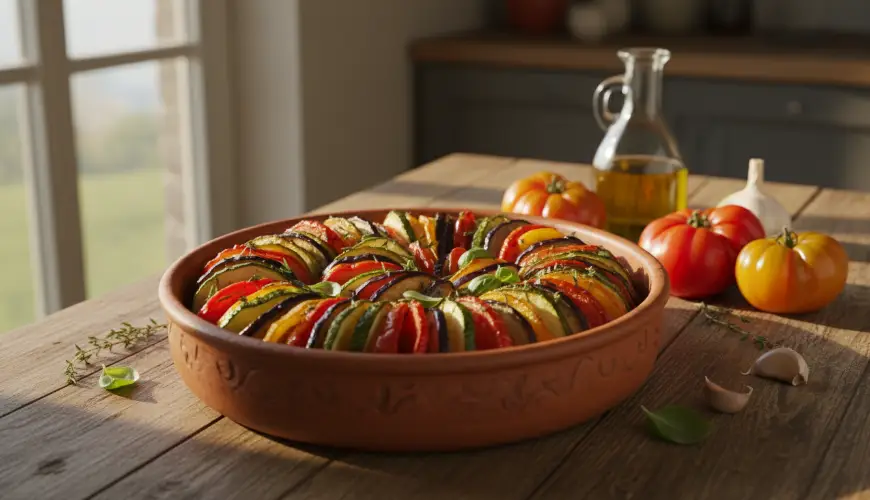
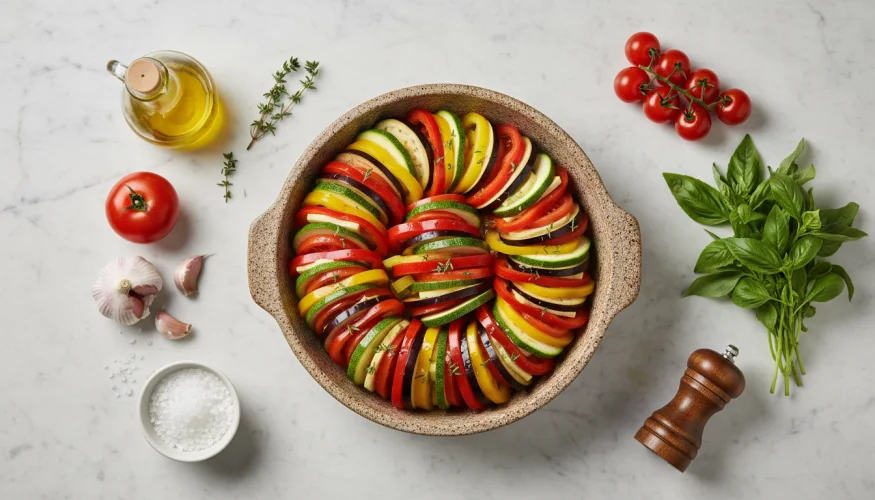
The preparation is surprisingly straightforward. Slice the vegetables into rounds approximately half a centimetre thick – thinner slices roast faster but can easily dry out, while thicker ones remain more succulent. Lightly coat a baking dish or casserole with olive oil and pour a little blended tomato or tomato passata on the bottom – this layer prevents burning and creates the base of the sauce. Then comes the most beautiful part of the preparation: overlapping slices of vegetables are arranged in a circle or in rows, much like fish scales or the pages of a book. Alternate colours and varieties so that each mouthful brings a different flavour.
Top with a generous drizzle of olive oil, salt, freshly ground pepper, sprigs of thyme, and optionally crushed garlic. Some bakers also add fresh basil leaves only after removing from the oven, to preserve their freshness and aroma. Cover the baking dish with foil or a lid and place in an oven preheated to 180 degrees Celsius. After approximately forty minutes, remove the foil and allow the vegetables to finish roasting uncovered for a further twenty to thirty minutes, until the edges begin to lightly brown and the liquid at the bottom thickens.
And this is precisely where the essence of the whole concept lies: no stirring, no checking, no standing by the stove. The oven does the work on its own. The vegetables roast in their own juices, which gradually evaporate and concentrate, while the surface of the slices simultaneously caramelises and develops that unmistakable roasted flavour.
The result differs from the classic stirred version not only in flavour, but also in texture and visual impression. The vegetable slices retain their shape, the colours remain vivid and richly saturated, and the whole dish looks elegant – almost like something from a restaurant. It is little wonder that this very version became famous around the world following the release of the Pixar animated film Ratatouille in 2006, in which the chef Remy prepares precisely such a composed dish that moves even the harshest critic.
As the French gastronome Jean Anthelme Brillat-Savarin once said: "Tell me what you eat, and I will tell you what you are." In the case of oven-baked ratatouille without stirring, the answer is clear: a person who values simplicity, quality ingredients, and patience.
Why This Method Is Ideal for the Modern Household
One of the greatest arguments in favour of oven baking without stirring is time – or rather, the saving of it. While the classic stovetop version requires constant presence in the kitchen, continuous stirring, and careful attention to prevent the vegetables from burning or overcooking, the oven version is essentially a "put it in and forget about it" dish. After preparing and placing it in the oven, you have roughly an hour of free time to devote to anything else.
In today's world, where we are trying to balance work, family, and healthy eating, this is a considerable advantage. Moreover, oven-baked ratatouille is an excellent example of sustainable cooking – it makes use of seasonal vegetables, requires no complex ingredients or expensive equipment, and can easily make use of vegetables that are nearing the end of their life. Rather than throwing away overripe tomatoes or courgettes with soft spots, we slice them and transform them into a delicious meal for the whole family.
From a nutritional standpoint, the dish is equally exceptional. Vegetables retain more nutrients when roasted in the oven than when boiled in water for a long time, while olive oil aids in the absorption of fat-soluble vitamins such as beta-carotene from peppers or lycopene from tomatoes. According to information from the Harvard T.H. Chan School of Public Health, the Mediterranean diet, of which ratatouille is a natural part, is associated with a lower risk of heart disease, type 2 diabetes, and an overall longer and healthier life.
Oven-baked ratatouille works wonderfully as a main dish with fresh bread or as a side to meat, fish, or eggs. It also tastes excellent cold the next day – in fact, many people claim that the flavours meld even further overnight and the dish is even better. It can be served on toast, stirred through pasta, used as a filling for an omelette, or simply eaten with a spoon directly from the baking dish, which is perhaps the most sincere form of praise for any dish.
For those interested in an ecological and sustainable approach to food, ratatouille is an almost ideal dish. All the ingredients are plant-based, locally available during the summer season, and require no complex processing. If you also buy the vegetables at a farmers' market or grow them in your own garden, you gain not only better flavour but also the knowledge that your meal has a minimal carbon footprint.
The summer months are absolutely ideal for preparing ratatouille – that is precisely when all the necessary vegetables are in full season, readily available, affordably priced, and full of flavour. And the oven, which in summer may not be the first choice, is well worth switching on in this case. The result is worth it – and the whole household will sense it before you even manage to close the oven door.