

# Choking in children during eating and foods to watch out for

Every parent knows that moment when a child is sitting at the table, contentedly chewing, and suddenly something changes. Their face turns red, their eyes widen, and a silence falls over the room that lasts only a fraction of a second – but feels like an eternity. Choking in children is one of the most terrifying situations parents can experience, and yet in many cases it can be prevented. The key is knowing which foods pose the greatest risk and learning how to serve them safely.
The World Health Organization and pediatricians around the world repeatedly warn that choking is one of the leading causes of accidental deaths in children under five. Yet most dangerous situations don't arise from parental negligence, but simply from a lack of awareness. Few people realize that seemingly innocent and healthy foods – such as grapes or nuts – can, under certain circumstances, be fatally dangerous.
Try our natural products




Why are young children so vulnerable?
To understand why the very youngest children are most at risk, it's important to understand how their ability to chew and swallow develops. Infants and toddlers don't have fully developed teeth, their chewing muscles are weak, and the coordination of swallowing is still maturing. This means that a food an adult can chew and swallow without difficulty can become lodged in a child's airway before they have time to react. A child's airways are also significantly narrower than an adult's, so even a small piece of food can cause a complete blockage of airflow.
This anatomical and physiological reality is precisely what makes certain foods a genuine threat. It's not only hard or large pieces that are dangerous – the consistency, shape, or slippery surface of food can also be a problem. Grapes are a perfect example: they are round, smooth, and firm enough to seal a child's airway completely, like a cork in a bottle.
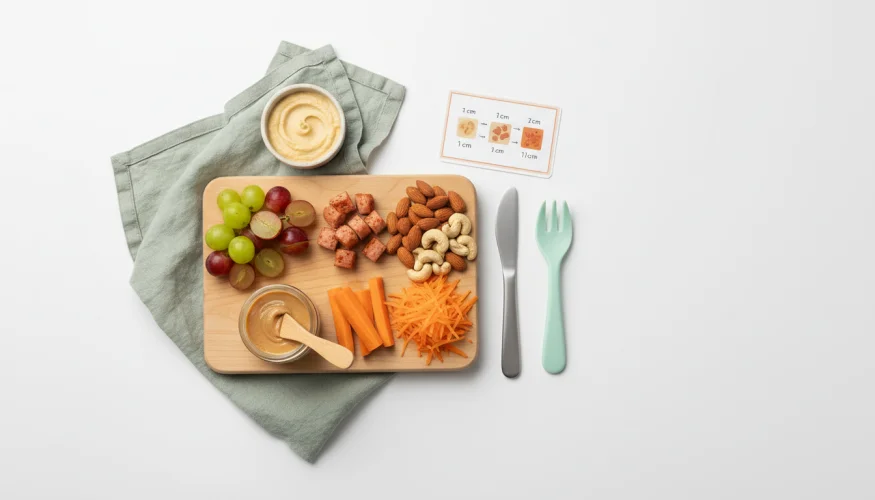
The British charity St John Ambulance has long warned that grapes are among the most common causes of choking in preschool-aged children. This organization, dedicated to first aid and saving lives, recommends always cutting grapes into quarters for children under four – and doing so lengthwise, not just across. The reason is simple: even a halved grape retains its round shape and can still be dangerous.
A story that made headlines around the world in 2016 took place in Sydney, Australia. A four-year-old boy choked on a grape during a family celebration. Despite immediate intervention by paramedics, he was in critical condition for several days. His mother later said in an interview with the Australian newspaper Daily Telegraph: "I thought grapes were healthy and safe. Nobody ever told me I needed to cut them." This story sparked a worldwide campaign for greater awareness about safe food preparation for children.
Hot dogs, nuts, and other hidden dangers on the plate
While grapes are the most well-known example, they are far from the only hazard. Hot dogs and processed sausages are among the riskiest foods when it comes to choking. Their cylindrical shape corresponds precisely to the diameter of a child's airway, and they are both firm and slippery at the same time. The American Academy of Pediatrics has even previously proposed that hot dog manufacturers be required to change the shape of their products or add warning labels to packaging – the problem is that serious in the United States, where hot dogs are a traditionally popular children's food.
Giving a child under four a whole hot dog is genuinely risky. A safer option is to cut the hot dog lengthwise and then crosswise into small, irregularly shaped pieces that are harder to get stuck. An even better choice is to opt for less processed alternatives – quality lean meat cut into small pieces serves the same purpose without the additional health risk.
Nuts and seeds form another major chapter. Whole nuts are unsuitable for children under four, ideally under five, for two reasons. First, they are hard and small – they easily enter the airway and are difficult to remove. Second, even if a child manages to swallow a nut without choking, it can enter the bronchial tube and cause chronic breathing problems. Doctors refer to such cases as foreign body aspiration, a condition requiring bronchoscopy – a procedure performed under general anesthesia. Peanuts, cashews, walnuts, and almonds should therefore only be given to young children in the form of smooth butter spread on bread, or as finely ground powder mixed into food.
Beyond these three most well-known culprits, there are many other foods that parents often wouldn't think to label as dangerous:
- Hard raw vegetables and fruit – carrots, celery, apple, or pear in firm chunks can be just as dangerous as nuts; the solution is cooking or grating
- Hard sweets and chewing gum – lollipops, hard candies, and chewing gum should not be given to children under six at all
- Popcorn – the airy structure of popcorn is deceptive; pieces can easily break off and become lodged in the airway
- Whole beans and peas – like grapes, their round shape fits perfectly into a child's airway
- Fish with bones – fish bones are treacherous, as they can catch in the throat or trachea; fish should always be carefully checked
Interestingly, many of these foods are also very healthy and nutritious. Grapes contain antioxidants, nuts are packed with healthy fats and protein, and hot dogs – though not ideal nutritionally – are convenient and children love them. The goal is therefore not to eliminate these foods entirely, but to learn how to prepare them so they are safe.
How to recognize choking and what to do first
Recognizing choking in a child is not always straightforward, because not every choking episode looks dramatic. There are two types: partial choking, where the child can still cough, gurgle, or make sounds, and complete choking, where the airflow is entirely blocked and the child is not coughing, crying, or able to speak. Paradoxically, silent choking is more dangerous, as it may not immediately attract attention.
With partial choking, the most important thing is to encourage the child to cough forcefully – coughing is the body's natural defense mechanism and the most effective way to expel a foreign object. Do not put your fingers into the child's mouth or try to pull the object out unless you can clearly see it – you could push it further in.
With complete choking, the situation is urgent and immediate action is required. The exact procedure depends on the child's age, and it is recommended that parents attend a first aid course where they can properly practice the technique. The Czech Red Cross and many hospitals offer these courses and they are available to the general public. Generally speaking, for children over one year of age, a combination of back blows and the Heimlich maneuver is used, with the force and technique varying according to the child's size.
What may be more important than knowing the first aid technique by heart is creating conditions in which choking doesn't occur in the first place. Simple preventive habits can significantly reduce the risk. A child should always eat sitting upright, never lying down, while running, or during play. Eating should not be distracted by screens or toys – focusing on food naturally slows the pace of eating and reduces the risk of swallowing a large piece. Parents should never rush a child to eat quickly and should always monitor the size of bites.
Bite size is a key variable that is very easily overlooked in practice. The general recommendation is that foods should be cut into pieces no larger than one centimeter – roughly the size of an adult's little fingernail. For very young children who are just beginning to eat solid food, pieces should be even smaller.
It's also important to know that food safety doesn't only apply at home. Birthday parties, nurseries, visits to grandparents – these are places where a child may come into contact with foods they never receive at home. Grandparents in particular tend to want to spoil children and may offer them sweets, nuts, or other treats without realizing the risk. Gentle but clear communication with those around you is therefore part of a safe approach to food.
The topic of food safety has been gaining increasing awareness in recent years thanks to initiatives by pediatricians, paramedics, and parenting communities on social media. Viral posts showing how to correctly cut grapes or hot dogs have millions of views on platforms like Instagram and Facebook – and that is good news. It means that awareness efforts are working and that parents are interested in learning.
A healthy lifestyle for children doesn't just mean choosing the right foods – it also means knowing how to prepare and serve them safely. Grapes are a fantastic source of vitamins, nuts are an excellent source of energy and healthy fats, and even a hot dog can be part of a balanced diet. It simply requires a thoughtful approach, a little more attention when cutting, and a willingness to learn the basics of first aid. Safety at the table is not a complicated science – it is simply a conscious habit worth building from the very first day a child reaches for solid food.