

Hand washing dishes or dishwasher and what actually saves water
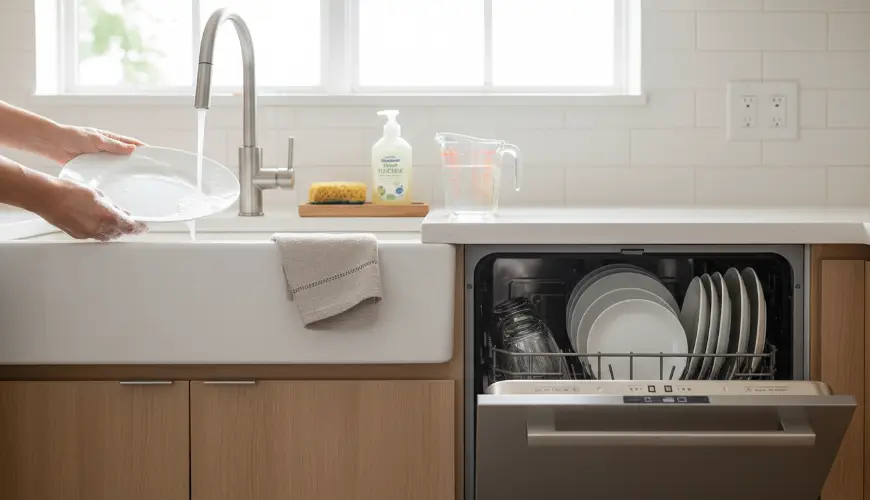
Every day, millions of households around the world grapple with a seemingly trivial question – how to wash the dishes. Some reach for a sponge and dish soap, others rely on a dishwasher. Yet behind this everyday routine lies a surprisingly complex debate that has a direct impact on water consumption, energy use, and the ecological footprint of the entire household. And the findings that independent research has reached often surprise even those who consider themselves responsible stewards.
The intuition of many people suggests that washing dishes by hand must be more environmentally friendly. After all – why would a large electrical appliance consume less water than a person with a sponge? Yet this is precisely where intuition fails. The reality is considerably more complex and depends on a whole range of factors, from the way a person washes, to the age of the appliance, to the amount of dishes that can fit in the dishwasher at once.
Try our natural products

How much water do we actually use when washing by hand?
The answer to this question is not as straightforward as it might seem. Washing dishes by hand is, by its very nature, a highly individual matter. Some people wash under running water, others fill the sink and wash in a single batch of water. Some let the water run the entire time, others only turn it on for rinsing. These seemingly minor details are what determine whether hand washing is economical or, on the contrary, wasteful.
Research conducted by the University of Bonn, which analysed water consumption in households across Europe, showed that the average person uses up to 100 litres of water when washing dishes by hand for twelve people. This is a figure that would surprise many. The study confirmed that the key factor is precisely washing technique – people who let the water run the entire time use several times more than those who work with a full sink.
Let us imagine a typical situation in a Czech household: a family of four after a weekend lunch with guests. Pots, plates, cutlery, and glasses are piling up on the counter. Mum starts running hot water, washing one item after another and rinsing continuously. Dad is meanwhile rinsing another glass. Over an hour of washing, 60 to 80 litres of water can easily flow down the drain – and that is still with a relatively conscientious approach. If someone also lets the water run during breaks or while setting dishes aside, the figure can easily exceed a hundred litres.
Modern dishwashers operate on an entirely different principle. A closed water recirculation system allows them to manage with a surprisingly small amount. Energy-efficient models rated class A or higher use just 6 to 10 litres of water per cycle. That is a fraction of what the average person uses when washing the same amount of dishes by hand. The European Environment Agency has long pointed out that households account for a significant share of drinking water consumption, and the choice of dishwashing method is one of the areas where measurable savings can be achieved.
Of course, exceptions exist. If someone washes just two plates and a mug by hand in a full sink with a minimal amount of water, and would otherwise run the dishwasher half-empty, then the situation is different. The dishwasher's efficiency is only fully realised when it is completely loaded. Running a dishwasher for three mugs and a few pieces of cutlery is wasteful – both in terms of water and energy.

Energy, detergents, and the hidden ecological footprint
The debate about dishwashing does not stop at water alone. Other factors also enter the overall ecological equation, which need to be taken into account if we want a truly comprehensive picture.
Dishwashers consume electricity – and that is a fact that cannot be ignored. Older models can be energy intensive, while new appliances are becoming increasingly efficient. When assessing the true environmental impact, it also matters what sources the electricity in a given country comes from. In countries with a high share of renewable energy, dishwashers come out even more favourably than in places where electricity comes primarily from coal.
Another dimension is water temperature. Dishwashers typically operate at temperatures of 50 to 70 degrees Celsius, which ensures thorough hygiene and the elimination of bacteria. When washing by hand, few people use truly hot water – partly for practical reasons, and partly because the skin on one's hands can only tolerate such high temperatures with difficulty. The result is that hand-washed dishes may not always be as hygienically clean as they appear.
Detergents cannot be overlooked either. Dishwasher tablets are now formulated to be effective even in smaller quantities, whereas when washing by hand, people dose dish soap very imprecisely and often use considerably more than necessary. The excess chemicals then flow into the sewage system and burden wastewater treatment plants. Ecological dishwasher tablets or natural washing products, available from specialist e-shops such as Ferwer, can further reduce this impact and bring the entire washing process closer to a truly sustainable approach.
An interesting perspective on the whole issue was also offered by science writer and populariser Charles Fishman, who wrote in his book The Big Thirst: "Water is so cheap and so accessible that we have forgotten how precious it truly is." These words apply very aptly to the topic of dishwashing – precisely because tap water flows reliably and cheaply, few people think about how much they actually consume.
A practical tip recommended by environmental organisations and appliance manufacturers alike is simple: if you own a dishwasher, use it – but always fully loaded, with an eco programme, and without pre-rinsing under running water. Pre-rinsing is one of the greatest sources of unnecessary water consumption in households. Modern dishwashers are designed to handle even burnt-on or dried food, so pre-rinsing is superfluous in most cases.
If you do not have a dishwasher or prefer hand washing for various reasons, there are ways to significantly reduce water consumption. The key is working with a full sink – first soaking the dishes, then washing in soapy water, and only rinsing at the end. This approach can reduce water consumption during hand washing by up to half compared to washing under running water. Another step is choosing a quality ecological dish soap that lathers even in smaller quantities and does not burden nature with aggressive chemicals.
It is also important to mention that not every type of item is suitable for the dishwasher. A wooden chopping board, a quality knife with a wooden handle, a cast iron pan, or delicate glassware – all of these are better suited to hand washing. A combination of both approaches is therefore the most sensible solution in many households: the dishwasher for everyday plates, pots, and cutlery, and hand washing for specific items.
Also worth mentioning are the results of a comparative study from 2020, published in the Journal of Cleaner Production. This confirmed that when used correctly, a modern dishwasher consumes less water and energy than hand washing in the vast majority of households studied. The only exception was very small households where the dishwasher would never be fully loaded.
From a long-term perspective, investing in an energy-efficient dishwasher is not only ecologically but also economically advantageous for the average Czech family. Savings on water and sewage charges can amount to several hundred crowns per year, even after accounting for the costs of electricity and washing products. With rising water prices in Czech cities, this argument carries more weight with each passing year.
The whole story of dishwashing thus illustrates something that holds true in the area of sustainable living in general: common sense and good intentions are not enough if they are not grounded in facts. Many people believe their behaviour is environmentally friendly without ever verifying whether this is actually the case. Yet it is precisely these small everyday choices – such as how to wash dishes, which cleaning products to choose, or whether to run the dishwasher full or half-empty – that together make a significant difference. Water is a resource we take for granted, but its availability in the future depends, among other things, on how we manage it today, at the kitchen sink.