
# How to Gradually Reduce Toxins in an Everyday Household Reducing toxins at home doesn't have to h
The modern home appears at first glance to be a safe haven from the dangers of the outside world. Closed doors, clean floors, fragrant laundry – everything suggests that we are safe at home. Yet the reality is considerably more complex. According to the U.S. Environmental Protection Agency (EPA), indoor air can be up to five times more polluted than outdoor air, even in industrial areas. Toxic substances lurk in places where no one would expect them – in cleaning products under the sink, in new living room furniture, in a favourite scented candle, or in the pan used to make breakfast every morning.
The point is not to cause unnecessary panic. The point is to understand what we come into contact with every day and to take sensible steps to reduce our exposure. Because toxins in the average home are not the invention of conspiracy theorists – they are a scientifically documented reality with a measurable impact on human health.
Try our natural products

Where do toxic substances in the home actually come from?
Most people, when they think of a "toxic substance at home," probably only picture drain cleaner or paint thinner. In reality, however, the spectrum of problematic chemicals is far broader, and many of them come from products that appear completely harmless.
One of the biggest sources of harmful substances is furniture and home textiles. A new sofa, carpet, or mattress can contain volatile organic compounds (VOCs), formaldehyde, and flame retardants known as PBDEs. These substances are released into the air through a process called "off-gassing" – the gradual evaporation of chemicals from materials. The characteristic "new" smell of a freshly purchased sofa or a new car is nothing other than this chemical cocktail. Formaldehyde, which is classified by the World Health Organization as a Group 1 carcinogen, is commonly found in particleboard, adhesives, and laminate flooring.
Another problematic area involves cleaning and hygiene products. Industrial chemistry can make a toilet sparkle in two minutes, but the price of this convenience may be higher than it seems. Many conventional cleaning products contain sodium hypochlorite (bleach), ammonia, phthalates, or synthetic fragrances composed of dozens to hundreds of different chemical substances. Phthalates are endocrine disruptors – substances that interfere with the human hormonal system. Research links long-term exposure to them with fertility problems, developmental issues in children, and thyroid disorders. Yet they are found not only in cleaning products, but also in cosmetics, perfumes, and plastic packaging.
The kitchen deserves its own chapter. Non-stick pans made from polytetrafluoroethylene (PTFE, commercially known as Teflon) release substances when overheated that can cause so-called polymer fume fever – symptoms similar to the flu. Even more serious, however, are perfluorinated compounds (PFAS), sometimes called "forever chemicals" because they virtually do not break down in nature and accumulate in the human body and the environment. The European Chemicals Agency (ECHA) is paying increasing attention to regulating these substances, yet they are still present in a wide range of cookware, food packaging, and even drinking water.
Plastics are another silent source of problems. Bisphenol A (BPA), used in the manufacture of polycarbonate plastics and epoxy resins for lining cans, mimics oestrogen in the body and can disrupt hormonal balance. Although many manufacturers have replaced it with substances labelled "BPA-free," substitute bisphenols (BPS, BPF) exhibit similar properties according to numerous studies.
How to reduce toxins in the home – practical steps that work
Awareness of the presence of toxic substances in the home can be unsettling, but it is also the first step towards change. And the good news is that reducing exposure does not require a radical life overhaul or enormous financial investment. It is more a matter of gradually changing habits and making informed product choices.
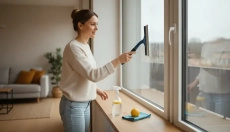
The simplest yet most effective measure is regular ventilation. Opening a window for 15 to 20 minutes a day can significantly reduce the concentration of VOCs and other volatile substances indoors. Ventilation is particularly important after painting, after installing new furniture, or after cleaning with chemical products. Where conditions allow, houseplants also help improve air quality – certain species such as ivy, indoor linden, or croton have the ability to absorb some harmful substances from the air, as shown by a NASA study from the late 1980s that is still widely cited today.
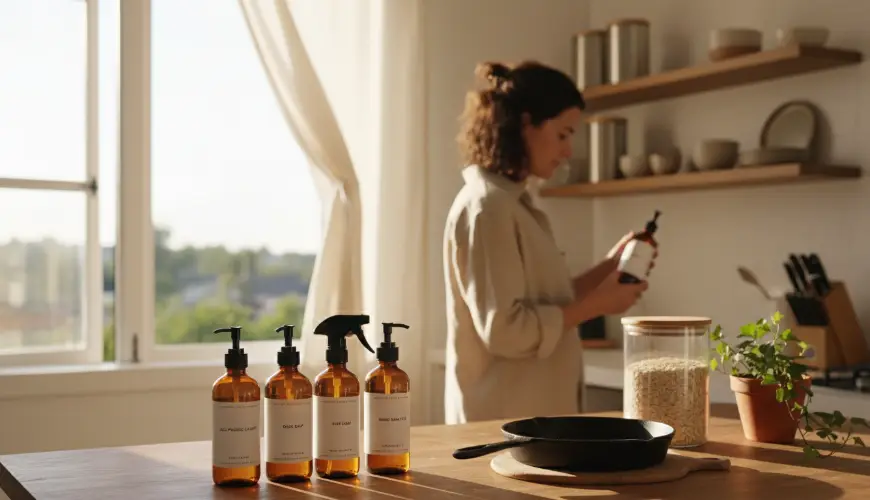
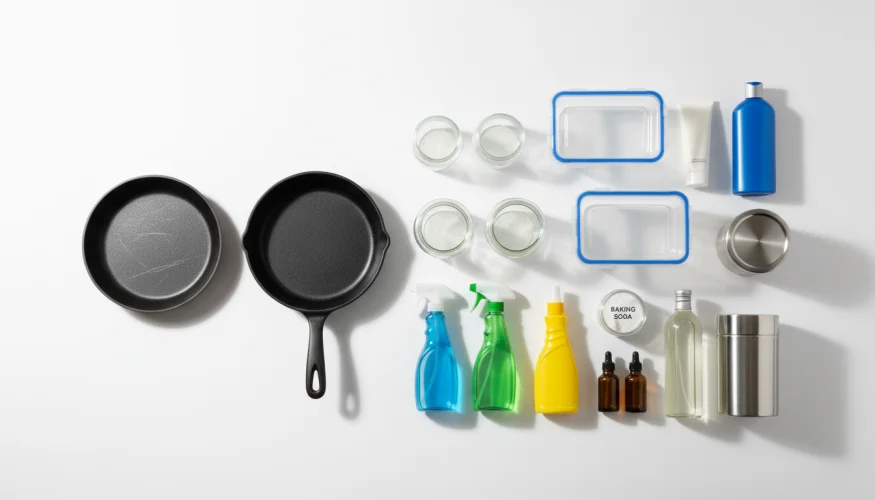
Switching to natural cleaning products is another important step. A combination of vinegar, baking soda, and lemon juice can handle a surprisingly large portion of household cleaning tasks – from removing limescale and cleaning kitchen surfaces to disinfecting the bathroom. For those who do not want to experiment with homemade products, there is now a wide range of certified ecological cleaning products on the market whose ingredients are transparently listed on the packaging. When shopping, it is worth looking for certifications such as Ecocert or EU Ecolabel, which guarantee compliance with strict ecological and toxicological criteria.
In the kitchen, it makes sense to replace non-stick cookware with a damaged surface with alternatives made from cast iron, stainless steel, or ceramic. Cast iron cookware, when properly cared for, can literally last generations – it is an example of a product where investing in quality truly pays off. It also makes sense to switch from plastic food storage containers to glass or stainless steel alternatives, especially for foods that are stored for longer periods or heated.
Let us look at a specific example from everyday life: Jana, a thirty-year-old mother of two young children from Brno, began gradually changing the products in her home two years ago after her older son developed recurring allergic reactions. She first replaced her cleaning products with ecological alternatives, then purchased new stainless steel cookware and began ventilating regularly. "I didn't change everything at once – that would have been financially and psychologically exhausting," she says. "But after a year, I noticed how much the air quality in the flat had improved, as well as the children's health."
Jana's story illustrates an important principle: gradual change is the key to sustainable transformation. It is not necessary to throw out everything at home and start from scratch. It is enough to consider the composition of a product with each purchase, to favour natural materials, and to pay attention to what enters the home.
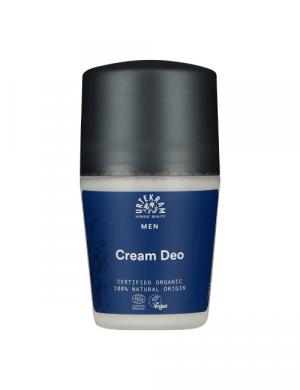
Personal care and cosmetics also deserve special attention. Deodorants, creams, shampoos, and make-up contain a whole range of substances that are absorbed through the skin. Parabens, synthetic fragrances, oxybenzone, and triclosan are among the most frequently discussed problematic ingredients. Databases such as EWG Skin Deep allow consumers to easily look up ratings for specific products and compare their ingredients against available scientific findings. Switching to natural or minimalist cosmetics with a shorter and more understandable list of ingredients is a trend that has grown significantly in recent years.
Water quality must not be overlooked either. Tap water in the Czech Republic generally meets the statutory limits for drinking water, yet it may contain trace amounts of chlorine, nitrates, pesticides, or pharmaceuticals that enter water sources from agriculture and industry. Filtration systems – from simple filter jugs to osmotic filters and comprehensive home filtration systems – can significantly improve the quality of drinking water. Regular filter replacement is a prerequisite for their proper function.
As environmental scientist and author Bill Nye once noted: "Science tells us where the problems are. What we do about them is up to us." These words apply equally to the issue of household toxins. Science has clearly identified a whole range of substances whose presence in the home environment is undesirable. Regulations are gradually tightening, and manufacturers, under pressure from consumers and legislation, are reformulating their products. But the pace of these changes also depends on the choices made by individual consumers.
One of the most overlooked sources of toxic substances is also candles and air fresheners. Paraffin candles release benzene and toluene when burning – substances classified as carcinogens. Alternatives include candles made from soy wax or beeswax with natural essential oils, which burn more cleanly and without synthetic fragrances. Electric air fresheners and synthetic car fragrances are in a similar position – bamboo charcoal filters or natural essential oils can serve as replacements.
The home as a whole can be compared to a living organism – every change, however small, affects the entire system. Replacing one cleaning product, choosing furniture made from solid wood instead of particleboard, investing in a quality water filter, or selecting cosmetics without parabens – these are all pieces of a mosaic that ultimately creates an environment in which the body does not have to constantly cope with a chemical burden. And that is the essence of a healthy lifestyle: not a dramatic gesture, but a collection of conscious everyday decisions that accumulate over time.