

# Hip Mobility for People with Sedentary Jobs
Modern life largely takes place sitting down. Office jobs, long commutes, evenings spent on the sofa watching TV series – all of this together creates conditions in which the human body slowly but surely begins to protest. And one of the first places where this protest manifests is the hip joints. Stiffness, lower back pain, tight groins, or the feeling that it's hard to get up from a chair – these are signals that shouldn't be ignored.
The hips are one of the most important joints in the entire body. They enable movement during walking, running and standing, stabilise the spine, and transfer the weight of the upper body to the legs. However, when a person sits for eight, ten or even twelve hours a day, the muscles around the hips – particularly the hip flexors such as the iliopsoas – shorten and lose their natural length and elasticity. The result is a restricted range of motion, which then manifests not only during sport, but also during completely everyday activities.
Try our natural products



Why sitting is so harmful to the hips
To make it clear what we're actually talking about, it's helpful to picture a specific situation. Jana works as an accountant and sits at her computer for an average of around nine hours a day. After work, she drives home and lies down on the sofa. She doesn't avoid exercise – she occasionally goes for a walk or does some sport at the weekend. Yet she has started experiencing back pain and feels an unpleasant tension in her groin when getting up from a seated position. Her story is not unusual – according to data from the World Health Organization, physical inactivity is one of the greatest global health risks, and a sedentary lifestyle is closely linked to it.
The problem with sitting is that hip flexors are permanently shortened when seated. Over time, the muscles "memorise" this position and remain contracted even after standing up from a chair. This causes overloading of the lumbar spine, because the body seeks alternative ways of moving. Do you get out of breath walking up stairs? Do you feel a pull in the front of your thigh when walking? These are classic symptoms of shortened hip flexors.
In addition to the shortening of the flexors, there is also weakening of the gluteal muscles – the glutes. These are practically inactive during sitting and their strength gradually declines. Physiotherapists have even coined the apt term "gluteal amnesia" for this phenomenon – a state in which the brain stops activating the gluteal muscles correctly because they haven't been used for a long time. The result is an imbalance that places strain on the hips, knees and back.
As physiotherapist and author Kelly Starrett once noted: "Sitting is the new smoking." This provocative idea captures how serious the consequences of a seemingly innocent everyday activity – or rather inactivity – can be.
Exercises and movement that genuinely help the hips
The good news is that hip mobility can be significantly improved without visiting a physiotherapist or using expensive equipment. The key is regularity and correct execution of exercises that target the release of shortened muscles and strengthening of the weakened ones.
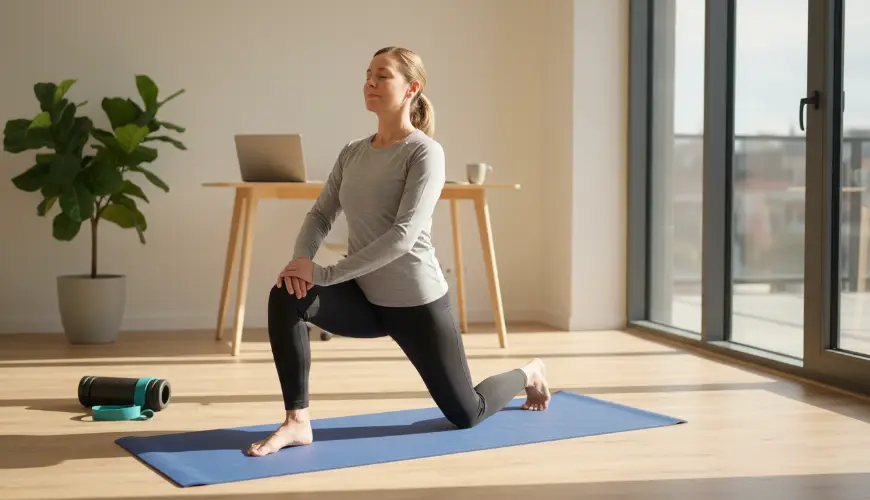
One of the most effective exercises for releasing the hip flexors is the deep lunge with trunk rotation. From a deep lunge position, the front foot is planted on the ground, hands are on the floor, and then a rotation of the upper body is performed towards the front leg. This exercise stretches the hip flexors, opens the chest and simultaneously mobilises the thoracic spine. It's ideal to incorporate it in the morning or before a prolonged period of sitting.
Another popular tool among physiotherapists is the so-called "pigeon pose" – the pigeon position, borrowed from yoga. In this position, one knee is bent in front of the body with the foot resting on the floor, while the other leg is extended behind. This position intensively stretches the external hip rotators and the piriformis – a muscle that tends to be chronically overloaded in people who sit at a desk. Holding the position for 60 to 90 seconds on each side is sufficient, and the feeling of relief comes relatively quickly.
For strengthening the weakened gluteal muscles, the ideal exercise is the "glute bridge." Lie on your back, bend your knees and rest your feet on the floor. Then lift your pelvis so that your body forms a straight line from your knees to your shoulders, and hold the top position for a moment. This seemingly simple exercise activates the gluteus maximus, medius and minimus, and helps restore their function. Research published in the Journal of Orthopaedic & Sports Physical Therapy has repeatedly confirmed that regular strengthening of the gluteal muscles significantly reduces lower back pain.
Equally important are movements that take the hip joint through various planes – not just forwards and backwards, but also sideways and into rotation. Hip circles, lateral leg raises and kneeling on one knee with a lateral pelvic shift are examples of exercises that comprehensively develop joint mobility. Incorporating them regularly into a daily routine – even just ten to fifteen minutes a day – can produce noticeable results within a few weeks.
Many people are unaware of the significant role played by ankle and thoracic spine mobility. The body functions as an interconnected chain, and if one link is restricted, another compensates – very often the hips. A comprehensive approach to mobility therefore also includes work on these areas.
How to improve hip mobility without exercise
In addition to targeted exercises, there are simpler ways to help the hips throughout the course of an ordinary day. Breaks from sitting are one of the most important steps. Ideally, you should get up and walk around at least once every 30 to 45 minutes. Simply standing isn't enough, however – it's good to take a few steps, stretch, or do a few squats. A height-adjustable desk that allows you to alternate between sitting and standing work is an excellent investment for anyone who spends most of their day at a computer.
An interesting alternative to the traditional office chair is sitting on the floor – for example in a cross-legged position or in an asymmetrical position with one leg bent. Various cultures around the world, particularly in Asia, maintain the tradition of sitting on the floor, and researchers have noted that people from these cultures maintain significantly better hip mobility even at an advanced age. Furthermore, transitioning from a floor-seated position to standing requires the activation of the entire body, which in itself serves as an unobtrusive daily exercise.
Footwear choice also plays an important role. High heels or excessively rigid shoes alter the alignment of the entire lower limb and indirectly affect the position of the pelvis and hips as well. Minimalist footwear or walking barefoot at home naturally supports correct body alignment.
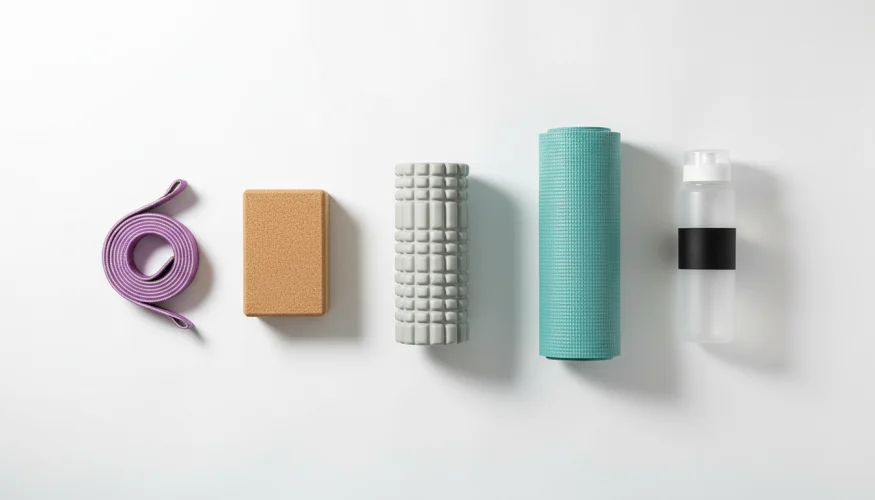
For those who want to go even further, it may be beneficial to incorporate techniques such as myofascial release using a foam roller into their routine. Rolling the front of the thigh, the groin and the hips helps release the fascia – the connective tissue surrounding the muscles – and reduces tension that contributes to restricted mobility. This approach is a common part of athletes' recovery protocols, but it works equally well for people with predominantly sedentary occupations.
When hip care is approached comprehensively, results will follow. People who work on their mobility regularly report not only a reduction in pain, but also improved gait quality, easier rising from seated positions, and an overall sense of lightness in movement. Some also report improved sleep, as chronic muscle tension is reflected in the body's ability to relax.
It is worth noting that hip mobility is not just a concern for athletes or young people. On the contrary – as we age, the joint capsules naturally shorten and mobility declines. Regular care of the hip joints is therefore a means of preventing not only pain, but also falls and injuries, which are among the most common causes of loss of independence in older people. According to the Czech Society for Orthopaedics and Traumatology, a femoral neck fracture – a fracture of the bone in the hip area – is one of the most serious injuries in elderly patients, and its prevention begins precisely with maintaining muscular strength and mobility.
It is therefore clear that investing in hip mobility pays off at any age and with any lifestyle. You don't need expensive equipment, a gym membership, or hours of free time. All it takes is establishing a small ritual – a few minutes in the morning, a break at work, a stretch in the evening before bed. Your body will remember this regular care and reward you with freer movement, less pain, and greater energy for everyday life.