

How much money is unnecessarily disappearing from your household every month

Every month it comes as a surprise. The paycheck arrives, a seemingly solid amount lands in the account, and yet somewhere around the twentieth, an uncomfortable unease starts to creep in. Where is that money, exactly? What happened to it? Most people don't have a clear answer to this question, and that's precisely where the whole problem lies. Money doesn't disappear because of one big expense that a person remembers. It vanishes in dozens of small, inconspicuous payments that individually don't look particularly dramatic, but together create a significant hole in the household budget.
Financial psychologists call this phenomenon the "latte effect" – a term popularized by American author David Bach. It's not just about a daily coffee, though. It's about an entire way of thinking in which we underestimate recurring small expenses and overestimate our ability to remember them. According to various surveys, the average household in the Czech Republic wastes hundreds to thousands of crowns every month on expenses they're not even properly aware of. And that's precisely the part of the budget where savings can be made painlessly.
Try our natural products






How to conduct a review of household expenses
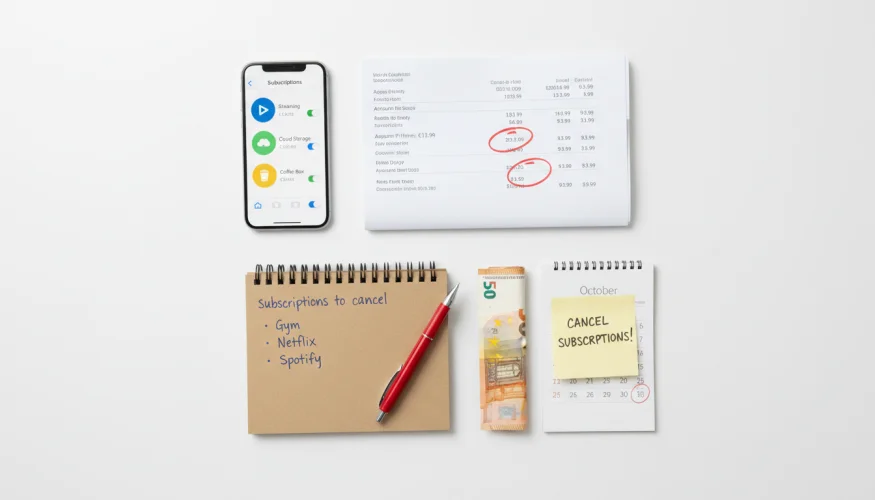
The first step toward finding out where money is leaking at home is to conduct a thorough review of all regular payments. It doesn't sound exciting, but the results can be surprising – and in a good way. Imagine sitting down with a bank statement from the last three months and going through every single item for the first time. That's when most people experience a moment that can be described as a financial awakening.
A practical example: Jana, a thirty-four-year-old graphic designer from Brno, discovered during a similar review that she was paying for four different streaming services, two of which she hadn't used for more than half a year. She also had an active subscription to a meditation app she had downloaded in January as part of a New Year's resolution, and a cloud storage subscription with a capacity that would suffice for a small business. In total, it came to over eight hundred crowns per month – nearly ten thousand crowns a year for services that brought her no real value.
When reviewing expenses, it's best to proceed systematically. Start with your bank statement and look for everything that recurs – monthly, quarterly, or annually. Annual payments are particularly tricky, as they come once every twelve months and are easy to forget. Pay special attention to payments in foreign currencies, which are often a sign of foreign digital services – these also tend to increase in price and notify you of the increase only with a brief email in English that most people scroll past without noticing.
The key question for each item is: Do I actively use this service and does it bring me real value? If the answer isn't an unequivocal yes, it's time to decide whether to cancel the subscription or at least downgrade to a lower tier.
Unnecessary subscriptions: the biggest hidden money drain
The world of digital subscriptions has changed dramatically over the past ten years. Where once there were only newspapers and magazines, today we find hundreds of services operating on a monthly or annual fee model. Streaming films and series, music, podcasts, fitness apps, password managers, antivirus programs, cloud storage, premium versions of games, professional databases, online courses – the list is endless. And each such service costs seemingly just a few crowns or tens of crowns. The problem arises when you have ten or fifteen of them at once.
Unnecessary subscriptions are today one of the biggest hidden money drains in the household budget. According to data from the analytics firm West Monroe, the average American underestimates their subscription spending by more than 100 dollars per month – and there's no reason to assume the situation in Czech households is significantly different. Psychologically, it works simply: a small, automatic payment doesn't trigger the same emotional response as a large one-time purchase. The brain stops perceiving it as a decision and starts treating it as a given.
A special category consists of subscriptions that started as free trials. The freemium model is designed so that the transition to a paid plan happens as naturally and inconspicuously as possible. All it takes is entering a card number at registration and forgetting to cancel before the trial period ends. The result is a payment for a service the person doesn't even know they're paying for. The solution is simple: whenever you sign up for a free trial, set a reminder in your calendar two days before the trial period ends.
Specialized apps can also help when reviewing subscriptions. Tools like Revolut or Air Bank, for example, allow you to clearly display recurring payments directly within the app. Alternatively, there are specialized apps like Truebill or Bobby that track regular payments and alert you to changes. It's nothing complicated – it's about staying informed.
After the review comes the time for decisions. Subscriptions can be divided into three groups: those you actively use and find valuable; those you use occasionally and could be replaced by a cheaper alternative; and those you pay for purely out of inertia. Cancel the third group immediately. For the second group, consider downgrading to a lower tier or sharing an account with family or friends – many services explicitly allow this today.
More tips for saving painlessly
Reviewing subscriptions is a great start, but it's certainly not the only place where reserves can be found in the household budget. There are many other areas worth paying attention to – and most of them don't require any dramatic lifestyle changes.
One of the most significant, yet often overlooked, items is energy. Electricity and gas prices have fluctuated considerably in recent years, and not everyone regularly compares offers from different suppliers. A comparison tool like Energie123.cz allows you to find out in just a few minutes whether your current tariff reflects the market situation, or whether you could save money with a different supplier. Switching is usually administratively straightforward, and the new supplier handles most of the paperwork themselves.
Similar logic applies to insurance products. Home, vehicle, or liability insurance are things people arrange once and then forget about for years. Yet the market changes, offers evolve, and loyalty to a single insurer doesn't pay off financially. Once a year, it's worth going through all active insurance policies and checking whether the same coverage could be obtained more cheaply elsewhere.
Everyday grocery shopping also hides significant reserves. According to data from the Ministry of the Environment, the average Czech household throws away dozens of kilograms of food per year. Every discarded yogurt, wilting vegetable, or forgotten cheese in the fridge is a direct loss of money. Planning meals a week in advance and shopping according to a specific list – rather than on impulse or based on promotions that tempt impulsive purchases – can reduce food expenses by tens of percent.
Another area where money quietly disappears is bank fees. Fees for account maintenance, ATM withdrawals, or foreign transactions are items that few people actively monitor. Yet there are numerous banks and financial institutions that offer these services for free or at a significantly lower cost. Comparing offers through a comparison site like Ušetřeto.cz takes an hour and can save hundreds of crowns per year.
Impulse online shopping is a chapter unto itself. Online shops are designed so that purchasing decisions happen as quickly as possible and with as little deliberation as possible. Discount notifications, countdown timers, "other customers also bought" sections – these are all tools to get customers to buy before they have time to think. A simple trick: add the item to your cart and leave it there for 48 hours. If after two days you still want to buy it, you probably genuinely need it. If you've forgotten about it, the answer is clear.
An interesting alternative to new purchases is also offered by secondhand platforms and local swap markets. Clothing, electronics, books, sports equipment, or furniture – all of these can be purchased in good condition for a fraction of the original price. Websites like Vinted, Bazoš, or Facebook Marketplace offer a huge selection while also helping to reduce the household's ecological footprint. Shopping secondhand is today not only economically advantageous but also a conscious decision in favor of a more sustainable lifestyle.
As another practical step worth mentioning is the so-called envelope system, or its digital equivalent. It's a simple method in which, at the beginning of the month, you divide your available money into categories – food, entertainment, clothing, transportation – and then spend only what you've allocated from each category. Once the envelope is empty, you stop spending in that category. This approach works because it makes expenses visible and tangible, rather than leaving them as abstract numbers on a bank statement.
After all, the whole thing can be summed up in the words of personal finance advisor Suze Orman: "People spend more money trying to look wealthy than they do trying to be wealthy." True financial wellbeing doesn't come from high income, but from the ability to consciously manage whatever income one has. And that starts with sitting down, opening a bank statement, and honestly asking: where is my money actually going? The answer tends to be surprisingly specific – and surprisingly solvable.