

# What Chlorophyll and Green Drinks Can Actually Do

Green smoothies, liquid chlorophyll, spirulina, young barley – the shelves of health food stores and social media feeds are literally flooded with them. Influencers swear by their miraculous effects, manufacturers promise detoxification, glowing skin and an explosion of energy. But what is reality and what is just a cleverly marketed myth? Chlorophyll and green drinks deserve a sober, honest look – without excessive enthusiasm or unnecessary skepticism.
Chlorophyll is the green pigment in plants that drives photosynthesis – the process by which plants convert sunlight into energy. Chemically, its structure is surprisingly similar to haemoglobin, the red pigment in human blood. While haemoglobin has iron at the centre of its molecule, chlorophyll has magnesium. This similarity has long inspired speculation that chlorophyll can directly "enrich the blood" or increase red blood cell counts. The reality is somewhat more complex, but certainly not uninteresting.
Try our natural products


What actually happens in the body after consuming chlorophyll
When a person drinks a glass of green juice or adds liquid chlorophyll to water, their body deals with this substance differently than many might wish. Chlorophyll as such is not well absorbed in the digestive tract – a large portion of it passes through the digestive system without any significant effect. This is why supplement manufacturers often work with so-called chlorophyllin, a semi-synthetic, water-soluble form of chlorophyll that is better absorbed. It is chlorophyllin that has been the subject of numerous scientific studies, and their results are at least interesting.
Research published in the scientific journal Mutation Research, for example, suggests that chlorophyllin may act as an antimutagenic substance – meaning it can bind to certain carcinogens and prevent them from damaging DNA. Studies conducted in regions of China where there is high exposure to aflatoxin (a mould toxin that contaminates food and damages the liver) showed that regular intake of chlorophyllin reduced levels of this toxin in urine. This is a concrete, measurable result – not just a marketing claim.
Nevertheless, it is important to keep one's feet on the ground. Research on chlorophyll in the context of human health is still at a relatively early stage. Most studies have been conducted on cell cultures or animals, and translating these results directly to humans must always be done with caution. This does not mean that green drinks serve no purpose – it simply means that their effects are likely more subtle than advertising would have us believe.
One area where more solid evidence exists is the effect of chlorophyll on inflammation and oxidative stress. Green plants are rich not only in chlorophyll itself, but also in a whole range of other bioactive substances – flavonoids, vitamin K, vitamin C, magnesium and various antioxidants. It is precisely the combination of these substances that likely accounts for the positive effects that many people genuinely experience after incorporating green drinks into their diet. It would therefore be an oversimplification to attribute everything to chlorophyll alone – it is an interplay of the entire spectrum of nutrients.
An interesting chapter is also the relationship between chlorophyll and digestion and the gut microbiome. Some studies suggest that green plant substances can positively influence the composition of gut bacteria and support digestive health. Green vegetables in general contain fibre and prebiotic substances that nourish beneficial bacteria in the gut. Regular consumption of green smoothies or green juices can thus indirectly contribute to better digestion, even if the cause is not necessarily chlorophyll itself.
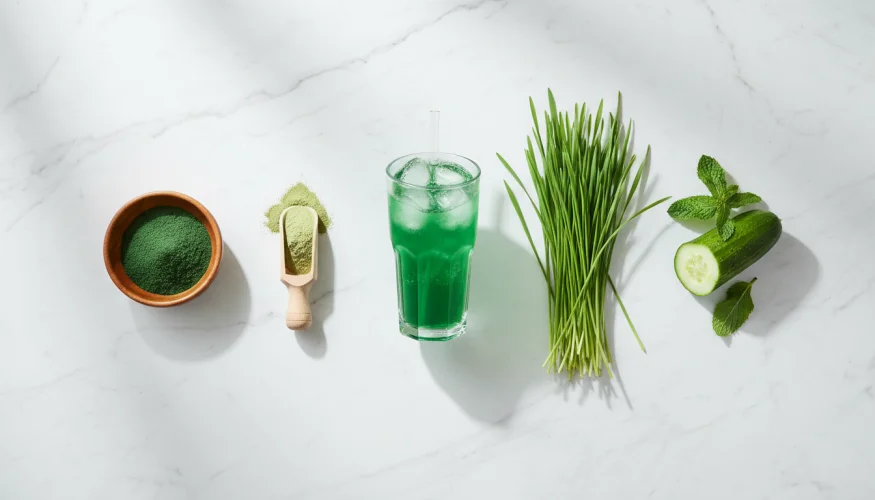
Green drinks in practice: spirulina, young barley and liquid chlorophyll
Let us take a look at the specific products that appear most frequently on the market. Spirulina is a blue-green algae that is among the most thoroughly researched superfoods of all. It contains an enormous amount of protein – up to 60–70% of its dry weight – and is rich in iron, B vitamins and various antioxidants. The US National Institutes of Health (NIH) states that spirulina shows potential benefits in lowering cholesterol levels, regulating blood pressure and reducing inflammation, although further research is needed. For vegetarians and vegans, spirulina can be a valuable source of nutrients that are otherwise difficult to obtain from a plant-based diet.
Young barley, meaning dried juice from barley leaves harvested at an early stage of growth, is another popular green powder. Its nutritional profile is rich – it contains chlorophyll, enzymes, vitamins and minerals. Japanese researcher Yoshihide Hagiwara, who devoted decades to the study of young barley, described it as "the most complete food nature offers." Whether or not this statement is slightly exaggerated, the fact remains that young barley is a nutritionally valuable food that can supplement the diet of people who do not eat enough fresh vegetables.
Liquid chlorophyll, which is added to water to create a beautifully green drink, has been a social media phenomenon in recent years. Many people report that it helps them with hydration, fresh breath and even with reducing body odour. This last property in particular has scientific backing – chlorophyllin has historically been used as a means of reducing odour in patients with colostomies, and older clinical studies confirm this effect. This is therefore one of the few direct effects of chlorophyll that has been clinically verified.
Imagine Martina, a thirty-year-old graphic designer from Brno, who decided to try liquid chlorophyll after seeing enthusiastic reviews online. She added it to a glass of water every morning and after three weeks noticed a significant improvement in her digestion and felt less bloated. Was it the chlorophyll? Perhaps partly – but it was likely also due to the fact that she started her day more mindfully, drank more water and generally thought about her health differently. This placebo effect and behavioural change effect are very difficult to separate from the actual physiological effect when evaluating supplements.
As with any food or dietary supplement, the context of one's overall lifestyle is decisive. A green drink consumed after a fast food lunch and a sleepless night cannot work miracles. On the other hand, as part of a diet rich in vegetables, fruit, wholegrains and sufficient physical activity, it can be a valuable addition that helps fill gaps in micronutrient intake.
It is also important to mention possible risks and limitations. Green powders and supplements are food supplements, not medicines, and their quality varies significantly between manufacturers. Spirulina, for example, can be contaminated with heavy metals or other toxins if it is not cultivated and processed under strict conditions. When selecting products, it is therefore sensible to opt for brands that have independent quality certifications and provide transparent information about the origin of their ingredients. People taking blood-thinning medications should be cautious about high doses of green barley or other foods rich in vitamin K, which affects blood clotting.
Green drinks are also not a substitute for a varied diet. Nutrition experts repeat this warning so often that it can sound like a cliché – but it is absolutely fundamental. Fresh vegetables contain fibre that is lost during the production of powders, and the synergy of nutrients in whole foods is difficult to replicate in a capsule or sachet. The World Health Organization (WHO) recommends consuming at least 400 grams of fruit and vegetables per day – and this amount should come primarily from whole foods, not supplements.
So what can green drinks realistically do? They can be a practical way to increase micronutrient intake on a hectic day when there is no time to prepare a proper serving of vegetables. They can contribute to better hydration if they motivate a person to drink more water. Liquid chlorophyll has a proven effect on reducing body odour. Spirulina is nutritionally valuable and can be particularly beneficial for those who have reduced or eliminated animal products from their diet. And the overall content of antioxidants and anti-inflammatory substances in green drinks is undoubtedly real – it is simply a matter of having realistic expectations.
The green colour in a drink is not magical. But behind that colour lies an entire world of chemistry, biology and nutrition that is worth paying attention to. Green drinks are neither a miracle cure nor a fraud – they are simply one of the tools that, when used correctly and with realistic expectations, can meaningfully contribute to overall health care. And that is no small thing.