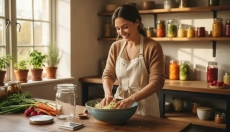

# Best Sheet Pan Recipes for the Whole Family
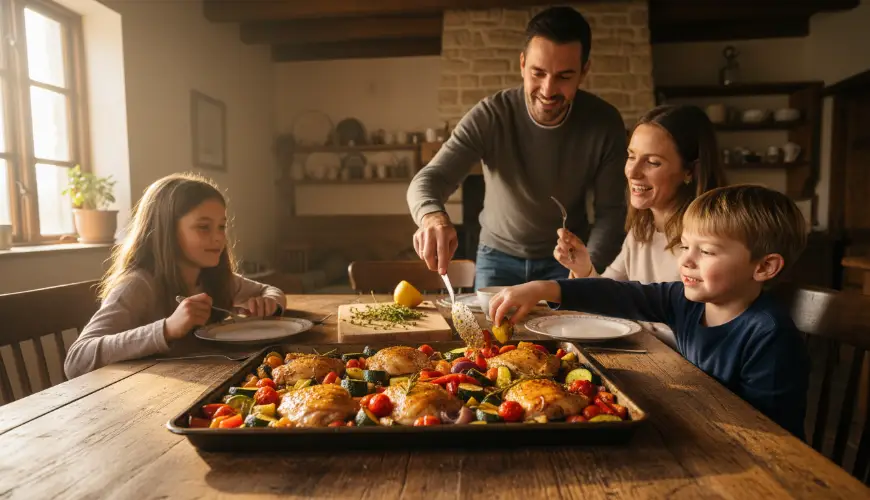
There is one type of dinner that everyone loves – those who dislike cooking, those who have no time, and those who simply don't want to spend an hour washing dishes. These are sheet pan recipes, and if you haven't tried them yet, you may be surprised at how fundamentally they can transform your approach to weeknight cooking.
Imagine a typical Tuesday afternoon. Coming home after work, tired legs, an empty mind, and the question that repeats itself in almost every household: "What are we having for dinner tonight?" At that moment, most people feel like calling for delivery or opening the freezer. But there is another way – quick, tasty, and surprisingly simple. All you need is one pan, a little oil, seasonal vegetables, protein of your choice, and a pinch of seasoning. The result is a complete dinner that practically makes itself while you rest.
Try our natural products




Why is sheet pan cooking so popular?
The phenomenon of so-called sheet pan dinners – dinners prepared entirely on one baking tray or pan – originated in the United States, where it became a veritable cult of healthy and convenient cooking. And no wonder. The principle is simple logic: everything you need for a nutritious dinner goes onto one pan, into the oven, and in 25 to 45 minutes it's done. No watching pots, no pouring things over, no frantically stirring five things at once.
But perhaps even more important than the preparation itself is what comes after the meal. Clean-up takes literally two minutes. One pan, or a sheet of baking paper that you simply throw away. That's it. For anyone who has ever stood over a pile of dirty dishes after cooking something more complex, this is nothing short of a small miracle.
Nutrition experts and practical cooks alike agree that one of the biggest reasons people reach for unhealthy alternatives is precisely the complexity of preparing healthy food. As the Harvard T.H. Chan School of Public Health notes, regular home cooking is one of the most effective ways to control the quality and composition of your diet – and the simpler cooking is, the more likely we are to stick with it.
Sheet pan cooking breaks down this barrier. And there are no compromises in taste or nutritional value – quite the opposite. Oven roasting preserves the natural flavours of ingredients, caramelises vegetables into beautifully sweet notes, and leaves meat juicy on the inside while developing a golden crust on the outside. It is a way of cooking that works for you.
How to put together the perfect sheet pan dinner
The basic logic is simple, but a few rules help achieve a great result every time. The key is to correctly combine ingredients with similar cooking times, or to add them in stages. For example, potatoes or root vegetables need longer than cherry tomatoes or spinach, so it's a good idea to put them in the oven ten to fifteen minutes earlier.
Every recipe is built on three components: protein (chicken thighs, salmon, tofu, chickpeas, or eggs), vegetables (whatever you have at home or whatever is in season), and fat along with seasoning (olive oil, garlic, lemon, herbs, paprika, turmeric – the possibilities are almost endless). This trio is enough to create a nutritious and tasty dinner that will satisfy the whole family.
One of the most popular recipes of this kind is roasted chicken thighs with vegetables. The thighs are coated with a mixture of olive oil, garlic, sweet paprika, and thyme, surrounded by diced courgette, red onion, peppers, and cherry tomatoes, seasoned with salt and pepper, and put in the oven at 200 degrees. In 35 minutes it's done – the chicken is juicy, the vegetables are tender with lightly crisped edges, and the whole kitchen smells wonderful. Clean-up? One pan and a knife.
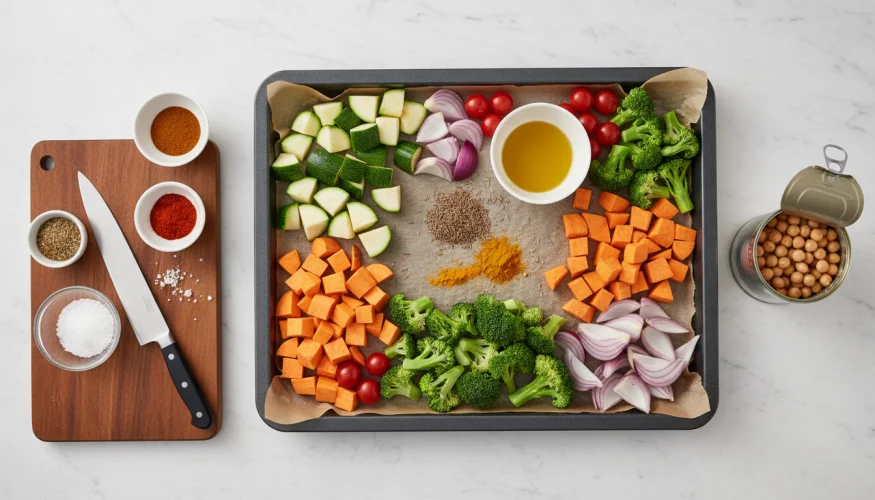
For vegetarians or vegans, the same principle works brilliantly with chickpeas, for example. Roasted chickpeas with vegetables is one of the most underrated dishes around. Tinned chickpeas are dried, mixed with olive oil, cumin, turmeric, and sea salt, broccoli, carrot, and sweet potatoes cut into chunks are added to the pan, and in 30 minutes a dish full of protein, fibre, and flavour is on the table. Anyone who tastes this dish for the first time is often surprised at how rich and satisfying a purely plant-based meal can be.
Another popular option is salmon with asparagus and lemon. Here the preparation is even quicker – salmon fillets are placed on the pan, asparagus is arranged alongside, everything is drizzled with olive oil and lemon juice, a little garlic and dill is added, and in 20 minutes an elegant dinner is ready that would cost a pretty penny in a restaurant. Omega-3 fatty acids from the salmon, vitamins from the asparagus, and minimal calories on top of that – this is healthy eating without compromise.
A major advantage is also that sheet pan recipes can be easily adapted to whatever is in the fridge. Leftover vegetables, a piece of cheese, a handful of nuts, or legumes from the day before – everything can find its place on the pan and be transformed into a new dish. This approach can significantly reduce food waste, which is an increasingly relevant topic. According to data from the Food and Agriculture Organization of the United Nations (FAO), approximately one third of all food produced for human consumption is wasted globally – and households account for a considerable share of this figure.
Tips for even easier preparation and perfect results
To ensure consistently great results, it pays to follow a few simple guidelines. Cut vegetables into roughly equal-sized pieces – this way they cook evenly and nothing burns while other parts remain raw. Don't overcrowd the pan: ingredients should lie in a single layer with a little space between them. If they are crammed together, the vegetables will steam rather than roast and won't develop that beautiful caramelised flavour that's the whole point of putting them in the oven.
Baking paper is your best friend. Not only because the pan stays clean and washing up truly takes just a moment, but also because it prevents sticking and makes serving much easier. An alternative is a silicone baking mat, which is reusable and more eco-friendly – an excellent choice for anyone who thinks about the impact of their everyday behaviour on the environment.
Seasoning and marinades play a key role in these recipes. While the roasting itself takes care of texture and concentration of flavours, it is the seasoning that gives each dish its character. Mediterranean style with olive oil, rosemary, garlic, and lemon. An Asian variation with soy sauce, ginger, and sesame oil. Mexican inspiration with cumin, coriander, lime juice, and chilli. One basic recipe can be transformed in this way endlessly without ever getting boring.
As the famous British chef Yotam Ottolenghi once said: "Cooking is not a science, it is an art – and like any art, it needs above all the courage to experiment." And sheet pan recipes are the ideal space for this kind of culinary boldness. It's very hard to go wrong, and yet the scope for creativity is enormous.
For families with children, these recipes are particularly practical. Children can help with the preparation – tossing vegetables with oil and seasoning is a task even the youngest can manage, and it's also a great way to gently involve them in cooking and build their relationship with food. Research shows that children who participate in meal preparation are more willing to eat vegetables and healthier foods – and that is an argument that speaks for itself.
When it comes to choosing ingredients, it pays to reach for quality and, where possible, locally sourced products. Seasonal vegetables not only taste better and contain more nutrients, but are also kinder to the wallet and the planet. Spring asparagus, summer courgettes and tomatoes, autumn squash and sweet potatoes, winter root vegetables – each season offers a different palette of flavours that makes sheet pan cooking a constantly fresh experience.
It is no coincidence that interest in a simple, sustainable, yet delicious way of cooking continues to grow. People are looking for balance – they want to eat well, but they don't want to sacrifice all their free time in the kitchen. Sheet pan recipes offer this balance naturally and without compromise. Dinner is on the table in under an hour, of which the active preparation takes ten to fifteen minutes, and the clean-up – as mentioned – two minutes. The rest of the time, the oven does the work.
And perhaps this is precisely what is most fascinating about these recipes: it's not just about the food. It's about reclaiming a little peace in an ordinary day. About transforming dinner from a chore into something to look forward to – or at the very least, something not to dread. One pan, a few good ingredients, and an oven that works for you. It really couldn't be simpler.