

# Try Fermentation for Complete Beginners Fermentation is one of the oldest food preservation metho
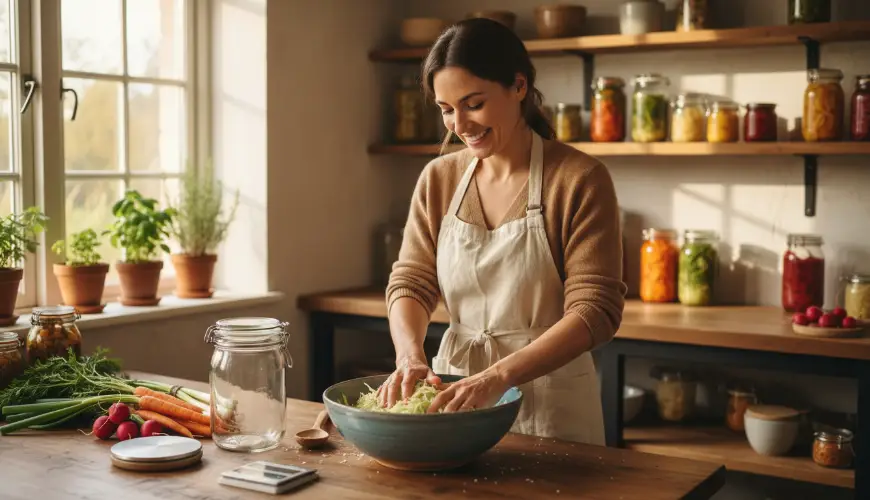
Fermentation has been experiencing a true renaissance in recent years. What was a staple of every household for centuries is now returning to modern kitchens as a response to industrially processed foods, unnecessary packaging, and a desire for authentic flavour. And yet many people still regard fermentation as something complex, almost alchemical – as if it were a skill reserved only for experienced cooks or enthusiasts with an entire shelf full of books. Nothing could be further from the truth. Fermentation is, at its core, a very simple process that anyone can master, literally over a single weekend.
Just think of grandmother, who every autumn would fill jars with cabbage, cucumbers, or beetroot. She needed no special equipment or courses. She had only the experience passed down from generation to generation and the basic ingredients she had on hand. Today, many people lack this experience, but the good news is that getting started is easier than it seems.
Try our natural products





What actually happens during fermentation?
Before reaching for that first jar, it's worth understanding the basic principle – not to become an expert, but to know what you're doing and why it works. Fermentation is a natural biological process in which microorganisms – primarily lactic acid bacteria – convert the sugars found in foods into lactic acid. This acid acts as a natural preservative that inhibits the growth of unwanted bacteria while simultaneously giving fermented foods their characteristic sour taste.
Salt is the key player in the entire process. In so-called lacto-fermentation – the simplest and most widespread method – vegetables are mixed with salt, which draws water out of the cells and creates a natural brine. This environment favours beneficial bacteria while suppressing the growth of harmful ones. The result is a food that is not only safe but also significantly richer in probiotics, B vitamins, and absorbable minerals than its raw counterpart.
The scientific basis of lacto-fermentation is well established – for example, the Harvard T.H. Chan School of Public Health states that fermented foods can positively influence the composition of the gut microbiome, which has a direct impact on immunity, digestion, and overall wellbeing. It is no wonder that interest in fermentation is growing in parallel with science's increasing focus on the role of the gut microbiome in human health.
The natural question is: where to begin if you have no experience and don't want to invest in expensive equipment? The answer is surprisingly straightforward – start with fermented vegetables, specifically cabbage or radishes, because these ingredients are accessible, inexpensive, and more forgiving of beginner mistakes than, say, kombucha or kefir.
How to make your first jar, step by step
Let's imagine a specific scenario: it's Friday afternoon, you've returned from shopping with a head of cabbage, coarse sea salt, and a clean preserving jar. That's all you need. By Sunday evening, you can have your first home-fermented food on the table.
The process is intuitive. The cabbage is sliced into fine strips – a knife or grater can be used – and mixed with salt at a ratio of approximately two percent salt to the weight of the cabbage. That means roughly twenty grams of salt per kilogram of cabbage. Then comes the part that surprises many with its simplicity: the cabbage is thoroughly kneaded and squeezed by hand until it releases enough liquid. This liquid is the natural brine that will protect the cabbage during fermentation. No added water, no canning, no vinegar.
The cabbage is packed tightly into a clean jar so that it is completely submerged beneath the surface of its own brine. If there isn't enough liquid, simply add a little boiled and cooled water with salt in the same ratio. The jar is covered – not airtight, but loosely, for example with a lid simply resting on top or a piece of cloth – and left to stand at room temperature. Within two to four days, visible fermentation will begin, the cabbage will start to smell sour, and after five to seven days it is ready to taste. It is then moved to the refrigerator, where fermentation slows and the cabbage will keep for weeks to months.
This basic method applies to the vast majority of vegetables. Carrots, radishes, beetroot, cucumbers, celeriac – all can be fermented using the same method, with only minor adjustments to the salt ratio or fermentation time. Some people add spices: caraway, bay leaf, garlic, or horseradish, which lend the result a distinctive character. This is where there is room for creativity, but even without any spices at all, the result is surprisingly tasty.
One of the most common beginner mistakes is worrying too much about whether everything is being done correctly. Jana, a thirty-year-old teacher from Brno, describes her first attempt like this: she checked the jar every two hours throughout the weekend to see whether it had gone off, and wondered whether the white film on the surface of the brine was mould. It was, however, a yeast film – a completely natural and harmless occurrence that is simply removed with a spoon. The resulting cabbage was excellent, and Jana now ferments regularly every month. Her story is typical: the greatest obstacle is not technique, but the psychological barrier of the unknown.
That is precisely why it is important to know what is normal and what is not. During fermentation, the following are normal: a mild sour smell, bubbles in the brine, a slightly cloudy brine, a white yeast film on the surface. Warning signs, on the other hand, include visible mould – that is, coloured patches of green, black, or pink – or a very unpleasant, putrid smell. If the vegetables remain submerged beneath the brine and everything proceeds at room temperature, the risk of failure is minimal.
Why ferment at home rather than buy ready-made products?
Fermented foods are widely available in shops today – sauerkraut, kimchi, kefir, and kombucha are sold practically everywhere. So why bother with home production? The answer has several layers.
First, there is the question of quality. Many industrially produced fermented products undergo pasteurisation, which prolongs shelf life but simultaneously destroys the live bacteria responsible for fermentation's health benefits. Home-fermented foods contain live cultures that the vast majority of industrially produced shop products lack. The difference is fundamental – it is like comparing fresh fruit with high-sugar jam.
Second, there is the economic aspect. A kilogram of cabbage costs on average around twenty crowns in the Czech Republic. For this price, approximately one litre of quality sauerkraut full of probiotics is produced. A comparable product of organic quality with live cultures costs several times more in a shop. Home fermentation is therefore one of the few healthy habits that is simultaneously cheaper than its industrial alternative.
Third – and this is an argument particularly appreciated by people interested in a sustainable lifestyle – home fermentation produces almost no waste. Jars are reused, vegetables are bought without plastic packaging, and the entire process is energy-efficient, as it requires no heat treatment. As writer and activist Michael Pollan wrote: "Cooking is one of the most revolutionary acts a modern person can perform." Fermentation takes this statement even further – it is cooking that happens on its own, without energy, without waste, with minimal effort.
Home fermentation also naturally leads to a deeper relationship with food. You begin to think about seasonality – cabbage and beetroot in autumn, cucumbers in summer – and gradually discover how the natural rhythm can also influence your way of eating. Many enthusiasts describe fermentation as the first step towards broader changes: towards composting, buying from local farmers, and reducing industrially processed foods.
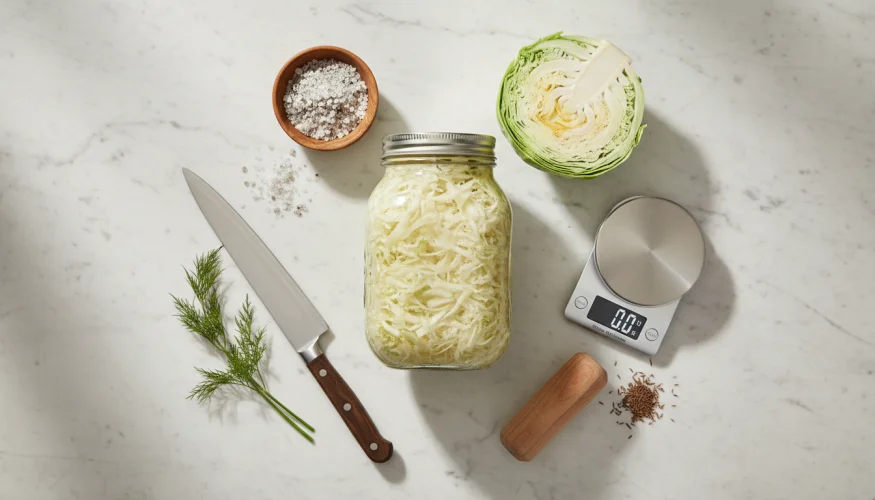
The equipment you need is truly minimal. A clean wide-mouthed jar – ideally one or two litres – a spoon or wooden pestle for pressing the vegetables, kitchen scales for accurately measuring the salt, and a sharp knife are sufficient. No special fermentation crocks, no airlock valves, and no digital thermometers are necessary for a start, although as enthusiasm grows some people do acquire them. Basic fermentation equipment can easily be found in the range offered by ecologically oriented online shops such as Ferwer, where jars and tools that are kind to the environment are also available.
There is yet another dimension that is not spoken about as often: fermentation is a deeply calming activity. At a time when most food is produced anonymously somewhere far away and people have no control over what they eat, fermentation provides a sense of autonomy. A direct connection is created between the hands, the ingredients, and the resulting food. It is not just about health – it is about a conscious relationship with what you put into your body.
For those who want to go beyond basic lacto-fermentation, water kefir, kombucha, or miso paste present themselves as natural next steps. Each of these ferments has its own specifics and requires a little more attention, but the principles remain the same. The fermentation community in the Czech Republic is vibrant – online groups exist where people exchange experiences, share recipes, and give each other starter cultures. Entering this world is therefore not only delicious but also socially enriching.
So if someone spends this Saturday morning in the kitchen with a head of cabbage and a jar, they can be sure they are doing something meaningful – for their health, their wallet, the planet, and their own wellbeing. And when they taste the result of their own work for the first time a week later, they will most likely understand why people return to fermentation again and again.