

# Homemade Probiotic Shot from Sauerkraut Juice for Every Day

There is something that our great-grandmothers' generation took for granted, which modern science is only now fully appreciating – and that is sauerkraut. More precisely, its juice: a humble, sour liquid that for centuries was poured down the drain or, at best, added to goulash. Today, however, nutritionists, gastroenterologists and healthy lifestyle enthusiasts are calling it one of the most accessible and effective natural probiotic shots that nature has to offer. What is actually hidden in that simple sour liquid, and why might it be worth stopping to overlook it?
Probiotics are live microorganisms that, when consumed in sufficient quantities, provide health benefits to the host – so reads the definition of the World Health Organization. Most people associate this term with yoghurt or pharmacy capsules. Sauerkraut juice, however, offers something different: a naturally fermented, live culture of bacteria, produced without the addition of any starter cultures, solely through the action of lactobacilli naturally present on cabbage leaves. This process, known as lactic acid fermentation or lacto-fermentation, is one of the oldest methods of food preservation in the world, and its end product contains a surprising amount of biologically active substances.
Try our natural products


What makes sauerkraut juice so exceptional
During the fermentation of cabbage, bacteria of the genus Lactobacillus multiply – particularly species such as Lactobacillus plantarum, Lactobacillus brevis and Lactobacillus mesenteroides. These microorganisms produce lactic acid, which acidifies the environment and prevents the growth of pathogenic bacteria. At the same time, enzymes, B vitamins, vitamin C and a whole range of bioactive peptides are produced. The juice released from the cabbage during fermentation is literally a concentrate of these living organisms and their metabolites.
A single glass – roughly 30 to 60 millilitres – of unpasteurised sauerkraut juice can contain hundreds of millions to billions of colony-forming units (CFU) of probiotic bacteria. For comparison, many commercial probiotic dietary supplements offer 1 to 10 billion CFU per capsule, but these bacteria are lyophilised – freeze-dried – and their survival in the digestive tract depends on the quality of the product and storage conditions. Bacteria in live fermented juice, on the other hand, are active and adapted to surviving in an acidic environment – which is precisely what awaits them in the stomach.
Research published in journals such as Frontiers in Microbiology has repeatedly confirmed that fermented foods represent one of the most effective ways to diversify the gut microbiome. And it is precisely the diversity of the gut microbiome that is currently considered one of the key indicators of overall health – influencing immunity, mood, metabolism and the body's ability to regulate inflammation.
The gut is increasingly being referred to in modern medicine as the "second brain" – and not merely metaphorically. The enteroendocrine system of the gut produces approximately 90% of the body's serotonin, the neurotransmitter that fundamentally influences mood, sleep and a sense of wellbeing. A healthy microbiome is therefore not just a matter of digestion – it is the foundation for mental health, resilience to stress and sleep quality. Regular intake of probiotics in the form of fermented foods, including sauerkraut juice, can be one of the steps to support this system.
Consider a specific example: Jana, a thirty-four-year-old teacher from Brno, began drinking a small glass of juice from unpasteurised sauerkraut every morning on the recommendation of her GP. She had been troubled by recurring digestive problems, bloating and a feeling of heaviness after meals. After six weeks of regular consumption, she reported a significant improvement in digestion, less frequent mood swings and greater energy throughout the day. Thousands of people around the world share similar experiences – and science backs them up.
How to properly incorporate sauerkraut juice into your diet
The transition to fermented foods should be gradual, especially for people who are not accustomed to probiotics. Introducing a large amount of probiotic bacteria into the gut too quickly can cause short-term bloating or changes in bowel frequency – this is a natural response of the gut microbiome to new microorganisms and usually subsides within a few days.
The recommended starting point is one tablespoon of juice per day, ideally in the morning on an empty stomach or before a meal, when gastric pH is still relatively lower and the bacteria have a greater chance of surviving the passage through the stomach. The dose can gradually be increased to 30 to 60 millilitres per day. It is important to choose unpasteurised sauerkraut juice, because pasteurisation destroys live cultures through heat, making such a product worthless from a probiotic standpoint. The label should indicate that it is a live fermented product, and ideally the juice should be stored refrigerated.
As British gastroenterologist Tim Spector, author of The Diet Myth and one of the world's leading experts on the gut microbiome, has noted: "Fermented foods are probably more important for gut health than any probiotic supplement, because they offer a complex ecosystem of microorganisms, not just one or two strains."
Sauerkraut juice can be consumed on its own as a shot, but it can also be added to salad dressings, smoothies or used as a base for marinades – provided, of course, that it is not heated. Temperatures above 40 degrees Celsius destroy live bacteria, making any heat treatment counterproductive from a probiotic perspective. The flavour of the juice is distinctly sour and salty, which may come as a surprise at first, but most people quickly get used to it – especially when they combine it with a little water or lemon juice.
In addition to its probiotic effect, sauerkraut juice offers further benefits. It is a rich source of vitamin C – cabbage naturally contains large amounts of it, and fermentation further increases its bioavailability. It also contains vitamin K2, which plays a key role in calcium metabolism and bone health, as well as electrolytes such as sodium and potassium, which are important for hydration and neuromuscular function. For athletes, fermented juice can therefore be an interesting alternative to commercial sports drinks – without added sugar or artificial ingredients.
However, it is also worth mentioning certain limitations. Sauerkraut juice is relatively high in sodium, so people with high blood pressure or kidney disease should consult a doctor before consuming it. Similarly, people taking immunosuppressants or undergoing chemotherapy should consult a specialist before incorporating fermented foods into their diet, as live bacteria can cause complications in a weakened immune system. For the healthy adult population, however, sauerkraut juice is considered a safe and beneficial food.
The question that naturally arises is: why, then, are fermented foods not part of every doctor's recommendations? The answer is partly economic – the pharmaceutical industry has no interest in promoting cheap natural alternatives – and partly scientific, as research into the gut microbiome is still a relatively young field. Only in the last decade have large longitudinal studies begun to map the relationship between the microbiome and chronic diseases, and their findings are fascinating. The Human Microbiome Project, funded by the US National Institutes of Health, found, for example, that the human microbiome contains more than 38 trillion microorganisms and that its composition differs between individuals in much the same way as a fingerprint.
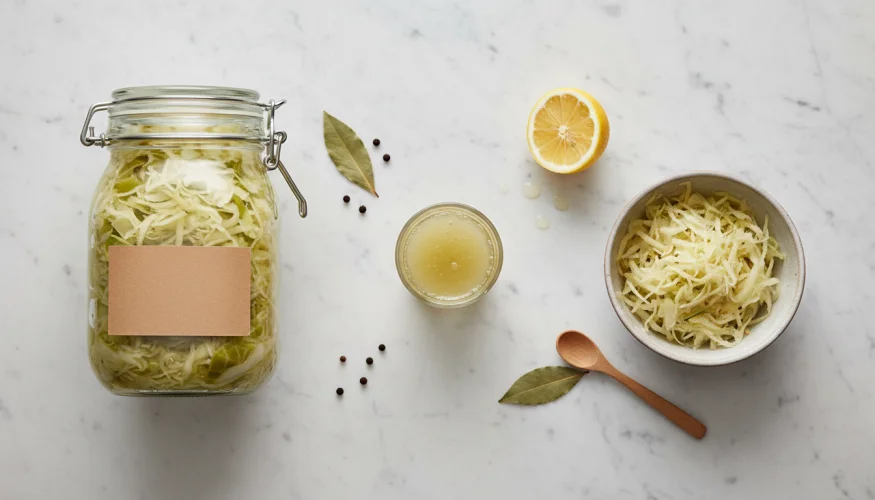
Making sauerkraut and its juice at home is surprisingly simple and accessible to almost anyone. All you need is fresh cabbage, salt and a clean container. Shredded cabbage is salted at a ratio of approximately 2% salt to the weight of the cabbage, kneaded to release its juice, and packed into a jar so that it is completely submerged beneath its own liquid. At room temperature, fermentation begins within 24 hours, and after five to ten days the cabbage is ready to eat. The juice that collects at the bottom of the jar is, in fact, the most valuable thing fermentation produces.
Interest in fermented foods has grown significantly in recent years – not only among health enthusiasts, but also in mainstream gastronomy. Michelin-starred chefs are fermenting vegetables, fruit and dairy products; scientific laboratories are investigating the therapeutic potential of probiotics in the treatment of depression, obesity and autoimmune diseases; and the global market for fermented products is growing by billions of dollars annually. Yet sauerkraut juice remains one of the most underrated and, at the same time, most accessible ways to support gut health without the need to invest in expensive dietary supplements.
At a time when pharmacy shelves are filling up with ever-newer probiotic preparations costing hundreds of crowns per pack, it is worth reflecting on the fact that our ancestors had the solution close at hand long ago – quite literally in the pantry. Sauerkraut juice is not a passing trend or a marketing gimmick. It is a food with thousands of years of proven use, now backed by solid scientific evidence. And that is a combination you rarely come across.