# What Children Remember Differently Than We Do and Why ## How Children's Memory Works Children's
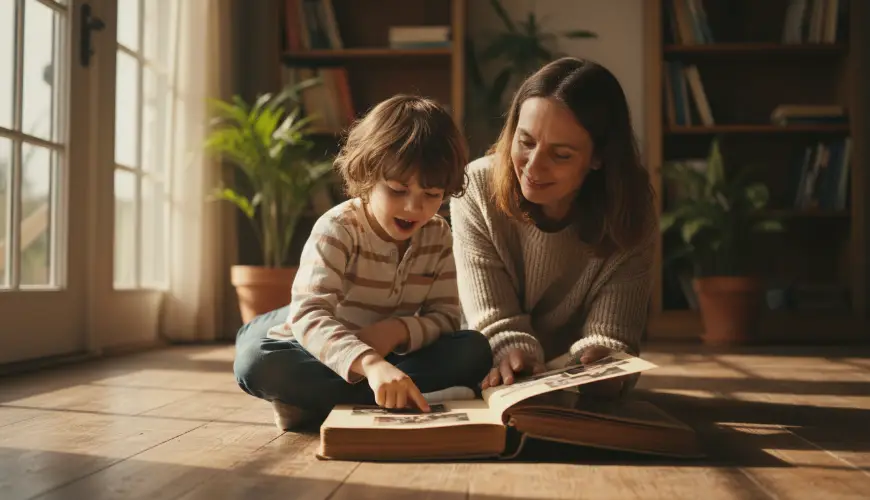
Each of us has at some point reached into memory for a childhood recollection and been surprised – or even confused. How is it possible that we recall certain details with crystal clarity, while other events that seemed significant are shrouded in fog? And why do parents and their children describe the same family trips or holidays as if they had participated in two entirely different experiences? The phenomenon of what children remember differently than adults is a fascinating intersection of neuroscience, psychology, and everyday life.
The answers are not trivial and are certainly not merely an academic matter. The way the child's brain stores, sorts, and retrieves memories fundamentally influences who children will eventually become. It affects their relationships, their sense of identity, and even how they perceive their own family and history.
Try our natural products



A child's brain is not simply a miniature adult brain
To understand why children remember things differently, one must first look at how the child's brain actually functions. A child's brain is not merely a scaled-down copy of an adult brain – it is a dynamically developing organ that processes reality in a way that differs fundamentally from adult perception.
The hippocampus, the brain region crucial for storing long-term memories, matures only gradually throughout childhood and early adolescence. This is precisely why most people cannot recall events from the first two to three years of life – a phenomenon scientists refer to as infantile amnesia. Research published in journals such as Science shows that young neurons in the hippocampus form so rapidly that they effectively overwrite older memories before they have a chance to become firmly established. A child does not forget out of carelessness – they forget because their brain is biologically configured differently.
Yet infantile amnesia is only one part of the story. Once a child passes the age of three or four, they begin storing memories in a way that is more lasting, but still markedly different from the adult approach. Children tend to remember emotions and sensory impressions far more intensely than specific facts or the chronological order of events. An adult remembers from a family holiday that the train was delayed two hours and the hotel was on the third floor. A child remembers the smell of the sea, the colour of an ice cream, and the feeling of warm sand between their toes.
This difference is not coincidental. The amygdala, the part of the brain responsible for processing emotions, is relatively more active in children than the prefrontal cortex, which handles the logical organisation of information and its placement in context. The result is that children's memories are vivid, colourful, and emotionally charged – but at the same time less accurate in terms of facts.
Consider a specific situation: nine-year-old Tereza remembers Christmas at grandmother's mainly through the scent of gingerbread, how grandmother's sweater scratched her a little, and how safe and happy she felt. Her mother remembers the same Christmas as tense due to a family argument, the oven breaking down, and the Christmas tree being smaller than usual that year. Both are right. Both are remembering the same event – and yet their accounts would be difficult to reconcile.
How context and language shape what we remember
Another key factor explaining what children remember differently than adults is the role of language and social context in the very process of storing memories. Memories are not static recordings of reality like a video on a hard drive. They are living, changeable constructs that shift each time we recall them.
Psychologist Elizabeth Loftus, one of the world's foremost experts on memory, spent decades studying how easily human memories can be altered – even unconsciously. Her research showed that the way questions are posed to us, or even what other people tell us, can fundamentally affect what we "remember." As Loftus herself noted: "Memory works more like a Wikipedia page – it can be edited, by you and by others."
In children, this effect is even more pronounced. A child who has not yet fully mastered language or lacks sufficient frames of reference for understanding complex situations stores memories in a raw, unstructured form. Only later – through conversations with parents, siblings' accounts, or family photographs – do these memories acquire a more defined shape. And it is precisely in this process of "retrospective narration" that the greatest discrepancies arise between what the child originally experienced and what they ultimately remember.
Family stories play an enormous role in this regard. If parents repeatedly recount a holiday incident in a way that emphasises certain details and omits others, the child will eventually adopt this version as their own memory. Research in developmental psychology, such as studies by Robyn Fivush at Emory University, confirms that children whose parents regularly and in detail discuss past experiences with them develop richer and more coherent autobiographical memories. The way a family talks about the past literally shapes what a child will remember.
This has practical implications worth considering. If parents deliberately avoid mentioning unpleasant or traumatic events, this does not mean the child will forget them. A child may retain a strong emotional imprint of an event without understanding its context – and this incomplete memory can be confusing or even burdensome in the long term.
The age at which an event occurs also plays a crucial role. Research shows that memories from the period between the tenth and thirtieth year of life are generally the strongest and most numerous – a phenomenon psychologists call the "reminiscence bump." For early childhood memories, this means they are naturally fewer in number and less detailed, but emotionally they can be all the more intense.
Why children remember "bad" things differently
Unpleasant or stressful experiences are a special chapter in themselves. Intuitively, one might assume that children suppress or forget traumatic events – but the truth is more complex. The brain under stress releases cortisol and adrenaline, which paradoxically strengthen the storage of memories – but also distort them. A child may vividly remember how they felt, but incorrectly reconstruct exactly what happened or who said what.
This mechanism has evolutionary logic: remembering what was dangerous or painful helps survival. The problem arises when these memories are stripped of context or misunderstood. A child who experienced their parents' divorce may remember a particular evening as pivotal and traumatic – while the parents do not recall that same evening as remarkable at all.
It is also important to note that children attach enormous significance to seemingly small things. While an adult regards a cancelled trip as a logistical problem, a child may experience it as a profound disappointment that etches itself into memory for years. Conversely, major family events such as moving house or starting school may be represented only fragmentarily in a child's memory, while a specific afternoon spent with a grandparent doing something seemingly ordinary remains vivid forever.
This asymmetric storage of memories is one of the reasons psychologists and educators recommend paying attention to the everyday, unremarkable moments in a child's life. The American Psychological Association repeatedly emphasises in its materials that the quality of daily interactions between parents and children matters more for a child's healthy development than exceptional events or grand gestures.
Sensory memories hold an entirely special place in the child's world. Smells, textures, sounds, and tastes are the primary carriers of experience for a child – and are therefore also the most enduring traces in memory. It is no coincidence that the smell of freshly baked bread or a specific melody can instantly evoke a vivid image from childhood in an adult. Sensory memory is the most ancient and most durable component of human recollection, reaching deep into the evolutionary layers of the brain that existed long before we learned to tell stories or keep diaries.
All of these insights lead to an interesting conclusion about how to approach childhood – one's own and that of one's children. If we want to understand why someone remembers a particular event differently than we do, it is not enough to say they are "lying" or "exaggerating." We must take into account that their brain was functioning differently at the time, captured different details, and stored them through a different emotional filter. A child's memory is not an inferior version of an adult memory – it is a different kind of record of the same reality.
Recognising this fact can be surprisingly liberating. Rather than arguing about "how it really was," it opens space for curiosity: what were you experiencing at the time? What did that moment mean to you? Such a question can be the beginning of deeper understanding – not only between parents and children, but also between ourselves and our own past. Because we too were once children who perceived the world with their whole bodies, all their senses, and an open heart – and the traces of that remain within us, even when we are not always aware of it.