

# Dopamine Menu as a Path to Digital Freedom

There is one habit that has crept into modern life so quietly that most people haven't even noticed it. Every morning, before their feet touch the floor, a hand automatically reaches for the phone. Notifications, Instagram, messages, TikTok – and before you know it, thirty minutes have passed in a kind of half-dream state, leaving nothing behind. No joy, no energy, just a dull feeling that time has somehow vanished. It is precisely for these moments that a concept has emerged which, in recent months, has been spreading among psychologists, coaches, and ordinary people looking for a way back to themselves – the dopamine menu.
The name might sound a little scientific, but the idea behind it is surprisingly simple and human. It is a personal list of activities that bring genuine joy, a sense of fulfilment, or calm – and which a person can reach for at any time instead of their phone. It is not another productivity hack, nor a digital detox in the radical sense of the word. It is a conscious decision to offer the brain something better than an endless stream of other people's lives and advertising messages.
Try our natural products



Why the brain loves scrolling so much – and why it hates it at the same time
To understand why the dopamine menu works, it is worth pausing for a moment on dopamine itself. This neurotransmitter is often referred to as the "happiness hormone," but that is slightly inaccurate. Dopamine is not a reward for experienced pleasure – it is more of an anticipation signal. The brain releases it the moment it senses that something interesting might be coming. And it is precisely this mechanism that social networks exploit so perfectly.
Every swipe of a thumb across the screen is essentially a small bet. Will the next post be boring, or surprising? Will there be a funny video, or a message from a friend? This unpredictability is key – the brain enters a state that neuroscientists compare to playing a slot machine. The reward comes irregularly, and that is precisely why it is so addictive. Research in the field of neuroscience repeatedly shows that variable reinforcement is one of the most powerful mechanisms for habit formation in both humans and animals.
The problem is that scrolling does release dopamine, but at the same time exhausts the brain's capacity to perceive smaller, more natural pleasures. After an hour on social media, a walk in the park or reading a book seems boring – not because it actually is, but because the brain is overwhelmed and its threshold for satisfaction has shifted higher. A vicious cycle emerges: the more we scroll, the less anything else interests us, and so we scroll again.
The dopamine menu breaks this cycle by offering alternatives that, while not as immediately stimulating as Instagram, provide a deeper and more lasting sense of contentment. Psychologists call this "eudaimonic wellbeing," as opposed to mere hedonic pleasure – it is a form of joy that leaves a lasting impression.
How to create your own dopamine menu
The concept is easy to grasp, but putting it into practice requires a little reflection. A dopamine menu is not a universal list – what works for one person may bore another to tears. The first step, therefore, is honest self-reflection: when did you last experience a feeling that time was passing pleasantly and meaningfully? What were you doing? Were you alone or with someone? Were you outside or at home?
It is helpful to divide activities into several categories based on how much time and energy they require. Some pleasures take five minutes and need no preparation – making a good cup of coffee and giving it your full attention, stretching by the window, reading a single poem. Others require more space – going for a longer walk, calling a friend, trying a new recipe, taking the guitar out of the cupboard. And then there are activities that require planning and are therefore more of a weekly or monthly affair – a trip into nature, visiting an exhibition, taking a ceramics class.
A concrete real-life example can help: Jana, a thirty-four-year-old graphic designer from Brno, realised she was spending two to three hours every evening on her phone without getting any good feeling from it. She decided to write down – on paper, not in her phone – things she used to enjoy: watercolour painting, walking her dog without headphones, cooking Thai food, reading detective novels. She began consciously fitting these activities in instead of her evening scrolling. After three weeks, she described the change as "a feeling of having returned to myself." There was no dramatic transformation, just a small, repeated decision to reach for something different.
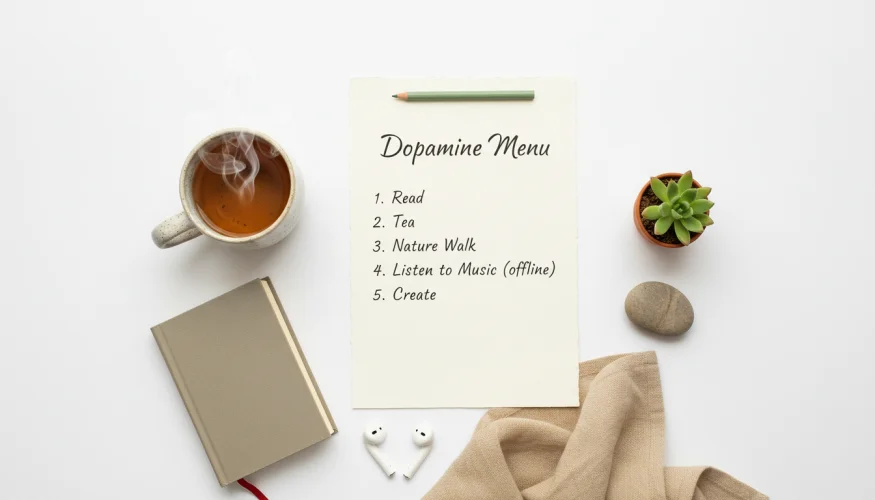
The key is to have the list physically accessible – written on paper on the fridge, as an image on the phone's wallpaper, or as a bookmark in a diary. In the moment when the urge to open social media strikes, the brain needs an alternative immediately at hand. Otherwise, the path of least resistance wins, and that path leads straight to Instagram.
A good dopamine menu typically includes activities of varying lengths and intensities:
- Quick pleasures (1–10 minutes): a cup of tea without the phone, a short meditation, looking out the window, a few pages of a book, stretching
- Moderately demanding activities (30–60 minutes): a walk, cooking, drawing, a phone call with someone close, gardening, yoga
- Deeper experiences (half a day or more): a trip into nature, a creative project, a board game with friends, visiting a market or cultural event
A sustainable lifestyle and joy that doesn't burden the planet
Interestingly, many of the activities that naturally find their way onto dopamine menus share one more common quality – they are gentle on both the environment and the wallet. While scrolling is only seemingly free (we pay with our attention and mental wellbeing), activities such as a walk in the forest, cooking with seasonal ingredients, or making something by hand leave behind neither a carbon footprint nor a sense of emptiness.
This connection is no coincidence. Psychological research, including studies published in the Journal of Environmental Psychology, repeatedly confirms that contact with nature, physical activity, and creative pursuits are among the most powerful natural sources of dopamine and overall wellbeing. This is not a luxury available only to a select few – these are activities most people have access to, but which have been displaced by a culture of constant online presence.
The conscious choice of pleasures that do not draw from the digital world thus naturally leads to a more mindful approach to life in general. Someone who spends an afternoon making homemade candles or tending to houseplants also begins to appreciate slowness, naturalness, and what is truly within their own hands. As American psychologist and author Sherry Turkle once said: "To connect with others, we must first learn to be with ourselves." And that is precisely what the dopamine menu quietly helps us do.
This is not about rejecting technology as such. A phone is a useful tool and social networks have their place. The point is to stop being a passive consumer and become a conscious user who decides for themselves when and how their time is spent. The dopamine menu is not a manifesto against the modern world – it is a gentle, everyday form of self-determination.
Getting started is very simple. All it takes is a piece of paper, a pen, and writing down five things that you enjoy or used to enjoy – regardless of how "small" or "impractical" they may seem. Baking bread, listening to vinyl records, photographing details around the city, reading poetry, sitting by a fire. No activity is too trivial if it brings a genuine sense of presence and joy.
And next time your hand automatically reaches for the phone for no particular reason – out of boredom, anxiety, or habit – it is enough to pause for a moment and look at that list. It might take five minutes, or it might take an hour. But the brain will receive something that scrolling can never give it: the feeling that the time spent was time well spent.