

# Hormonal or Copper IUD and the Main Differences Between Them Intrauterine devices (IUDs) are one

Deciding on contraception is one of the most important health decisions a woman makes during her lifetime. And although there are numerous options on the market, intrauterine devices have gained extraordinary popularity in recent years – in two basic variants. Hormonal IUD versus copper IUD is a topic that occupies not only gynaecologists, but also thousands of women seeking reliable, long-term and, if possible, natural protection against unwanted pregnancy. Both options have their enthusiastic supporters and critics, which is why it is worth diving deeper into the subject than merely listening to friends' recommendations or the first results in an internet search engine.
The intrauterine device as such has existed in various forms for decades. Its modern versions are small, T-shaped devices inserted directly into the uterus by a doctor, where they perform their function for several years. Although they may appear similar at first glance, hormonal and copper IUDs work on entirely different principles – and therein lies the key to understanding which option is suitable for a particular woman and her life situation.
Try our natural products

How do they work and in what ways do they fundamentally differ?
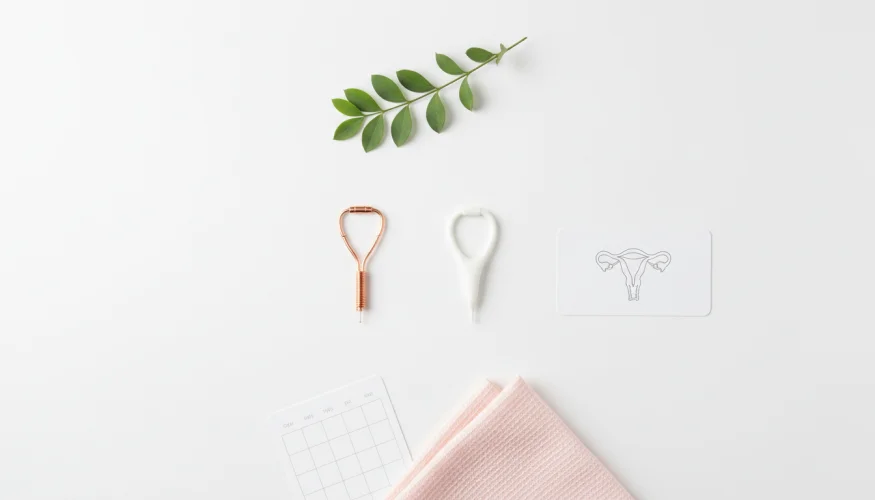
The copper IUD, referred to in medical terminology as an IUD (intrauterine device), works on a purely physicochemical principle. The copper with which it is wound releases ions into the uterine cavity that are toxic to sperm – reducing their motility and ability to fertilise an egg. It also affects the uterine environment to make it unfavourable for potential fertilisation. The copper IUD contains no hormones, and for many women this is its greatest advantage. The body functions in its natural cycle, menstruation arrives regularly, and the woman has full control over what she does not allow into her body.
The hormonal IUD, best known under the brand name Mirena or its smaller variant Kyleena, releases a small amount of synthetic progestogen – levonorgestrel – into the uterus. This hormone acts locally on the cervical mucus, thickening it to the point where sperm are unable to reach the egg. It also thins the uterine lining and in some women suppresses ovulation, although this is not its primary mechanism of action. The amount of hormone released into the bloodstream is significantly lower than with a classic contraceptive pill, which for many women represents an acceptable compromise.
The reliability of both options is comparably high. According to data from the World Health Organization, intrauterine devices are among the most effective contraceptive methods of all – with an efficacy exceeding 99%. This figure places both options on a par with sterilisation, while unlike sterilisation they are fully reversible. After removal of the device, fertility is restored virtually immediately.
An interesting perspective concerns the duration of effectiveness. The copper IUD lasts in the body for up to 10 to 12 years, with some types approved for even longer periods. Hormonal IUDs typically have a lifespan of 5 years (Mirena) or 3 years (Kyleena) respectively. For a woman planning a family within a three-year horizon, this duration may be a decisive factor – just as it may be for a woman in her fifties deciding how to get through the menopause without an unwanted pregnancy.
Side effects that influence the decision
If there is one topic that resonates most strongly in discussions about contraception, it is side effects. And it is precisely here that the hormonal and copper IUD diverge most markedly.
The copper IUD is often associated with heavier and more painful menstruation, particularly in the first months after insertion. Some women describe stronger bleeding and cramps, which can be uncomfortable enough for some of them to opt for a different type of contraception. On the other hand, this effect diminishes over time in many women as the body adjusts to the presence of the device. For women who already suffer from heavy periods before insertion, the copper IUD may not be the ideal choice.
The hormonal IUD, by contrast, significantly reduces or completely suppresses menstruation in a large proportion of women. For women suffering from endometriosis, heavy periods or painful cramps, this can be a genuine relief that transforms the quality of their everyday life. This is precisely why the hormonal IUD is also prescribed as a therapeutic aid in the treatment of these conditions, not only as contraception.
On the other hand, there is a group of women who are sensitive to hormonal interventions and in whom even a low local dose of progestogen can trigger side effects – mood changes, decreased libido, acne or headaches. These experiences are highly individual and science has not yet provided a definitive answer. As noted by a study published in JAMA Psychiatry, there is a statistical association between hormonal contraception and the occurrence of depression, with this association being weaker for intrauterine devices than for the combined pill – but it cannot be entirely ruled out.
Take the example of thirty-year-old Kateřina, who after years on the pill was looking for an alternative. She opted for a copper IUD because she wanted to be "free of chemicals". The first three months were challenging – heavier periods and occasional pain tested her resolve. But then the situation stabilised, and today, two years after insertion, she describes her cycle as natural and predictable. Her friend Lucie, on the other hand, chose a hormonal IUD after the birth of her second child; she suffered from endometriosis and appreciated that her periods almost disappeared entirely. Both are satisfied with their choice – and yet they chose opposite solutions. This is precisely the point that doctors repeatedly emphasise: there is no universally best option, there is only the right one for a particular woman.
Age and parenthood also play an important role. Historically, intrauterine devices were recommended primarily to women who had already given birth, because insertion into a uterus that has never been through childbirth tends to be more difficult and painful. This recommendation is changing today – modern gynaecology recognises that IUDs can be used by young women without children as well, both hormonal and copper. The deciding factors are individual anatomy and overall health status.
What to consider before visiting the gynaecologist
Before a woman walks into the surgery with the question "I want an IUD", it is worth reflecting on a few things. How does she respond to hormonal contraception? Does she tend to have heavy or painful periods? Is she planning a pregnancy in the near future? Does she suffer from any gynaecological condition such as endometriosis, fibroids or polycystic ovaries? The answers to these questions will significantly narrow down the options and help the gynaecologist offer a truly personalised recommendation.
There are also situations in which one of the options is contraindicated. The copper IUD is not suitable for women with Wilson's disease (a condition associated with impaired copper metabolism) or for those in whom fibroids are present that distort the uterine cavity. The hormonal IUD is not recommended for women with a history of hormone-dependent tumours or in cases of active liver disease.
Allergic reactions to copper are rare, but they do exist. If a woman suspects sensitivity to this metal, it is advisable to discuss this with a doctor before insertion and, if necessary, to undergo allergy testing. Similarly, it should be taken into account that the hormonal IUD, although it acts locally, still introduces a synthetic hormone into the body – and for women who have decided on completely hormone-free contraception, the copper IUD is the more logical choice.
The financial aspect is also worth mentioning. The cost of an IUD and its insertion in the Czech Republic runs to thousands of crowns, with part of the cost potentially covered by health insurance – depending on the specific insurer and indication. Given the duration of effectiveness, an intrauterine device works out significantly cheaper per month than a regularly purchased pill.
As a leading Czech gynaecologist noted in an interview for a specialist portal: "Women today come in far better informed than before. Nevertheless, our task is to help them distinguish what is truly suitable for them from what an algorithm on social media has recommended." These words precisely capture the dilemma of the modern patient – there is no shortage of information, but navigating it requires expert guidance.
Intrauterine devices in general – whether hormonal or copper – have today secured a firm place in the portfolio of contraceptive methods. Their long-term reliability, reversibility and relatively low burden on the body make them an attractive alternative to a daily pill or condom. Nevertheless, they are not without risks and limitations, and therefore the decision should never be hasty or made without consulting a gynaecologist.
If a woman is deciding between a hormonal and a copper IUD, the best advice is to forget what works for a neighbour or colleague and instead focus on her own body, her own history with contraception and her own plans for the future. It may ultimately turn out that the copper IUD is the right solution for a woman who wants to live without hormones and does not mind heavier periods. Or it may be confirmed that the hormonal option brings relief from years of painful cycles and becomes a small everyday revolution in quality of life. In either case, it is a free and informed decision – and that is what matters most.