
Rhubarb crumble with oat topping never disappoints
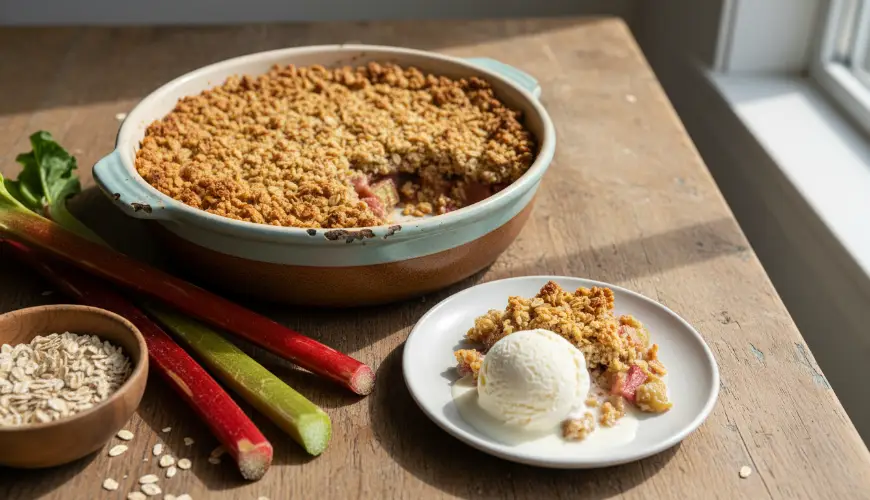
There are recipes that are passed down from generation to generation, yet retain their charm regardless of culinary trends. Rhubarb crumble with oat topping is exactly such a dish – simple, honest, and incredibly satisfying. Whether you know it as your grandmother's Sunday dessert, or tasted it for the first time in a cosy café, its tart rhubarb hidden beneath a golden, crispy crumble topping can warm the heart even on the greyest of days.
Crumble as such originates from Britain, where it began to be prepared during the Second World War as a practical substitute for cake pastry – flour, fat and sugar were rationed, so cooks looked for economical ways to use seasonal fruit. The result was a dessert so delicious that it survived the war, the post-war prosperity, and the arrival of modern patisserie culture. Today, crumble is a firm part of British culinary heritage and is slowly making its way into Czech kitchens, where rhubarb has always been one of the most beloved spring ingredients.
Try our natural products


Why rhubarb is such an exceptional ingredient
Rhubarb holds a completely special place among vegetables – yes, botanically it is a vegetable, even though we use it as a fruit. Its distinctive tartness comes from oxalic and malic acids, which give it that unmistakable, slightly sharp character. It is precisely this tartness that makes it the ideal partner for a sweet crumble topping: the contrast of flavours is what makes crumble so addictive.
Rhubarb is also surprisingly nutritious. It contains fibre, vitamin K, potassium and antioxidants. According to information available on Healthline, regular consumption of rhubarb may help support digestion and bone health thanks to its calcium and vitamin K content. Of course, in combination with sugar and butter it doesn't become a health superfood, but the awareness that the base of the dessert consists of something so natural and seasonal adds to the value of the crumble.
Rhubarb season lasts approximately from April to June, with the most tender and least fibrous being the spring variety. If you grow it in your garden, you certainly know how quickly and willingly it grows – almost without any care. That is precisely why rhubarb was for centuries a staple of rural cuisine. Older stalks tend to be tougher and more sharply tart, while young, pink shoots are more delicate and have a milder flavour. Both are suitable for crumble – it simply depends on how much sugar you add to the filling.
It is important to note that rhubarb leaves are poisonous and must not be consumed under any circumstances. Only the stalks are used, which are thoroughly washed, trimmed and cut into pieces. This basic information belongs in every recipe featuring rhubarb, as children in particular may be attracted by the bright green or red leaves.
The secret to a perfect oat crumble topping
While rhubarb forms the heart of this dessert, the crumble is its soul. And it is precisely the addition of oat flakes that transforms an ordinary crumble into something truly exceptional. A classic crumble consists of flour, butter and sugar, but oat flakes bring a new dimension of texture – they are what provides that unforgettable crunchiness that persists even after the crumble has been sitting on the plate, drenched in vanilla ice cream, for several minutes.
The foundation of the crumble is based on a ratio that cooks around the world agree on: approximately two parts flour to one part butter and one part sugar. Oat flakes are then added in roughly the same quantity as the flour, or even more, depending on personal preference. It is important to use good quality, wholegrain oat flakes – these will retain their structure during baking and will not turn into a mushy mass. Finely ground instant oats are not well suited to this purpose.
The butter should be cold and cut into small cubes. Working cold butter into the dry mixture with your fingers – the so-called "rubbing in" technique – creates irregular lumps of varying sizes, and it is precisely these that are the key to the ideal texture of the baked crumble. If the butter softens too much, the crumble will fuse together during baking into a single lava-like layer without that beautiful, bumpy structure.
Many modern recipes recommend adding a pinch of cinnamon, ginger or nutmeg to the crumble. These spices complement the tartness of the rhubarb beautifully and add a warmth that makes crumble an ideal dessert for both autumn and spring. Some cooks also add a few almonds or walnuts for an even richer flavour profile.
As British cook Nigel Slater, whose books on simple cooking have achieved cult status, once remarked: "Crumble is a pudding for people who like food more than decoration." And there is something to that – crumble doesn't look particularly spectacular, but its flavour speaks for itself.
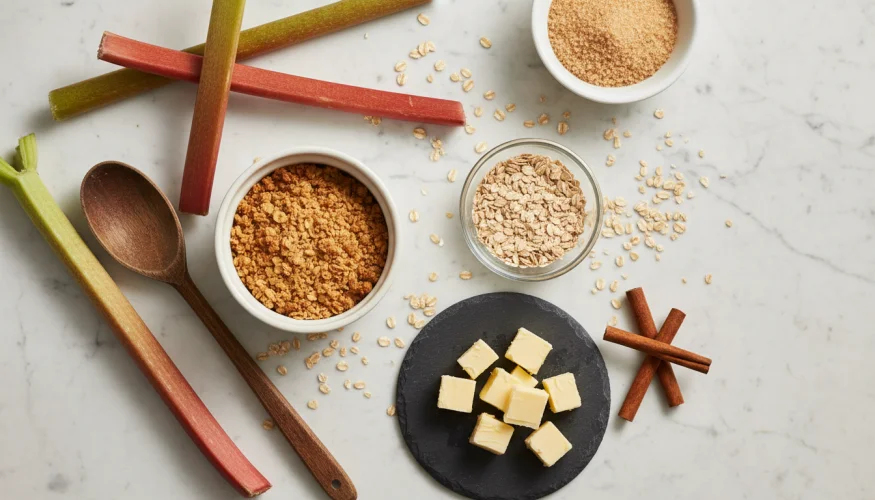
How to properly prepare and bake a crumble
The entire process of preparing rhubarb crumble with oat topping is surprisingly straightforward, yet there are a few details that make all the difference. It always begins with the filling. The rhubarb is cut into approximately two-centimetre pieces and mixed with sugar – the quantity depends on the tartness of the particular rhubarb and on personal taste. A rough guide is approximately 100 to 150 grams of sugar for every 500 grams of rhubarb. Some cooks also add a tablespoon of starch or cornflour, which thickens the juice released during baking and prevents the finished dessert from being too watery.
A great tip shared by many experienced bakers is to let the cut rhubarb rest with the sugar for 20 to 30 minutes before baking. During this time, some of the juice is released, which can simply be drained off, and the resulting filling will not be excessively liquid. Rhubarb also lends itself well to combining with strawberries, raspberries or cherries – these fruits add natural sweetness and a beautiful colour that shines through from beneath the golden crumble topping.
The baking dish should be deep enough – ideally at least five centimetres – to accommodate both the filling and the crumble topping. Pour the rhubarb into the dish, cover it evenly with the crumble, and bake in a preheated oven at 180 to 190 degrees Celsius for approximately 35 to 45 minutes, until the crumble is golden and the juice begins to bubble around the edges of the dish. That bubbling is a reliable sign that the crumble is ready.
It is served warm, and this is perhaps the most important rule of the entire recipe. Warm crumble with a scoop of vanilla ice cream or cold whipped cream is a combination that works perfectly precisely because the temperature contrast enhances both components. If the crumble cools down, it can simply be reheated in the oven or microwave – the crumble topping will lose a little of its crunchiness, but the flavour will remain just as wonderful.
An interesting variation that is becoming increasingly popular is gluten-free rhubarb crumble. In this case, the wheat flour is replaced with almond flour or buckwheat flour, and the oat flakes must be certified gluten-free – standard oat flakes are often contaminated with gluten during processing. The result is surprisingly delicious, and almond flour actually enriches the texture of the crumble topping with a subtle nutty flavour.
For those looking for a vegan option, substituting the butter is straightforward – coconut oil or good quality plant-based fat works very well. Coconut oil also adds a subtle exotic aroma that pairs surprisingly well with rhubarb. When using plant-based fats, however, it is important that they are solid and well chilled, otherwise the crumble topping will not come together properly.
Rhubarb crumble with oat topping is also one of those recipes that invites experimentation. Try adding a teaspoon of freshly grated ginger to the filling – it complements the rhubarb beautifully and adds a slightly spicy note. Or try using a tablespoon of good quality honey in place of some of the sugar, which gives a more complex, deeper sweetness. There are truly many possibilities, and every household will gradually find its own favourite version.
Imagine a typical Sunday afternoon in spring – the garden is full of the first greenery, the kitchen smells of freshly cut rhubarb, and the oven is slowly warming up. That is precisely the atmosphere this dessert brings. It is no coincidence that crumble has become a ritual in many families – something prepared whenever the first rhubarb appears in the garden, drawing the whole family together around the table.
From a sustainability and ecological cooking perspective, rhubarb crumble is an almost ideal dessert. Rhubarb is one of the least demanding crops – it requires almost no treatment, grows without pesticides, and is available locally throughout virtually all of Central Europe. Oat flakes are likewise an ingredient with a relatively low environmental impact compared to exotic ingredients. If we add butter from local farmers and sugar from domestic sugar beet, the result is a dessert with a truly minimal carbon footprint. This aspect is particularly appreciated by those who strive to cook responsibly and with consideration for the environment – and it is precisely such people that Ferwer is designed for.
Rhubarb crumble with oat topping is not just a recipe – it is a way of thinking. A way of thinking that prioritises seasonality, simplicity and quality ingredients over complexity and ostentation. It is a reminder that the best things in life – and in the kitchen – do not require complex techniques or expensive ingredients. All it takes is an oven, a few basic ingredients, and a willingness to devote a little time to something that will delight not only the taste buds, but the soul as well.