

Turkish get-up is a full-body exercise in a single movement
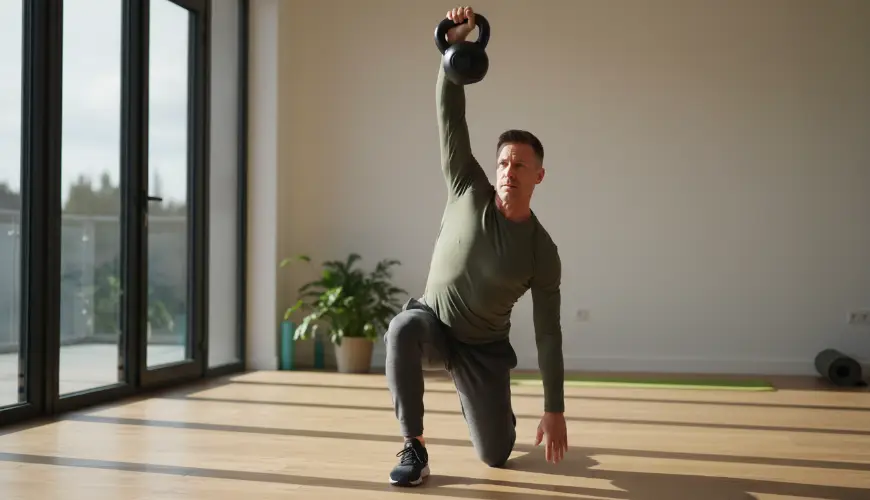
There are exercises that look simple but hide surprising depth within them. The Turkish Get-Up is exactly such a movement – at first glance it is merely getting up from the ground, but in reality it is one of the most complex exercises the human body can perform. It is no coincidence that it is used by rehabilitation therapists, elite athletes, and functional training enthusiasts around the world alike.
The Turkish Get-Up has its roots in Ottoman strength training tradition. According to historical records, it was used by Turkish wrestlers as fundamental strength and mobility preparation. Today it ranks among the favourite tools of kettlebell coaches, physiotherapists, and sports scientists. And the reason is simple: the Turkish Get-Up is one of the few exercises that truly works the entire body in one fluid movement.
Try our natural products




What exactly the Turkish Get-Up is and why it is so exceptional
The basic idea of the exercise is seemingly straightforward – you lie down on the ground, hold a weight in one hand (most commonly a kettlebell or dumbbell), and then smoothly stand up without lowering the weight or losing control of the movement. You then repeat the entire procedure in reverse and return to the ground. The full cycle takes beginners a minute or more.
What makes this exercise so exceptional is its complexity and synergy of movement patterns. While most classic exercises isolate one muscle group – the bench press works the chest, the squat the legs, the deadlift the back – the Turkish Get-Up engages practically everything at once. Shoulder stabilisers, deep abdominal muscles, hip flexors, gluteal muscles, thigh and calf muscles, as well as muscles along the spine and between the shoulder blades. It simultaneously trains coordination, balance, proprioception, and joint mobility. It is therefore truly a full-body exercise in the most literal sense.
Renowned physiotherapist and author Gray Cook, who stands behind the Functional Movement Screen (FMS) system, described the Turkish Get-Up as one of the best tests of a person's overall movement quality. If you can perform it cleanly and without pain, it is a good signal that your body is functioning as a whole. If not, the exercise will reveal precisely those areas that need attention.
This diagnostic function is one of the things that sets the Turkish Get-Up apart from other exercises. It is not just training – it is simultaneously feedback about the state of your body. People with limited thoracic spine mobility will feel it immediately. Those with weak shoulder stabilisers will find the weight overhead beginning to oscillate dangerously. And anyone with shortened hip flexors will struggle with the transition into the lunge position.
Take Jan as an example, a forty-four-year-old office worker who started the Turkish Get-Up after years of neglecting movement. At first he was unable to complete even a single repetition without losing his balance or feeling tension in his shoulder. After six weeks of regular practice – three times a week, always just a few repetitions – he noticed that his back had stopped hurting during long periods of sitting, his coordination had improved, and he generally felt more mobile. No other exercise in his routine had brought such rapid and visible change.
How to perform the Turkish Get-Up correctly
Proper technique is absolutely essential in the Turkish Get-Up. A poorly executed movement can load the shoulder or spine in undesirable ways. It is therefore always better to start without weight or with minimal load and only gradually add resistance.
The entire movement consists of several phases that flow smoothly into one another. First, you lie on your back, bend the leg on the side where you are holding the weight, and extend the other leg out to the side at an angle of approximately 45 degrees. The weight is held extended above your chest, the elbow is locked, and your gaze is directed at the weight throughout the entire exercise. You then use the support of your free elbow and palm to gradually rise to a seated position, transition into a single-knee position, and finally stand fully upright. You then proceed back in exactly the reverse order.
Keeping your gaze fixed on the weight throughout the entire movement is not merely an aesthetic matter – it is a safety mechanism that helps keep the weight stable above the body and simultaneously activates the deep stabilisers of the cervical spine. As soon as you begin tracking the weight with your eyes, your body naturally responds and better coordinates the entire movement.
Beginners are advised to start with an empty hand or a light object, such as a folded blanket or a plastic water bottle. The goal in the initial phase is not load, but understanding the movement pattern. Only when the movement is clean and fluid does a kettlebell or other weight come into play. Most experienced coaches recommend that men start with a kettlebell of around 8 to 12 kilograms, and women 4 to 8 kilograms – always with regard to individual fitness and movement experience.
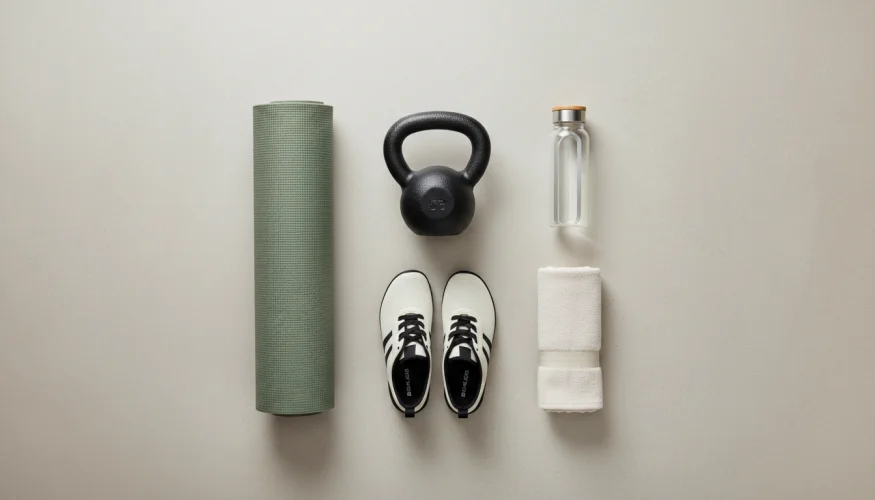
Interestingly, the Turkish Get-Up requires no equipment beyond a weight, no gym, and no special mat. It can be practised virtually anywhere – at home, outdoors, on holiday. This makes it an ideal exercise for people who do not have the time or inclination to visit a fitness centre but still want to care for their body in a comprehensive way.
If you are interested in the scientific basis, research published in the Journal of Strength and Conditioning Research, for example, repeatedly confirms that complex multi-joint movements are significantly more effective in terms of functional strength and mobility development than isolated machine exercises. The Turkish Get-Up is, in this respect, a prime example of such a movement.
Why to include it in your daily routine
One of the greatest strengths of the Turkish Get-Up is its transferability to real life. The movement from the ground to standing – and back – is something people do every day. We get out of bed in the morning, pick things up from the floor, play with children on the carpet, work in the garden. The Turkish Get-Up trains precisely these natural movement patterns and strengthens the body in a way that manifests in everyday functioning.
As Pavel Tsatsouline, one of the pioneers of kettlebell training in the West, says: "Strength is a skill." And the Turkish Get-Up is a skill par excellence – the more you practise it, the better you master it, and the more your overall movement quality improves.
From a injury prevention perspective, the exercise is particularly valuable for shoulder and spine health. Regular practice of the Turkish Get-Up strengthens the rotator cuff of the shoulder, an area that suffers in many people due to sedentary work and poor posture. It simultaneously activates the deep spinal stabilisers – muscles that classic sit-ups or press-ups cannot engage as effectively.
For older populations, the Turkish Get-Up is particularly interesting. Research shows that the ability to rise from the ground without the assistance of one's hands is one of the predictive indicators of longevity and overall health. Brazilian physician Claudio Gil Araújo published a remarkable study in the European Journal of Preventive Cardiology in this regard, which demonstrated a direct connection between the ability to rise from the ground and length of life. The Turkish Get-Up systematically develops and maintains this ability.
Another reason the exercise deserves attention is its positive effect on mental focus. Because each phase of the movement requires full attention, it is impossible to think about anything else during the Turkish Get-Up. It is movement meditation in the most practical sense of the word. Many practitioners describe how regular practice helps them calm their minds and improve their ability to concentrate even outside of training.
In terms of incorporation into a training plan, the Turkish Get-Up works well as a warm-up exercise, as the main part of a workout, or as a finisher. Just 3 to 5 repetitions on each side is enough to give the body a thorough workout. With heavier loads, even one to two repetitions per side can present a challenge worthy of respect. Training frequency depends on intensity – with lighter loads it can be done every day, with heavier loads two to three times per week with sufficient recovery.
It is also interesting that the Turkish Get-Up naturally reveals asymmetries between the left and right sides of the body. Most people discover that one side is more mobile or stronger than the other – and this is valuable information that helps prevent injuries caused by uneven loading. Working on the weaker side then naturally leads to an overall balancing of the body.
In an era when the market is flooded with complex training programmes, expensive machines, and endless lists of exercises, it is refreshing to know that there is one movement that can substitute for many. The Turkish Get-Up is not a passing trend or a marketing trick – it is movement wisdom that has survived centuries and continues to prove its value time and again. Whether it concerns strength, mobility, coordination, injury prevention, or mental focus, this exercise offers more than might appear at first glance. And all of this in a single, elegant movement from the ground to standing.