

# How to Train Your Dog Upside Down Without Wrist Pain
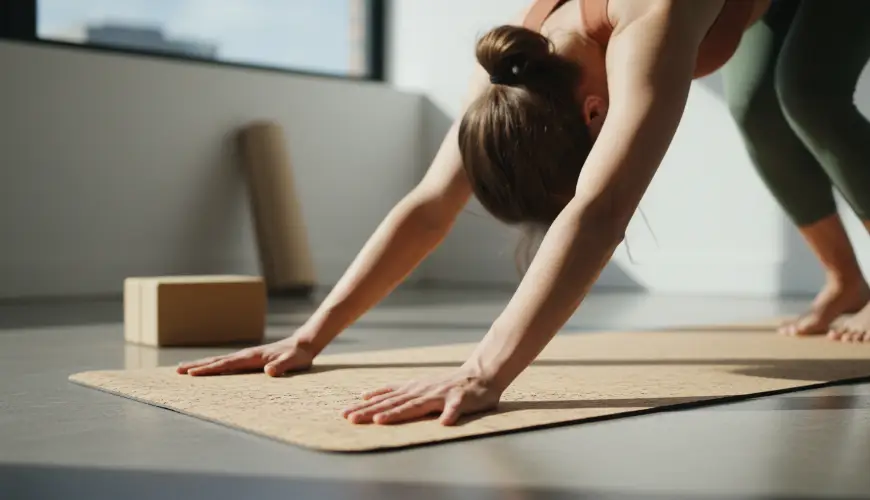
Everyone who has ever been through a yoga class knows that moment when the instructor says in a calm voice: "And we'll move into downward-facing dog." For some, it's a moment of relief, because this position truly can stretch the entire body wonderfully. For others, it's a moment of quiet dread – not because of the legs, not because of the back, but because of the wrists, which begin to protest almost immediately. Wrist pain in downward-facing dog is one of the most common problems yoga practitioners face, and yet it's one that can be significantly reduced or completely eliminated with the right approach.
Downward-facing dog, in Sanskrit Adho Mukha Svanasana, is a foundational pose that appears in virtually every style of yoga. The body forms an inverted letter V – the palms are firmly on the mat, the heels reach toward the ground, and the hips point as high as possible. The pose stretches the hamstrings, calves, shoulders, and spine, strengthens the arms, and simultaneously calms the nervous system. However, precisely because a significant portion of the body's weight falls on the wrists, these joints are exceptionally susceptible to overload – especially if the technique is incorrect or if the practitioner comes with already weakened or tense wrists, perhaps after a full day of working at a computer.
Try our natural products


Why wrists hurt and what lies behind it
The wrist joint is a structurally very complex structure. It is formed by eight small carpal bones, numerous ligaments, tendons, and nerves, where everything must work together like a precise mechanism. When a person spends eight hours a day with their hands on a keyboard or holding a phone, the forearm flexors gradually shorten and the wrist loses its full range of motion. Then yoga comes along, suddenly demanding that the wrists bear the weight of the upper half of the body in a ninety-degree extension – and the result is often an unpleasant burning sensation, pressure, or sharp pain.
The problem, however, often has nothing to do with the wrist itself. How weight is distributed throughout the entire pose matters greatly. If the practitioner doesn't distribute the load evenly across the entire palm and instead lets it collapse into the heel of the hand, the pressure on the carpal bones multiplies. Likewise, weak core muscles or insufficient shoulder activation cause the arms to bear more than they should. In other words – wrist pain in downward-facing dog is often a symptom whose cause lies elsewhere in the body.
Consider Martina, a thirty-year-old accountant from Prague, who started going to yoga to relieve back tension. At first, she didn't notice the wrist pain because the classes only lasted a short while. After several months of regular practice, however, she began to feel an unpleasant pressure that persisted even after class ended. The instructor noticed that Martina was transferring all her weight into the base of her palms in downward-facing dog, with her fingers passive and almost uninvolved. A few corrections to her technique were all it took, and the pain subsided significantly within two weeks.
Martina's story is not exceptional. It shows how crucial a role conscious body awareness and precise technique play. As the famous yogi B.K.S. Iyengar said: "Yoga is the mirror that allows us to see ourselves from within." And it is in downward-facing dog that this mirror shows itself with particular clarity.
How to practice downward-facing dog correctly without wrist pain
The foundation is what's called an active palm base. As soon as the practitioner places their hands on the mat, they should imagine having a small suction cup in each palm. The fingertips and the knuckles at the base of the fingers actively press into the mat, while the center of the palm remains slightly lifted. In this way, the weight is redistributed across the entire surface of the hand, and the wrist ceases to be the sole point of contact bearing all the load. Practicing this principle first in a tabletop position, where the load is lighter and conscious finger engagement can be better felt, is worthwhile.
The orientation of the hands also matters. The fingers should point straight forward or be slightly spread to the sides – never inward. The distance between the palms should correspond to shoulder width, though for people with narrower shoulders, a slightly wider spread may be more beneficial. The wrist creases should be parallel to the front edge of the mat. These seemingly minor details have a surprisingly large impact on how the joint perceives the load.
Another key element is activating the entire arms. The practitioner should feel as though they are trying to spread the mat apart sideways – this engages the forearm and shoulder muscles, creating natural stabilization of the entire chain from the palm to the shoulder girdle. The shoulder blades should not drift toward the ears, but rather be gently drawn downward and apart. This activation transfers some of the weight higher into the torso and significantly reduces pressure on the wrists.
If difficulties persist even after correcting technique, there are several effective modifications. A folded mat or a special yoga wedge under the palms reduces the angle of wrist extension and provides immediate relief. Alternatives include yoga blocks or the so-called neutral wrist position on fists – the pose is then practiced with fists firmly on the mat, placing the wrist in a more neutral position. This approach is particularly suitable for beginners or those going through rehabilitation.
Preparation before the actual practice is equally important. Brief wrist mobilization – circling, gently stretching the forearm flexors with the hand turned fingers-backward and the palm on the mat, or exercising with resistance bands – can significantly increase range of motion and prepare the tissues for load. According to recommendations from experts at Harvard Health Publishing, regular forearm stretching is one of the most effective preventive measures for wrist problems arising from repetitive strain.
It is equally advisable to pay attention to core strength. Strong abdominal muscles and spinal stabilizers help maintain balanced weight distribution, so the arms and wrists are not forced to compensate for insufficient trunk support. Downward-facing dog is, after all, a full-body exercise – not merely a stretch for the legs and back.
Accessories and daily habits that make a difference
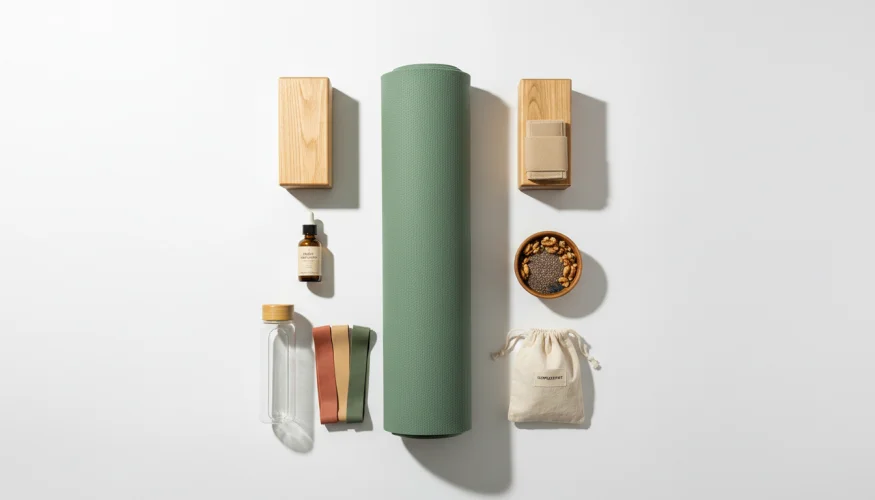
The choice of mat plays a greater role than it might initially seem. A thin, slippery mat doesn't allow the fingers to firmly engage with the surface, whereas a quality non-slip yoga mat with adequate thickness provides a stable base and cushions some of the impact. For those who suffer from chronic wrist pain, yoga mats with a gel layer or supportive straps and bandages are also available, which can be used as a temporary aid during healing – but not as a permanent solution, as excessive fixation can weaken the joint's natural stabilizers.
Everyday ergonomics is also worth mentioning. If a person works at a computer all day, the height of the keyboard and mouse is crucial. The wrists should be in a neutral position – not bent upward or downward. Regular breaks during which the practitioner stretches and shakes out their hands can be just as important as the yoga practice itself. Wrist health is built – or conversely undermined – throughout the entire day, not only on the mat.
Diet and hydration also have their influence. Collagen, which forms the basic building block of connective tissue in joints, can be supported by intake of vitamin C, zinc, and protein. Omega-3 fatty acids found in, for example, flaxseed, chia seeds, or walnuts contribute to reducing inflammation in joint tissue. An adequate fluid intake then ensures that joint cartilage remains hydrated and flexible.
Yoga should be a source of wellbeing, not pain. If wrist pain persists even after adjusting technique and implementing preventive measures, consultation with a physiotherapist or sports medicine doctor is appropriate. Sometimes what appears to be a trivial pain conceals carpal tunnel syndrome, tendinitis, or another structural cause that requires professional care. Ignoring persistent pain and practicing through it rarely brings improvement – quite the contrary.
Downward-facing dog is among those poses that can accompany a practitioner throughout their entire life, bringing ever new layers of experience and strength. It simply needs a little more attention, patience, and correct technique – and the wrists will transform from an obstacle into a firm foundation for the entire pose.