

Dinner in 15 Minutes from Local Ingredients to Save Weekday Evenings After Work
An evening after work often looks similar: one opens the fridge, stares at the shelves for a while, and two desires tug at the mind – to eat quickly while also eating deliciously and healthily. Add fatigue, kids, homework, sports, or just the plain need to finally unwind. And here is where the space opens for a simple yet surprisingly strong idea: dinner in 15 minutes using local ingredients. Not as a cooking competition, but as a realistic way to maintain energy, budget, and a relationship with what we eat.
Local ingredients are not just the "romance of farmer's markets." Often, it means practicality: potatoes, eggs, root vegetables, cabbage, legumes, cottage cheese, yogurt, seasonal herbs – things that can be bought almost anywhere, last longer in the fridge than exotic fruits, and most importantly, can be turned into surprisingly varied dinners. Add a few clever shortcuts, and fifteen minutes is more than enough.
In debates about healthy eating, it sometimes seems that either one cooks for a long time and thoroughly, or resorts to pre-packaged foods. Yet, reality is subtler. Quick dinners can easily be based on basic ingredients, without unnecessary additives, and with flavors that won't offend even a more discerning palate. It's also more planet-friendly – shorter supply chains often mean less transport burden, though of course, it depends on specific conditions. For a broader context on more sustainable eating, one can rely on FAO materials on sustainable food systems or nutrition and diet composition overviews from WHO.
Try our natural products




Why quick dinners with local ingredients make sense even on weekdays
The biggest obstacle is paradoxically the expectation. It's often assumed that a "proper" dinner must be complex, otherwise it's just a quick fix. But tasty and healthy food is more about balance than the number of steps in a recipe. In practice, it means having something filling on the plate (potatoes, whole-grain bread, buckwheat), something protein-rich (eggs, legumes, cottage cheese, fish), and something vegetable-based (fresh, fermented, quickly sautéed). It sounds like a guideline, but in reality, it's a simple framework that helps make quick decisions.
Local ingredients also support natural seasonality. In the spring, radishes, spinach, and herbs are available; in summer, zucchinis and tomatoes; in autumn, pumpkins and apples; in winter, root vegetables and cabbage. And seasonal things tend to have a more pronounced flavor, so they don't need as much "masking" with sauces or sugar. As the saying goes: when the ingredient is good, half the recipe is done.
A real-life example? A typical situation: on Thursday at 6:30 PM, the family gathers at home, hunger grows, and time is short. Leftover boiled potatoes from lunch, a tub of plain yogurt, a bunch of spring onions, some sauerkraut, and eggs are in the fridge. Instead of ordering pizza, a potato skillet with egg and a yogurt dip with herbs can be made in no time. Kids can add cucumber, adults a bit of chili. Done, warm, filling, and it doesn't look like a stopgap meal.
And if anyone argues that fifteen minutes is unrealistic, a slight change in mindset helps: it's not about doing everything from scratch, but having a few things ready. Cooked potatoes in the fridge, cooked lentils, a jar of fermented vegetables, eggs, cottage cheese – these are small "anchors" that speed up cooking more than any kitchen trick.
Specific tips and recipes for quick dinners in 15 minutes
The following ideas are designed to be made from commonly available ingredients from the Czech Republic and surrounding areas. Of course, they can be varied according to the season and what’s left at home. And yes, it assumes that local ingredients aren't always just "organic from the farm," but can also be ordinary potatoes from the market, eggs from neighbors, or cottage cheese from the nearest shop.
Potato skillet with egg, onions, and sauerkraut (10–12 minutes)
When boiled potatoes are on hand (perhaps from yesterday), it's one of the fastest dinners ever. A little oil or butter is heated in a pan, diced onion is added, and after a minute, potatoes sliced into rounds. Salt, pepper, add caraway seeds – they pair beautifully with cabbage. Place sauerkraut on the side (or briefly heat it in the pan). Finally, crack an egg into the pan and let it set to taste.
The result is a quick dinner that is nonetheless hearty: potatoes are filling, eggs provide protein, and cabbage brings freshness and natural "sour" taste. Whoever wants can add a teaspoon of mustard or chopped chives.
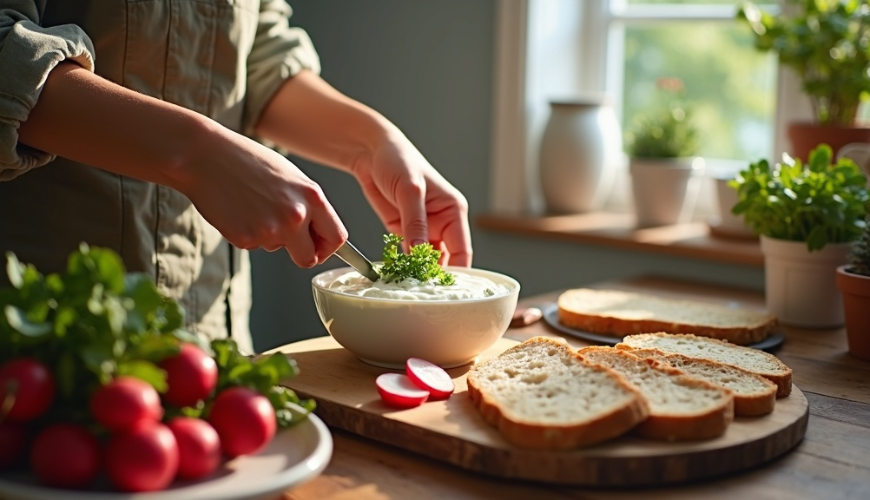
Savory cottage cheese bowl with radishes and rye bread (8–10 minutes)
Cottage cheese is somewhat underrated in Czech cuisine, yet it's an ideal base for tasty and healthy dinners. Into a bowl, cottage cheese, a spoonful of plain yogurt for smoothness, salt, pepper, caraway seeds, or dried garlic. Add chopped chives, spring onions, and sliced radishes. Serve with rye bread or sourdough.
This is the type of food that's so simple, it surprises how well it works. And if there’s cucumber, tomato, or leftover pickles at home, the dinner gains another dimension without any extra effort.
Quick lentil "skillet" with garlic and marjoram (12–15 minutes)
Whoever has cooked lentils in the fridge (or at least canned lentils without unnecessary additives) has it made. Briefly sauté onions in a pan, add lentils, crushed garlic, marjoram, salt, and pepper. If needed, add a splash of water or broth. Pickled vegetables, pickled cucumbers, or leftover cabbage go well with it.
It's filling, cheap, yet surprisingly "homemade" food. And for those who like stronger flavors, just add a teaspoon of mustard or a drop of apple cider vinegar.
Omelet with seasonal vegetables and herbs (10–12 minutes)
Eggs are a local classic, and omelets are grateful in that they can take almost anything. Briefly toss seasonal vegetables in a pan: spinach in spring, zucchini in summer, perhaps grated carrot in autumn. Whisk eggs in a bowl, salt, pepper, add herbs. Pour into the pan, let set, and fold if desired.
When a teaspoon of sour cream or a piece of cheese is added, the omelet gains creaminess. And when a few salad leaves are tossed on the plate, the dinner looks like it’s from a bistro – just without the wait.
Warm buckwheat "salad" with apple and cheese (15 minutes)
Buckwheat is perceived as healthy but sometimes "boring." Yet it takes little: cook the buckwheat (there are even quick-cook types), meanwhile briefly sauté onions in a pan, add diced apple and a pinch of cinnamon (just lightly). Mix with the buckwheat and finally add a piece of cheese – perhaps farmer's, Balkan-style, or cottage cheese. Salt, pepper.
It sounds unusual, but the combination of apple, onion, and buckwheat works surprisingly well. Moreover, it's a nice example of how local ingredients can be assembled into a dish that isn't "just" a Czech classic.
Quick smoked mackerel (or trout) spread with horseradish (10 minutes)
Fish are often considered complicated, but smoked fish is a shortcut that makes sense. Smoked mackerel (or trout) is flaked, mixed with cottage cheese or cream cheese, added grated horseradish, lemon juice, pepper. Serve with bread and vegetables.
It's quick, flavorful, and filling. And if fish from verified sources are chosen, it’s also a good step towards a more balanced diet.
Cabbage "mini-skillet" with caraway seeds and egg (12–15 minutes)
When there's a head of cabbage at home (or already shredded), it’s a winter treasure. Sauté onions in a pan, add shredded cabbage, salt, caraway seeds, a little water, and briefly simmer so it stays slightly crunchy. Finally, add eggs – either scrambled or just let them "poach" directly in the pan.
It tastes like something between a quick version of a classic and a modern "bowl" meal. And mainly: cabbage is often cheap, local, and of excellent quality in season.
One practical list that saves time all week
To ensure quick dinners in 15 minutes aren't a lottery, having a few certainties at home helps. It's not about perfect supplies, rather small assurances:
- eggs, cottage cheese, plain yogurt
- potatoes, onions, garlic
- sauerkraut or fermented vegetables in a jar
- legumes (lentils, chickpeas) – ideally already cooked or quality canned
- seasonal vegetables (what lasts: carrots, beets, cabbage; what quickly disappears: salad, herbs)
These few things turn dinner into more of a puzzle than a project.
Local ingredients as a flavor shortcut, not an obligation
Localism is sometimes communicated as a moral duty. Yet, in the kitchen, it works better as inspiration. When cooking with what grows nearby and what is in season, food tends to be naturally simpler. There’s no need to seek complex combinations because ingredients themselves tend to taste "fuller." Plus, one connects more with the rhythm of the year – lighter dinners in summer, heartier skillets and legumes in winter. Perhaps that's why so many people are rediscovering ordinary things like cabbage, buckwheat, or cottage cheese.
Add to this the issue of waste. When dinner consists of a few basic ingredients, the need for single-use packaging and "mysterious" additives often disappears. As a well-known phrase captures, which can be found in various forms: "Eat food. Not too much. Mostly plants." (Michael Pollan). It’s not dogma, more of a reminder that simplicity can be surprisingly effective.
And what if someone says: "But I don't have the time or energy to plan"? Then maybe the best start is with one single change: choose two or three dinners that will rotate and gradually vary them according to the season. The potato skillet can once be with an egg, another time with cottage cheese and herbs, the third time with lentils. The omelet can be spring with spinach, summer with zucchini, winter with cabbage. That’s the magic – specific tips and recipes for quick dinners in 15 minutes aren’t about learning something new every day, but relying on a few sure combinations.
Then when the fridge is reopened in the evening, instead of staring helplessly, a quite ordinary yet pleasant question appears: what from these local things gets a chance today? And fifteen minutes suddenly doesn’t feel like a limit but a liberating framework, ensuring dinner doesn’t take up the whole evening – and still tastes good enough to look forward to.