

Forget the myths about how much water the body really needs

Eight glasses a day. This number is known to virtually everyone who has ever taken an interest in a healthy lifestyle. It appears in magazines, on water bottle labels, in doctors' advice and in trainers' recommendations. But where does it actually come from? And what if the whole idea is far more complex than it first appears?
The truth about hydration is surprisingly nuanced, and science has revealed over the past few decades that the relationship between water and the human body cannot be reduced to a simple rule. The human body is, in fact, an extraordinarily intelligent system that manages hydration far better than most popular recommendations give it credit for.
Try our natural products
What the body actually does with water
Water makes up approximately 60% of an adult's body weight and is present in literally every biological process that takes place in the body. It regulates body temperature, transports nutrients and oxygen to cells, removes waste products, lubricates joints, and forms the basis for digestion and food absorption. Without sufficient water, the kidneys would be unable to filter blood, the brain would be unable to process information efficiently, and muscles would fatigue far more quickly.
Interestingly, the brain and heart are composed of approximately 73% water, the lungs about 83%, and even seemingly solid bones contain around 31% water. These figures illustrate well why hydration is so fundamental to overall health. Research published in the scientific journal Nutrients has repeatedly shown that even mild dehydration equivalent to a loss of just 1–2% of body weight can negatively affect cognitive function, mood, and physical performance.
Nevertheless, it is important to distinguish between what the body truly needs and what various health campaigns present to us as unquestionable truth. Hand in hand with the growing interest in wellness, a whole range of myths has emerged that sound convincing but have little to do with scientific reality.
Where the eight-glasses rule comes from and why it is misleading
The story of eight glasses of water a day is a fascinating example of how a simplified recommendation can transform into a widely accepted fact. Its roots go back to 1945, when the American Food and Nutrition Board recommended an intake of approximately 2.5 litres of water per day. But what was lost in the popular retelling was the crucial addendum: a large portion of this water comes from the food we eat.
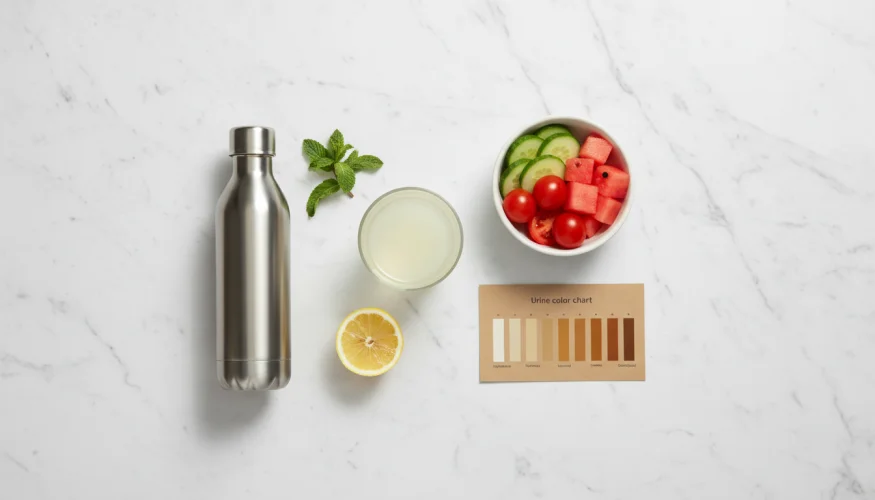
Fruit, vegetables, soups, yoghurts, tea, coffee – all of these contribute to the body's overall daily hydration. Cucumber contains over 95% water, tomatoes over 94%, and watermelon approximately 92%. A person eating a balanced diet rich in fresh foods may obtain 20–30% of their total daily fluid intake from food alone, without even being aware of it.
Harvard physician and researcher Heinz Valtin examined this question in detail and in 2002 published a review study in the American Journal of Physiology in which he found no scientific evidence supporting the eight-glasses rule as a universal standard for healthy adults. His conclusion was unambiguous: a healthy person who follows their natural sense of thirst is likely staying adequately hydrated.
This does not mean, however, that it is correct to drink as little as possible or to ignore thirst. The sense of thirst is a reliable signal in young and healthy individuals, but its sensitivity decreases with age. Older people often do not feel thirsty even when their bodies are mildly dehydrated, making them a higher-risk group. Similarly, athletes during intense exercise or people working in high temperatures need to consciously monitor their fluid intake, as the sense of thirst alone is insufficient to compensate for increased losses through sweating.
Everyone is surely familiar with the situation of forgetting to bring a water bottle on a longer outing on a hot summer day, only to be hit by fatigue, a headache, or a low mood upon returning home – even though they hadn't felt particularly thirsty an hour earlier. This is precisely where it becomes clear that relying solely on the sense of thirst is not always an ideal strategy, particularly under conditions of increased physical activity or heat.
How much water do we actually need
The answer, which surprises many people, is: it depends. And that is not an evasion, but a genuine reflection of how individual human hydration needs truly are.
Neither the World Health Organization nor any other recognised institution sets a single number applicable to everyone. The European Food Safety Authority (EFSA) recommends that women consume approximately 2 litres of fluids per day and men approximately 2.5 litres, with this referring to total intake including water contained in food. This is a considerably less dramatic figure than what circulates in popular media.
The following factors have the greatest influence on actual water needs:
- Body weight and composition – larger people and those with a higher proportion of muscle mass generally need more water
- Physical activity – during intense exercise, sweating can result in losses of 0.5 to 2 litres of water per hour
- Climatic conditions – hot and humid environments significantly increase fluid losses
- Health status – fever, diarrhoea, or vomiting can lead to rapid dehydration
- Diet – people who consume plenty of fruit and vegetables have a lower need for fluid intake through beverages
- Age – children and older people need to pay more conscious attention to hydration
As nutritional consultant and healthy eating author Kathleen M. Zelman puts it: "Your body is extraordinarily capable of maintaining fluid balance if you listen to it and no specific health factors are present."
A practical and scientifically supported indicator of adequate hydration is the colour of urine. Light yellow indicates good hydration, while dark yellow or amber signals a need to replenish fluids. This simple indicator is available to everyone and requires no counting of glasses.
Myths it is time to leave behind
One of the most widespread misconceptions is the belief that coffee and tea dehydrate the body and should not be counted towards total fluid intake. Research shows, however, that moderate consumption of coffee and tea has no negative effect on overall hydration. Caffeine does have a mild diuretic effect, but the amount of fluid in the beverage offsets or outweighs this effect at normal levels of consumption. A study published in PLOS ONE in 2014 confirmed that four cups of coffee per day have the same hydrating effect as the equivalent amount of water.
Another widespread myth is that drinking large amounts of water improves skin and removes wrinkles. Science does not support this claim. Healthy hydration is of course important for overall skin health, but excessive fluid intake beyond the body's actual needs has no demonstrable effect on skin appearance. The condition of the skin depends far more on genetics, UV protection, nutrition, and skincare than on the number of glasses of water consumed.
A third myth worth mentioning is the notion that hunger is actually thirst in disguise. This claim is spread primarily in weight-loss communities, with the recommendation to drink water whenever one feels like eating. The scientific evidence for this theory is very weak. Hunger and thirst are distinct physiological signals regulated by different mechanisms, and conflating them is not consistent with what we know about how the human body functions.
How to approach hydration sensibly
Rather than counting glasses and tracking exact millilitres, it is more meaningful to approach hydration with an awareness of one's own body and its needs. Drinking regularly throughout the day, particularly at mealtimes and during physical activity, is a sufficient strategy for most healthy adults. There is no need to force oneself to drink when thirst is not felt, but it is equally unwise to wait until strong thirst or fatigue sets in.
The quality of water plays as important a role as its quantity. Clean drinking water free of unnecessary additives is the foundation. For those who want assurance about the quality of the water they drink, good filtration systems or trusted spring waters may be a sound solution. An interest in the purity of drinking water naturally connects with a broader awareness of what we put into our bodies – the same principle that guides choices such as buying organic food or eco-friendly cosmetics.
Hydration is ultimately part of a larger whole when it comes to self-care. It is not a science accessible only to experts, but an everyday practice that requires no complex calculations or expensive supplements. It is enough to listen to the body, eat a varied diet rich in natural sources of water, and drink when the body needs it. Such an approach is not only scientifically grounded, but also sustainable and natural – and these are values worth keeping in mind not only when it comes to water, but in the whole way we live.