

Social fatigue is natural, not a personal failure

Have you ever come home after dinner with people you love and, instead of feeling joy and fulfillment, felt complete emptiness? Not sadness, not displeasure – just a deep, hard-to-explain exhaustion, as if someone had pulled your plug from the wall. This is exactly what millions of people around the world experience, and yet most of them think something is wrong with them. The truth, however, is different – and far more interesting.
The phenomenon of social fatigue – the exhaustion that comes after contact with other people, even those we love – has been the subject of growing interest among psychologists and neuroscientists in recent years. It is not coldness, disinterest, or a social disorder. It is a fundamental characteristic of how some people process the world around them.
Try our natural products




Introversion is not withdrawal, it is a way of recharging energy
Psychologist Carl Gustav Jung was the first to describe the concept of introverts and extroverts – not as personality types in a black-and-white sense, but as the way people draw and expend energy. Introverts recharge in silence and solitude, while extroverts gain energy from contact with others. This distinction is key to understanding why even the best company can be exhausting – not because it is bad, but because social contact itself costs energy that not everyone has in unlimited supply.
Modern research confirms and deepens this view. A study published in the Journal of Research in Personality showed that introverts display higher activity in brain regions associated with processing internal stimuli, while extroverted individuals respond more intensely to external stimuli. In other words, the introverted brain is constantly occupied with its own inner world, and when active social interaction is added on top of that, processing capacity is quickly depleted. This is not a weakness – it is simply a different hardware configuration.
Consider an example from everyday life: Jana works as a teacher, spending the entire day communicating with children, colleagues, and parents. After work, a friend invites her to a casual get-together that Jana had been looking forward to all week. She arrives, is glad to be there, enjoys herself – and yet after two hours she feels she must leave or she will fall apart. The next day she explains to her friend that she felt strange, and apologizes as if she had done something wrong. But Jana did nothing wrong. Jana is an introvert who simply reached her limit that day.
This scenario is surprisingly common and affects people in all professions and life situations. The problem is not the fatigue itself – that is natural. The problem is that society still perceives it as a social transgression or personal failure.
The social pressure to be constantly available and present is enormous in the modern world. We live in a culture that celebrates extraversion, networking, and the ability to be "energetic and present" under all circumstances. As writer and introvert advocate Susan Cain noted in her book Quiet, "in a world that can't stop talking, silence is a revolutionary act." Introverts are constantly given the message that their need for solitude is a problem to be overcome – rather than being respected as a legitimate part of their identity.
What happens in the brain and body during social fatigue
To understand why pleasant company exhausts us, it is useful to look at what happens on a physiological level during social interaction. Every conversation, every facial expression we interpret, every social signal we process – all of this requires cognitive effort. The brain must track context, tone of voice, facial expressions, and the content of words, while simultaneously formulating responses, monitoring social norms, and regulating its own emotions. For introverted individuals, who are naturally more sensitive to external stimuli, this work is more intensive than it is for their extroverted counterparts.
The nervous system also contributes to social fatigue. People with greater sensitivity – professionally referred to as Highly Sensitive Persons (HSP) – process sensory and emotional information more deeply and in greater detail. Psychologist Elaine Aron, who described this concept in her research available at hsperson.com, estimates that approximately 15 to 20 percent of the population has this trait. For these people, every social encounter is richer in experience, but also more demanding to process.
It is not true that sensitive or introverted people avoid social contact or dislike it. Many of them are excellent companions, empathetic friends, and sought-after colleagues. Yet after every such encounter, they need time to recover – just as an athlete needs rest after an intensive training session. Fatigue after a pleasant evening with friends is not a signal that the friends are not good enough or that the relationship is not working. It is simply a biological reality.
Interestingly, social fatigue also manifests physically. Headaches, a feeling of heaviness, inability to concentrate, hypersensitivity to sounds or light – these are all common accompanying symptoms. The body is signaling that it needs rest, just as it signals hunger or thirst. Learning to read and respect these signals is the first step toward social fatigue no longer surprising or unsettling us.
Another contributing factor is the type of social contact. Unstructured social gatherings – parties, large groups, situations without a clear agenda – are generally more demanding for introverted individuals than deep one-on-one conversations or meetings with a clear structure. This explains an apparent paradox: someone may spend three hours in an intense conversation with one close friend and feel relatively fine, but after an hour at a birthday party they are completely drained. It is not about the length of the encounter, but about its nature and the volume of stimuli that must be processed.
Modern life has added yet another layer to traditional forms of social contact: digital communication. Constant notifications, messages, comments, and reactions on social media are, in their own way, also a form of social contact that requires processing and response. For introverted or sensitive individuals, their total social load may therefore be far higher than they realize – even before they have left the house.
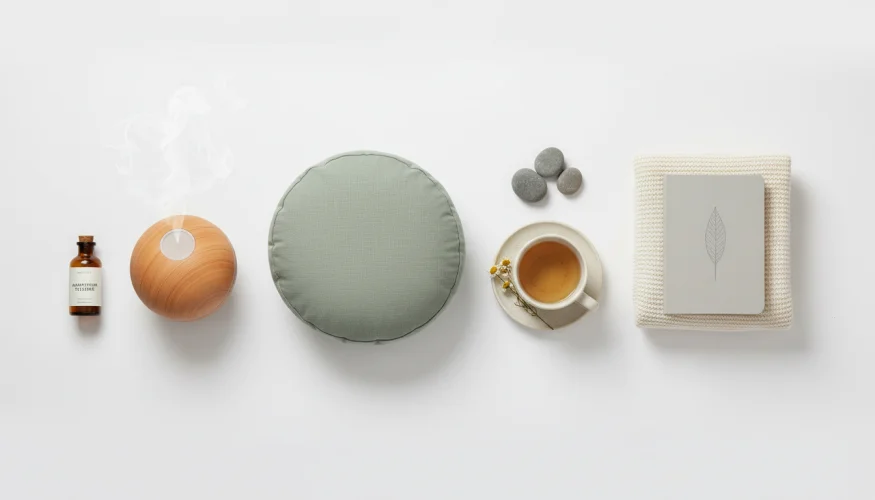
Self-care in this context does not mean withdrawing into oneself and refusing contact with people. It means consciously managing one's energy. Just as we pay attention to a healthy diet or adequate sleep, we must also pay attention to sufficient recovery time. Practical steps can be very simple: setting aside at least a moment of complete silence each day, reducing unnecessary social commitments, learning to say no without guilt, or simply consciously planning time for yourself after more demanding social events. Products that support relaxation and calm – such as natural adaptogens, aromatherapy tools, or meditation cushions – can be a useful aid in this process.
It is also important to talk about your needs with the people you spend time with. Healthy relationships are built on mutual understanding and respect, and that includes respect for different ways of processing social contact. Friends or partners who understand that your need to leave earlier or spend Sunday at home is not a personal insult, but a natural part of your character, are the right ones. And conversely – if we understand this need in ourselves and can explain it clearly, a great deal of unnecessary guilt and misunderstanding falls away.
Research also shows that the quality of social contact is more important for introverted individuals than its quantity. Studies from the University of Michigan have repeatedly confirmed that meaningful, deep relationships bring greater satisfaction and a sense of fulfillment than a large number of superficial contacts – and while this holds true for people in general, the effect is simply more pronounced in introverts. Less, but better – this is a principle that proves to be very wise in the context of social relationships and personal wellbeing.
Social fatigue is not a diagnosis or a problem that needs to be treated. It is a natural part of human diversity. The world needs people who can listen to silence, process depth, and bring attention and empathy to relationships – and it is precisely these people who are often the most exhausted by pleasant company. Accepting this part of oneself, learning to treat it with kindness and without shame, is perhaps one of the most important steps toward genuine wellbeing – the kind that requires no constant explaining or apologizing.
The next time you come home from a pleasant evening and need an hour of silence before you are capable of saying or doing anything, remember that this is not a flaw. It is your way of taking care of yourself – and that is something that deserves respect, not reproach.