
Do you know how to support birds in the garden and on the balcony
Every morning, when the windows open and the air fills with the song of blackbirds, tits or sparrows, we realise how much these small creatures add to our quality of life. Yet they are among those who face ever greater challenges in the modern age. The loss of natural habitats, chemical sprays in agriculture, the disappearance of old trees with hollows, and increasingly warmer winters – all of this is changing the conditions in which birds struggle to survive. The good news, however, is that each of us can make at least a small difference, even from a small balcony on the third floor of a tower block.
Interest in bird conservation has grown significantly in recent years. According to data from the Czech Society of Ornithology, the Czech Republic is among the countries where populations of many common bird species – such as skylarks, lapwings or swallows – have declined dramatically over the past thirty years. It is not just rare species that experts track with binoculars. Great tits, house sparrows and house martins – birds we see every day – are also struggling.
Nature is directly calling on us for help. And answering that call is neither costly nor complicated.
Try our natural products





What birds in the garden and on the balcony truly need
Before embarking on building a bird paradise, it is worth understanding what birds look for throughout the year. Their basic needs can be summarised in three areas: food, water and shelter. However, the way these needs should be met differs according to the season, the species and the specific environment – the approach to caring for birds in a rural garden with fruit trees differs from that in a densely built-up city.
Feeding birds in winter is a topic almost everyone knows. Bird feeders, fat balls, sunflower seeds – these are things many people remember from childhood. What is less well known is that feeding also makes sense in spring and autumn, when birds need energy for migration or are recovering from a demanding breeding season. In summer, on the other hand, it is advisable to reduce feeding, or at least offer only natural foods such as berries, seeds or insects, so that fledglings do not learn to depend on artificial food sources.
The quality of the food offered also plays a major role. Mouldy bread, salted nuts or sweets can harm birds more than help them. Ornithologists recommend above all sunflower seeds, millet, hemp seeds, suet and, in winter, dried berries. For thrushes and blackbirds, apples are a welcome treat – simply slice them and place on a feeder or directly on the ground.
Water is just as important as food, perhaps even more so. Birds need it not only for drinking, but also for cleaning their feathers, which is literally a matter of survival for them – properly maintained feathers insulate the body against the cold. A bird bath – a shallow container of clean water – should be available in the garden or on the balcony throughout the year. In winter it needs to be defrosted regularly; in summer it needs topping up, as it evaporates quickly.
Practical tips for the garden and balcony
The difference between a garden and a balcony is of course significant, but even flat owners without a garden need not be passive bystanders. A hanging feeder, a bird box or a shallow dish of water can be placed on a balcony – even on a railing or outside a window. The key is regularity and cleanliness: a dirty feeder or rotting food is dangerous for birds and can spread disease.
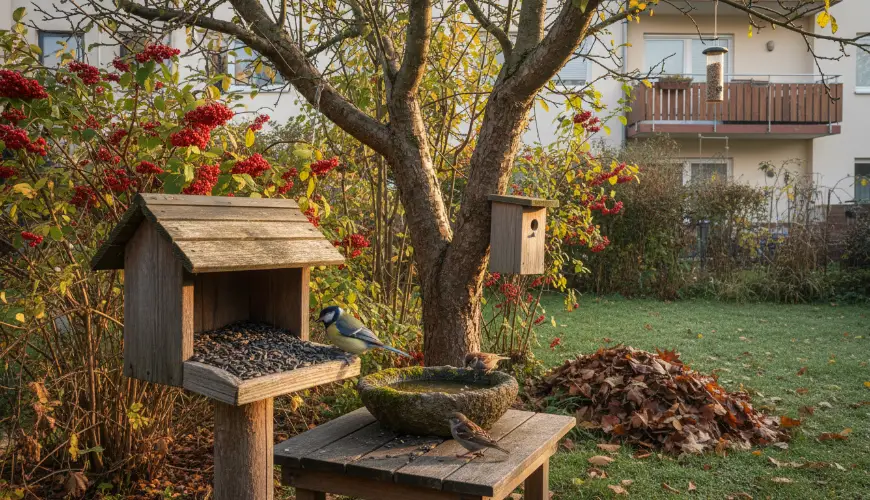
For those with a garden, the possibilities expand considerably. One of the most valuable steps is to leave part of the garden in a more natural state – not trimming every shrub into a geometric shape, leaving old wood standing as a refuge for insects and therefore a larder for birds. A pile of leaves in the corner of the garden, which may look like untidiness, is in fact a winter shelter for various creatures and a food source for birds searching for larvae and worms.
The choice of plants is another powerful tool. Birds love the berries of rowan, firethorn, elder, dogwood and dog rose. These shrubs and trees are not only beautiful, but in winter they provide a genuine food store. Planting them is therefore one of the longest-lasting investments in supporting birds in the garden. Moreover, it is an investment that grows in value over the years – the older and denser the shrub, the more it has to offer.
An interesting real-life example is the experience of a family from rural South Bohemia who decided three years ago to transform part of their lawn into a so-called bird corner. They planted firethorn and elder shrubs, installed three nest boxes of different sizes and added a stone dish of water. The result? In the first year they recorded a pair of great tits nesting. In the second year, sparrows and a robin joined them. In the third year, they began to observe a lesser spotted woodpecker, which had never previously visited their garden.
Stories like this show that change comes gradually, but it does come. Birds are creatures of habit who first cautiously explore new places. But once they establish that the environment is safe and offers what they need, they return – and bring others with them.
When it comes to nest boxes, it is important to bear in mind that different species of birds prefer different types. Tits, sparrows and common redstarts look for boxes with a round entrance hole approximately 28 to 32 millimetres in diameter. Flycatchers, on the other hand, prefer boxes with a larger but shallower opening. Detailed information on the correct dimensions of nest boxes for individual species is provided by the Czech Society of Ornithology, whose recommendations are backed by many years of practice and research.
The placement of a nest box is just as important as its type. It should hang at a height of at least two metres, with the entrance hole facing north-east or east – that is, not directly into the sun and not into the prevailing wind. There should be no branches nearby that a cat or marten could climb. And every autumn it is a good idea to clean the box so that old nests, which could harbour parasites, are not left inside.
Cats are a topic that is rarely discussed in the context of bird conservation, despite being one of the most significant factors in bird mortality in built-up areas. A study published in the journal Nature Communications estimates that in the USA alone, free-roaming and stray cats kill billions of birds each year. Numbers in Europe are lower, but still alarming. Cat owners can improve the situation by not letting their animals outside during the times when birds are most active – early morning and early evening. A bell on the collar will help birds register the approaching danger in time.
When and how to start – regardless of where you live
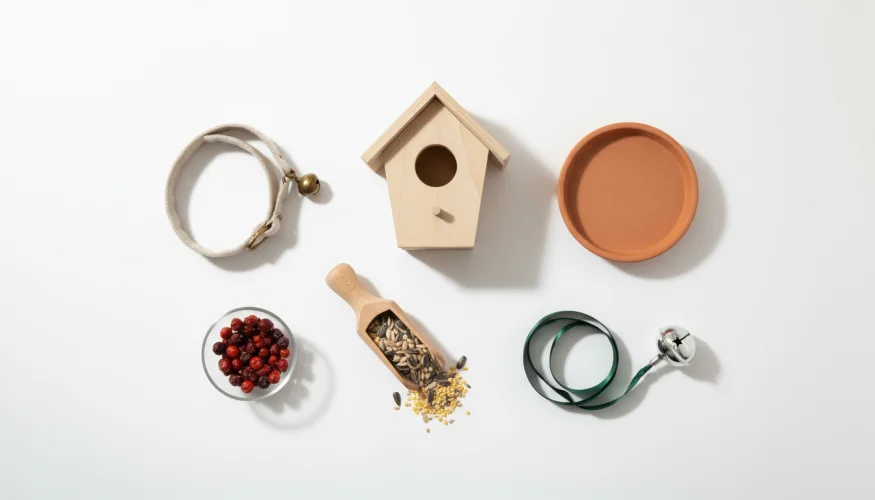
There is no need to wait for ideal conditions. A bird feeder can be built from wooden planks in an afternoon, a bird box can be bought for a few hundred crowns, and a dish of water costs virtually nothing. Consistency is what matters – birds will get used to a place where they find food and water, and will return. Interrupting care in the middle of winter can be critical for them, as they will not have had time to build up supplies elsewhere.
The British ornithologist Peter Scott expressed this as a wise principle: "Nature owes us nothing. But we owe it a great deal." These words ring doubly true at a time when human activity is transforming the landscape so dramatically that many bird species find themselves without a home virtually overnight.
For those who wish to go further, a number of organisations offer the opportunity to get involved in bird monitoring – for example, the annual Winter Bird Count at Feeders, organised by the Czech Society of Ornithology. All it takes is an hour of watching birds at your feeder and recording how many individuals of each species arrived at the same time. This simple activity provides scientists with valuable data on the state of bird populations, while also giving the observer an unexpectedly powerful experience – focused observation of nature has a demonstrably positive effect on mental wellbeing.
Environmentally minded gardeners can take one more significant step for birds: reducing or eliminating chemical sprays and synthetic fertilisers. The insects that chemicals kill are a key source of protein for birds – especially during the breeding season, when parents feed their chicks. A garden without chemicals may look less "perfect", but in terms of biodiversity it is incomparably richer.
Supporting birds in the garden or on the balcony is not merely a matter of sentiment or love of nature. It is a concrete, measurable contribution to preserving biological diversity in the place where we live. And it is also a way of reconnecting with the rhythm of nature – observing who has arrived, who has built a nest, who has brought fledglings. Such everyday observations have their own value that is hard to put into words, but anyone who has experienced it knows exactly what it means.