
# What to Do When Sibling Jealousy Arrives After a Baby's Birth Sibling jealousy after a new baby a
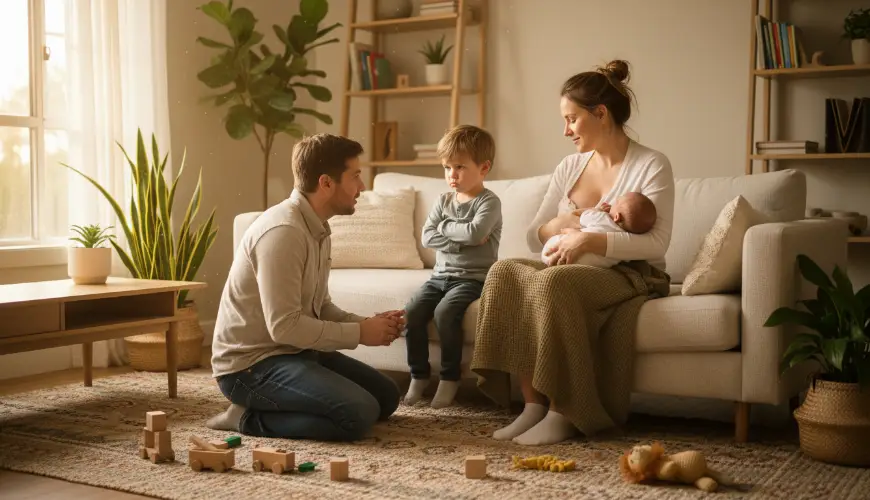
A new family member arrives, bringing with it a whole avalanche of emotions – joy, excitement, but also tension that parents may not have anticipated. Sibling jealousy after the birth of a baby is a phenomenon as old as humanity itself, yet it can catch many parents off guard with its intensity. The older child, who was previously the center of the universe, suddenly discovers they must compete for their parents' attention with someone who cries, sleeps, and demands care twenty-four hours a day. And that isn't easy for a three-year-old toddler or a school-age child alike.
It's important to recognize that jealousy itself is not a bad thing. It is a natural emotional response to a change that occurs in a child's life – and that change is truly enormous. Psychologists from the American Psychological Association repeatedly emphasize that healthy expression of emotions, including negative ones, is a key component of a child's emotional development. The problem only arises when parents don't know how to respond to expressions of jealousy, or when they ignore them entirely.
Try our natural products





Why older children feel jealous and how it manifests
In order to manage the situation, it is first necessary to understand what is actually happening in the older child's mind. Young children perceive the world in a very concrete and immediate way – and the arrival of a sibling represents a direct threat to their sense of security. The mother who used to read a bedtime story every evening is now breastfeeding. The father who used to go on walks is now pushing a pram and tending to the baby. The time that belonged exclusively to the older child is suddenly being shared – and the child inevitably needs to process this somehow.
The ways jealousy manifests can vary greatly. Some children regress – they start wetting the bed again, asking for a pacifier, or speaking like babies. Others behave aggressively, have temper tantrums, or refuse to cooperate. Some withdraw into themselves and stop communicating. All of these reactions are essentially the same cry for help: "I'm here. Don't forget about me."
Interestingly, the age of the child at the time the sibling is born plays a significant role. Research suggests that children between the ages of two and four are most at risk, because they are old enough to perceive the change but too young to fully understand it. Older children – school-age kids and teenagers – may also experience jealousy, but they are better able to verbalize it and process it rationally. Even so, the need for parental attention and affirmation of their own worth never disappears.
Let's consider a specific situation: Tomáš is four years old and his mother has just brought little Eliška home. On the first day, Tomáš admired the baby, wanted to stroke her and have his photo taken with her. On the second day he was quieter. On the third day he broke a toy he had received for his birthday. On the fourth day he told his mother he didn't love her. His parents were taken aback – after all, they had carefully prepared Tomáš for his little sister's arrival! But even the best preparation cannot fully convey to a child the reality of what is to come. Preparation helps, but it does not replace the patient, day-to-day work of processing emotions.
What actually helps: practical approaches for the whole family
Child psychology experts agree on several key principles that can help parents navigate this challenging period. These are not complex techniques – they are primarily about the conscious decision to give the older child attention and to respect their emotions.
Naming emotions is one of the most important tools available to parents. Instead of saying "stop behaving like that" or "you have to love your little sister," they can try saying: "I can see you're sad because Mummy is breastfeeding Eliška right now. I understand, it's hard." This simple sentence works wonders – the child feels understood, and that is the foundation for them to calm down and gradually accept the situation.
Another tried-and-tested approach is the so-called special time – time set aside each day exclusively for the older sibling, without the baby, without the phone, without distractions. It doesn't need to be hours – twenty minutes of a parent giving their full attention to the older child and doing whatever they want is enough. A puzzle, playing with toy cars, reading a book. This ritual sends a clear signal: "You matter to me. The baby hasn't changed how much I love you."
As child psychologist Adele Faber, author of the celebrated book on sibling relationships, says: "Love is not a cake that has to be divided. It is a candle – one can light another from it without the first going out." This metaphor is enormously valuable precisely because it shows how a child can be helped to understand that the arrival of a sibling does not diminish love, but multiplies it.
Parents should also pay attention to how they talk about the baby in front of the older child. Phrases like "you need to be good now because Mummy is tired" or "wait, it's the baby's turn now" can unconsciously build negative associations in the child's mind – baby = restrictions, baby = obstacle. It is better to find ways to involve the older sibling in caring for the baby. They can fetch a nappy, sing a song to the baby, or show it their favourite toy. This transforms them from a rival into a helper – and that is a role that helps the child build a positive relationship with their sibling from the very beginning.
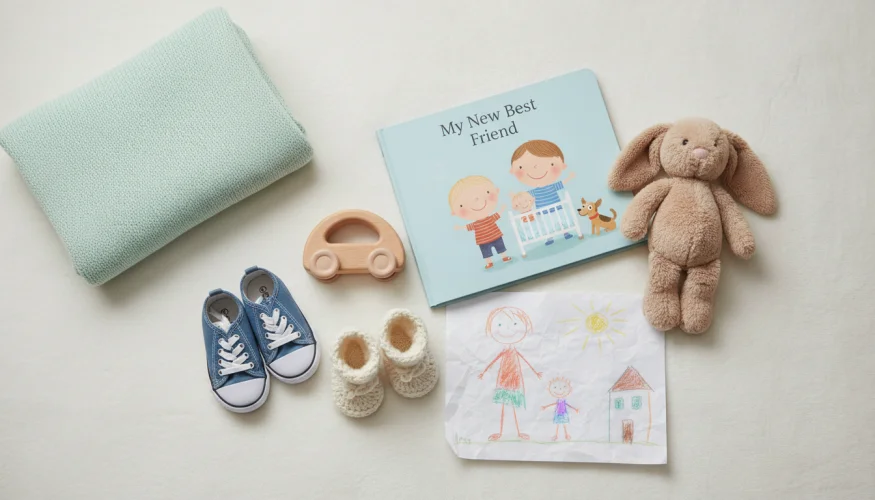
Preparation before the baby is born can also be a great help. Ideally several months in advance, the older child should know what is coming – not in the form of a lecture, but in a natural way: looking at books about babies, visiting a friend who has a younger sibling, or talking about what it was like when the older child was small themselves. It is important to be honest throughout – not to paint the arrival of the baby as a fairytale full of joy, but to also say that it will be demanding and noisy, and that it will take a while for everyone to adjust.
One of the things parents often underestimate is maintaining the older child's routine. A newborn brings chaos to the family – sleep patterns, mealtimes, outings, everything changes. The more successfully the older child's established rituals can be preserved – the bedtime story, Saturday breakfast with Dad, attending their activity group – the greater their sense of stability. And stability, in times of great change, is the most precious gift parents can give.
The wider family also plays a significant role. Grandparents, aunts and uncles have a natural tendency to focus on the newborn – this is understandable, as the baby is new, adorable and draws attention. However, parents might gently ask relatives to pay attention to the older child during visits too – to ask how they are, to praise them for something specific. Small gestures have a big impact.
There are, however, situations where jealousy exceeds the usual level and becomes a real problem. If the older child repeatedly physically harms the baby, stops eating or sleeping entirely, or their behaviour deteriorates significantly even after several months, it is advisable to seek professional help. A child psychologist or family therapist can offer tools tailored to the specific family and specific child. The Czech Psychological Society provides a directory of specialists who focus specifically on family issues and child development.
Parents should also not forget about themselves. Caring for a newborn is physically and emotionally exhausting, and if you add to that the older child's temper tantrums or their night-time waking due to jealousy, the situation can genuinely push parents to their limits. Tired and overwhelmed parents cannot be emotionally available to either of their children – and for this reason, taking care of one's own wellbeing is just as important as caring for the children. Accepting help from a partner, grandparents or friends is not a weakness, but a wise decision.
It is also worth knowing that sibling jealousy is not a permanent state. Most children adjust to their new sibling within a few weeks to months. And it is from this initial, challenging period of coexistence that something beautiful gradually emerges – a bond unlike any other relationship. Siblings argue, compete and envy one another – but they also protect each other, laugh together and share memories that no one else has. The sibling relationship shapes a person's character in ways that parents cannot fully influence, and that is precisely why it is worth giving it attention and care from the very first days.
The arrival of a baby is a transition into a new chapter for the whole family. It is normal for this chapter to begin somewhat chaotically, with crying and temper tantrums, with tired parents and a confused older child. What matters is not whether jealousy will arise – it almost certainly will – but how the family manages it together. And if parents approach the older child's emotions with patience, empathy and the awareness that behind every outburst of anger lies a longing for love and security, they hold in their hands the best tool there is.