
Chestnut Purée or a Forgotten Autumn Delicacy
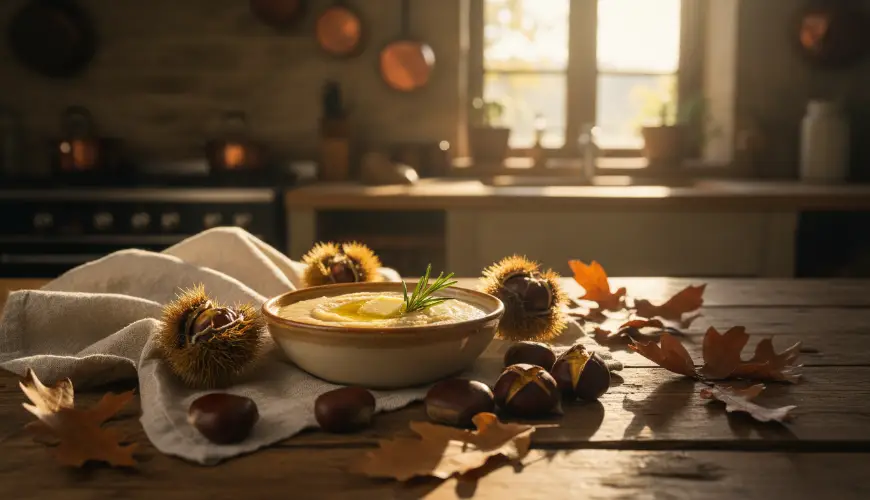
Autumn has its unmistakable scent. It's a blend of wet earth, leaves and wood smoke – and for those who grew up in the countryside or have grandmother's kitchen firmly anchored in their memories, also the scent of roasted chestnuts. Yet while chestnuts as a snack have survived on the margins of gastronomic awareness thanks to stalls at Christmas markets, their true potential remains largely untapped in Czech cuisine. Chestnut purée is one of those autumnal delicacies that deserves far more attention than it receives today.
This is not some trendy novelty or a foodie culture fad. Edible chestnuts – the fruits of the sweet chestnut tree (Castanea sativa) – were a staple of Central European and Mediterranean diets for centuries. Before potatoes arrived from the New World and completely transformed the European menu, the chestnut tree was literally the tree of life for entire mountain communities in Italy, France, Spain and the Balkans. Chestnut flour, chestnut porridge, chestnut bread – these were not delicacies, but everyday food. And chestnut purée was one of the most widespread ways of processing these fruits.
Try our natural products



Why did we forget about chestnuts?
The answer is simple: potatoes are cheaper, more accessible and easier to grow and process. With their arrival, chestnuts gradually lost their role as a staple food and shifted into the category of seasonal speciality or confectionery ingredient. In Czech cuisine, moreover, chestnut trees never grew in such abundance as in Italy or France, so the tradition of processing them never really took hold here. The result? Most people associate the word chestnuts with either a Christmas decoration or a sweet cake filling – and that is a shame.
Because chestnut purée is actually a surprisingly versatile ingredient, equally suited to both sweet and savoury cooking. And at a time when more and more people are interested in local, seasonal and minimally processed foods, this forgotten product could well find its way back onto our plates.
Take the example of Markéta, a thirty-year-old Praguean who discovered chestnut purée by chance on a trip to Piedmont. There it was served as a side dish with game – simply seasoned with butter, salt and a touch of rosemary. "I was expecting something sweet and heavy, but it was earthy, delicate and absolutely perfect," she recalls. After returning home, she began preparing chestnut purée herself and now uses it as a soup base, a side dish for roasted meat and as a filling for crêpes. Her experience is not unique – you just need to know how to go about it.
Nutritionally, chestnuts are interesting for several reasons. Unlike most other nuts and seeds, they have a relatively low fat content and a high proportion of complex carbohydrates, making them filling yet easily digestible. They contain a decent amount of vitamin C – which is quite unusual for nuts – along with B vitamins, potassium, magnesium and fibre. According to data from the United States Department of Agriculture, 100 grams of cooked chestnuts contain approximately 245 calories, with fat accounting for only a fraction of that amount. By comparison, walnuts contain more than twice as many calories for the same weight. Chestnuts are also naturally gluten-free, making them an interesting ingredient for people with coeliac disease or gluten sensitivity.
How chestnut purée is properly prepared
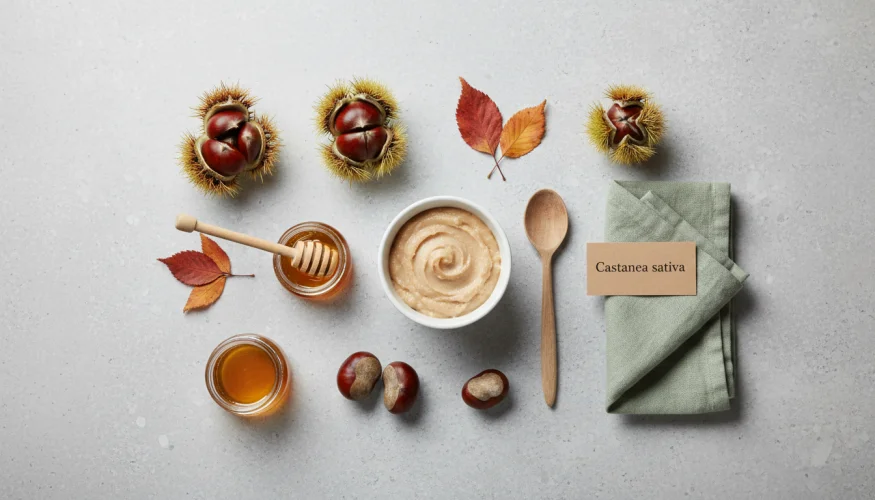
Making chestnut purée at home is not complicated, but it does require a little patience. The foundation is choosing the right chestnuts – they should be firm, heavy and free of mould. The edible chestnut season in Europe runs roughly from September to November, so right now is the perfect time to look for them at farmers' markets, health food shops or specialist stores.
The chestnuts first need to be scored – a shallow cross-shaped cut on the flat end is sufficient – and then boiled or roasted. Boiling takes approximately 20 to 30 minutes, roasting in an oven at 200 degrees Celsius around 20 minutes. After cooking, the shell is easier to remove, ideally while still warm. Once the chestnuts are peeled, simply blend them or press them through a sieve. The resulting consistency depends on how much liquid is added – for a thick purée, just a little water or stock is sufficient, while for a creamier version butter, cream or a plant-based alternative can be added.
French cuisine knows chestnut purée as crème de marrons or purée de marrons and works with it as a matter of course. The Italian tradition knows it as castagnaccio or as the basis of the famous Mont Blanc – a dessert composition of chestnut purée, whipped cream and meringue that originates from the Aosta and Piedmont regions. As the French chef and writer Auguste Escoffier once wrote: "Cooking is the art of transforming simple ingredients into experiences." And chestnut purée is a perfect example of this – from a simple forest fruit comes something that can be simultaneously a rustic side dish and an elegant dessert.
In its sweet form, chestnut purée works wonderfully as a filling for crêpes, croissants or cakes. Flavoured with vanilla, a splash of rum and sugar, it transforms into a delicious spread that rivals chocolate spreads or peanut butter. Added to muffin or brownie batter, it lends a subtle earthy flavour and an unexpectedly creamy texture. Its savoury uses are equally rich: chestnut purée as a side dish with game, lamb or duck is a combination that works beautifully, yet remains a rarity in Czech cuisine.
Its use in soups is also noteworthy. Chestnut soup with a touch of ginger, coconut milk and coriander is an example of how an ancient ingredient can be prepared in a modern way. Or more classically – a thick chestnut soup with sautéed onion, thyme and a dash of cream that warms and satisfies better than many other autumn recipes.
For those who do not want to venture into home preparation, there are also quality ready-made options. When choosing chestnut purée in a shop, it is worth paying attention to the ingredients – an ideal product should contain only chestnuts, possibly with a minimal amount of added sugar or salt. Products with a long list of additives, stabilisers or artificial flavourings should be avoided. Quality organic variants from certified sources are available in health food shops and eco-friendly online stores.
Chestnut purée is also interesting from a sustainability perspective. Chestnut trees are long-lived trees that require no intensive agricultural care, need no artificial fertilisers and whose fruits are harvested by hand or through natural drop. Compared to intensively farmed crops, chestnuts have a very low ecological footprint. Research published in the specialist journal Agroforestry Systems shows that chestnut groves contribute to biodiversity, water retention in the landscape and carbon sequestration. Choosing chestnut products is therefore not only a gourmet choice, but also a consciously ecological one.
Autumn is the season that naturally invites us to slow down, to cook at home and to embrace seasonal eating. And in this context, chestnut purée makes perfect sense. It is not an ingredient that demands complex techniques or expensive equipment. It requires only a little curiosity and a willingness to step beyond familiar recipes. Chestnuts have grown in European forests for millennia, nourished generations before us and still have much to offer – in terms of flavour, nutrition and ecology alike.
Perhaps it is time to stop seeing chestnuts merely as a Christmas decoration or a memory of grandmother and to start taking them seriously again as a fully-fledged autumn ingredient. Chestnut purée – whether homemade or from a quality organic source – is one of those things that only needs to be tasted once, properly prepared, to earn a permanent place in the kitchen. And that is precisely the kind of discovery that makes autumn cooking so enjoyable.