

Buckwheat risotto with pumpkin and sage for cold autumn days
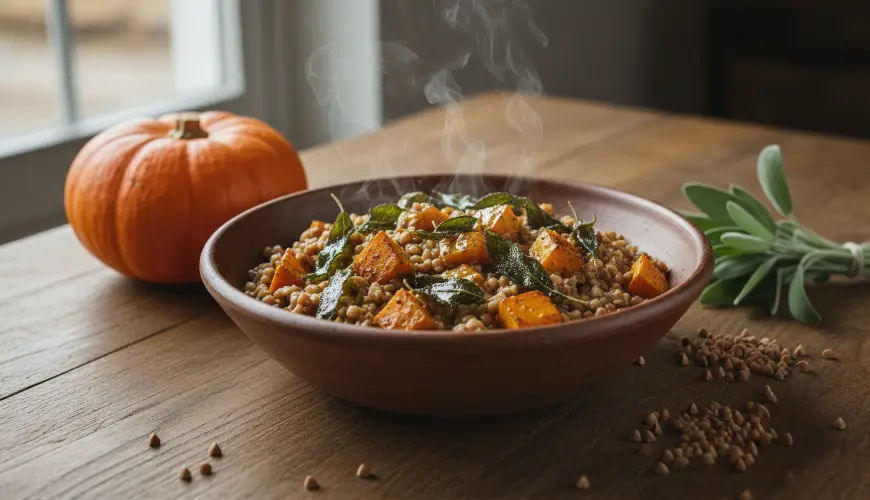
Autumn brings a completely different pace to the kitchen. The days grow shorter, the air turns cold, and the body begins to crave food that warms from within. It is precisely at this time of year that pumpkins appear at markets and in gardens in all shapes and colours – and with them comes the opportunity to cook dishes that are not only nutritious but truly delicious. Buckwheat risotto with pumpkin and sage is exactly such a recipe: simple to prepare, rich in flavour, and surprisingly healthy.
Buckwheat is no newcomer. It has a long tradition in Czech cuisine, though the modern era briefly pushed it into the background in favour of rice and pasta. Today, however, it is making a comeback – and with full force. Health-conscious cooks, vegans, people with gluten intolerance, and those simply seeking variety on their plate are discovering it again and again. And no wonder. Buckwheat is an exceptional food that deserves far more attention than we typically give it.
Try our natural products





Why buckwheat and not rice?
Classic risotto is made with short-grain rice, most commonly arborio or carnaroli varieties, which release starch during cooking and create the characteristic creamy consistency. Buckwheat works somewhat differently – it does not create such a pronounced creaminess on its own, but with proper preparation using sufficient stock and fat, the result is a dish with a rich, full flavour and pleasant texture. Some cooks add a knob of butter or a little cream at the end to achieve a silkier result. Others stick to a purely plant-based version and the outcome is equally satisfying.
Buckwheat also offers something rice does not: significant nutritional advantages. According to information published by the Harvard T.H. Chan School of Public Health, whole grains and pseudocereals such as buckwheat are among the foods associated with a reduced risk of heart disease, type 2 diabetes, and certain types of cancer. Buckwheat is naturally gluten-free, contains all essential amino acids, and is rich in magnesium, iron, and antioxidants – particularly rutin, which supports vascular health. This makes it one of the most valuable foods that can be incorporated into an everyday diet.
Pumpkin is buckwheat's natural autumn partner. Its naturally sweet, earthy flavour pairs with buckwheat's nutty notes in a completely natural way. Hokkaido pumpkin, which is the most widespread and popular variety in our country, has the added advantage of not needing to be peeled – the skin softens during cooking and is entirely edible. Pumpkin is rich in beta-carotene, vitamin C, and potassium, so it adds not only colour and flavour to the dish but also nutritional value.
And then there is sage. This aromatic herb is a classic in Italian cuisine – think of the famous "burro e salvia", pasta with butter and sage, one of the simplest yet most delicious dishes of the Mediterranean. Sage has a distinctive, slightly resinous fragrance that mellows when fried in butter or olive oil and transforms into something almost magical. Crispy sage leaves fried until golden are not merely decoration but the true flavour star of the entire dish.
How to prepare buckwheat risotto step by step
Preparing this dish requires no special equipment or culinary training. You need a pot, a pan, a little patience, and quality ingredients. It is the ingredients that matter most – the better the buckwheat, the fresher the sage, and the riper the pumpkin, the better the result.
Before cooking, it is recommended to rinse buckwheat under cold water to remove any potential bitterness. Some cooks also briefly toast it dry in a pan to enhance its nutty flavour – this step is optional but highly recommended. The buckwheat is then cooked in vegetable stock, ideally homemade, at a ratio of approximately 1:2 (one part buckwheat, two parts stock). The stock is added gradually, similar to classic risotto, and the buckwheat is stirred continuously.
Meanwhile, the pumpkin is cut into small cubes and sautéed in olive oil or butter until golden. It can also be roasted in the oven beforehand – this enhances its natural sweetness and the caramelisation adds another flavour dimension to the dish. Both approaches work excellently; it depends on time and personal preference.
Sage is prepared separately: fresh leaves are placed in heated butter or olive oil and fried briefly, for about a minute or two, until they begin to crisp and release their characteristic aroma. They are then removed and set aside – added only at the very end as both a garnish and a flavour accent.
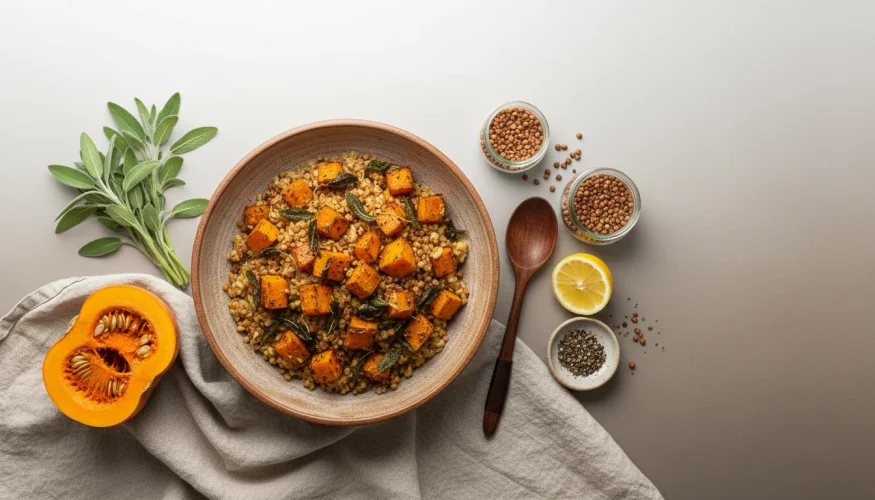
The finished dish is seasoned with salt, freshly ground pepper, and optionally a squeeze of lemon juice, which brightens the whole dish beautifully. Some add grated Parmesan or a vegan alternative made from cashew nuts, but even without this the dish is completely satisfying.
One specific example: Martina, a thirty-year-old teacher from Brno, began making buckwheat risotto with pumpkin last autumn after being diagnosed with gluten intolerance by her doctor. "I thought I would have to give up all the foods I love," she says. "But this risotto convinced me that gluten-free cooking can be just as tasty, if not tastier. Now I make it every week." Her story is not unique – thousands of people across the country are discovering buckwheat recipes as a path to a more varied and healthier diet.
As the famous French gastronome Jean Anthelme Brillat-Savarin once remarked: "Tell me what you eat, and I will tell you what you are." Buckwheat risotto with pumpkin and sage reveals quite a lot about its creator – a person who values seasonality, naturalness, and flavour without unnecessary compromise.
Buckwheat can be purchased at any larger supermarket, but quality organic buckwheat from verified sources has a noticeably better flavour and nutritional profile. Likewise, sage is far more aromatic fresh than dried – if you do not grow it at home, it is worth seeking out at farmers' markets or health food shops. Hokkaido pumpkin is practically available everywhere in season and its price is very reasonable, making the entire dish extremely economical.
In terms of variations, buckwheat risotto with pumpkin is an excellent base for experimentation. You can add toasted walnuts for extra crunch, a little ginger or nutmeg for warming spice, or replace the sage with thyme or rosemary. Vegans can fully substitute the butter in the recipe with coconut oil or a quality plant-based fat without any loss of flavour. The dish is also excellent cold as a base for a lunch box – unlike rice, buckwheat retains a pleasant texture even after cooling.
The cultural background of this dish is also interesting. Buckwheat has traditionally been cultivated in Asia and Eastern Europe – in Russia, Poland, Slovakia, and the Czech Republic. The Japanese make their famous soba noodles from it, the Russians prepare a porridge called grechka, and in Czech folk cuisine buckwheat was used to make porridges, soups, and side dishes. According to the Czech Statistical Office, buckwheat consumption in the Czech Republic has increased significantly over the past ten years, reflecting growing interest in healthy and alternative nutrition.
Buckwheat risotto with pumpkin and sage stands at the intersection of these traditions and a modern approach to cooking. It is not a dish trying to be something it is not – it does not pretend to be a classic Italian risotto, nor does it attempt to imitate traditional Czech porridge. It is a dish in its own right, with its own identity, its own flavour, and its own place at the autumn table.
Buckwheat as part of a sustainable lifestyle
Beyond the kitchen, it is worth mentioning the ecological dimension of buckwheat. Buckwheat is a crop that requires no pesticides – it naturally resists pests and weeds. It is also an excellent honey plant, so its cultivation supports biodiversity and bee populations. Choosing organic buckwheat from local farmers is therefore not only a health decision but also a conscious step towards a more sustainable way of life.
The same principle applies to pumpkin. Hokkaido pumpkin grows very well in the Czech Republic and Slovakia, so purchasing from local farmers or directly at farmers' markets significantly reduces the carbon footprint of your meal. Seasonal cooking – that is, cooking with what nature currently offers – is one of the simplest ways to eat more healthily while also being more considerate of the planet.
Sage can easily be grown at home on a windowsill or balcony. It is an undemanding herb that returns every year and requires minimal care. Having fresh sage readily available at home means it can be added not only to risotto but also to teas, sauces, soups, or even homemade butter. Growing your own herbs is one of those small steps that has a surprisingly large impact – both on the quality of one's cooking and on the sense of connection with nature and the seasons.
Buckwheat risotto with pumpkin and sage is therefore more than just a recipe. It is a way of thinking about food – mindful, seasonal, sustainable, and yet joyful. Autumn is a beautiful time of year precisely because it compels us to slow down, warm ourselves, and savour what we have. And a dish like this – simple yet rich – is the perfect response to a cool October or November afternoon.