
Learn breast self-examination step by step
Breast cancer is one of the most common oncological diseases in women worldwide. According to data from the World Health Organization, it is diagnosed in more than two million women annually worldwide, and early detection significantly increases the chances of successful treatment. Yet many women still underestimate one of the simplest and most effective preventive methods they literally have in their hands – regular breast self-examination. It is not a substitute for mammography or a visit to a gynaecologist, but an important complement to overall women's healthcare that can save lives.
Breast self-examination is a method that every woman can perform at home, without any tools, and it can reveal changes that would otherwise go unnoticed for months. The key to its effectiveness is regularity and proper technique. That is precisely why it is worth dedicating a few minutes each month to it – and learning how to perform it correctly.
Try our natural products


When and how to perform self-examination
The ideal time for breast self-examination is a few days after the end of menstruation, when the breasts are least sensitive and any changes are more easily felt. Women after menopause can choose any day of the month – the important thing is that it is always the same day, for example the first day of the month, so that the examination becomes a fixed part of the routine. Pregnant and breastfeeding women should consult their gynaecologist about the procedure, as their breasts undergo natural changes that can make orientation more difficult.
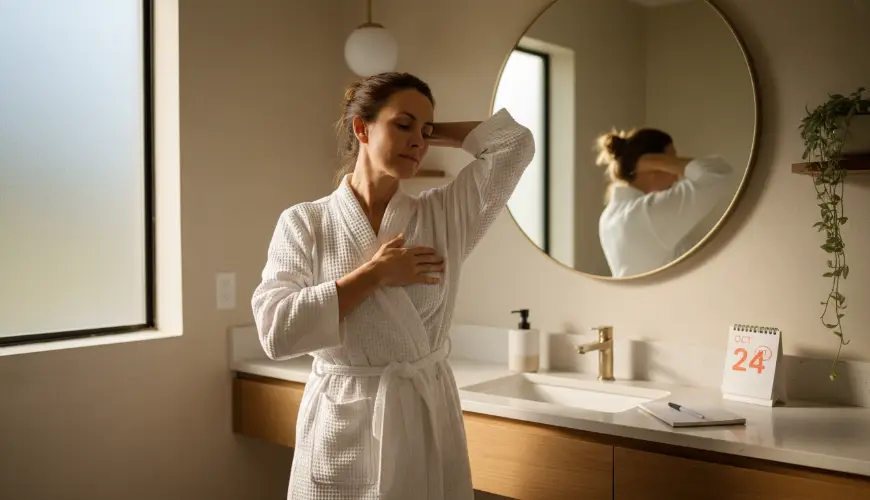
The examination itself takes place in two phases – a visual inspection in front of a mirror and a physical examination by touch. It begins with looking: the woman stands in front of a mirror, arms loosely at her sides, and carefully examines both breasts. She looks for any visible changes – asymmetry, change in shape or size, skin retraction, dimpling, change in colour, or an appearance resembling orange peel. She then raises her arms above her head and repeats the inspection. This simple visual step can reveal changes that might otherwise be missed even during a physical examination.
The second phase – the physical examination – is performed lying on the back. A small pillow or folded towel is placed under the shoulder on the side of the breast being examined, and the arm on the same side is placed behind the head. Using the other hand, specifically the pads of the three middle fingers, the entire breast is then systematically examined. The movements should be circular, gentle, yet thorough, and it is necessary to proceed methodically – the most commonly recommended approach is movement in a spiral from the nipple outward, or movement in rows like mowing grass. It is important to examine the entire breast area, including the armpit and the area below the collarbone, where the lymph nodes are located.
During the examination, the woman looks for any lumps, hardened areas, or regions that differ from the surrounding tissue. She also notices any pain or tenderness that was not previously present. Finally, she gently squeezes the nipple and checks whether any fluid is discharged – clear, bloody, or otherwise discoloured. The entire examination should take approximately five to ten minutes, but its value is invaluable.
Let us take a practical example: Jana, a forty-four-year-old teacher from Brno, began performing breast self-examinations after a friend drew her attention to it. During one of her regular monthly examinations, she felt a small, painless hardened area in the upper part of her left breast. Although she initially told herself it was probably just a cyst, she visited her gynaecologist. The examination revealed an early stage of breast carcinoma – so early that the treatment proceeded without chemotherapy, and Jana is healthy today. "If I hadn't felt it myself, I might not have found out until a mammography a year later. That would have made an enormous difference," she says today.
What to look for and when to be alert
Many women are afraid to perform self-examinations because they worry they will find nothing, or conversely – that they will find something that frightens them. Both reactions are understandable, but neither is a reason to avoid the examination. It is important to realise that most changes women feel during self-examination are not cancerous – they may be cysts, fibroadenomas, or common changes associated with the menstrual cycle. Nevertheless, every new or unusual change deserves a doctor's attention.
Symptoms that should prompt a woman to see a doctor without unnecessary delay include a new lump or hardened area in the breast or armpit, a change in the size or shape of the breast, retraction or wrinkling of the skin, a change in the appearance or position of the nipple, newly appearing nipple discharge, or persistent pain in one spot. None of these symptoms automatically indicates cancer on its own, but each deserves professional assessment.
The Czech Oncological Society recommends that women from the age of twenty perform breast self-examination every month, and from the age of forty undergo regular mammography covered by health insurance every two years. Self-examination is therefore not an alternative to mammography – it is its natural and necessary complement. While a mammogram can detect even very small lesions that are not palpable, self-examination enables ongoing monitoring of one's own body and early detection of changes between regular examinations.
There is also a group of women at increased risk, for whom regular self-examination is even more important. This includes women with a family history of breast cancer, carriers of BRCA1 and BRCA2 gene mutations, women with certain benign breast changes, or those who have undergone radiotherapy to the chest area. These women should discuss an appropriate screening programme with their doctor, as different recommendations may apply to them.
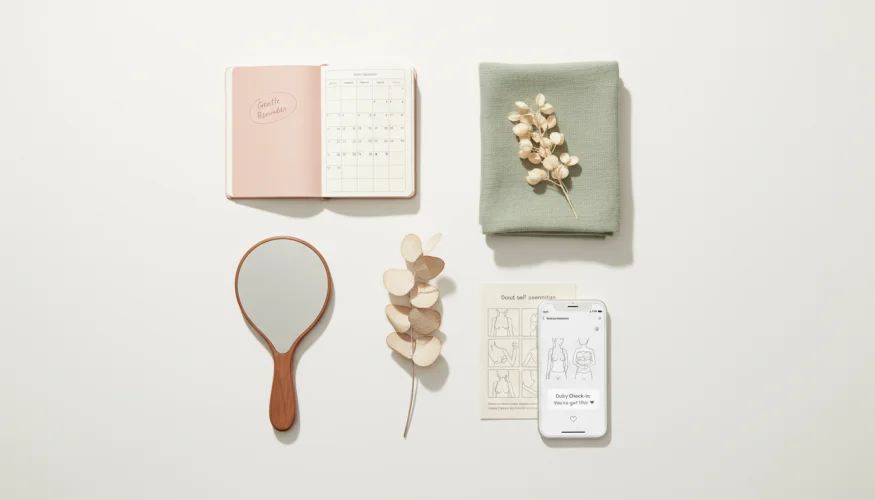
One of the greatest enemies of regular self-examination is forgetting or procrastinating. It helps to set a reminder on your phone, mark the day in a calendar, or link the examination to another regular activity. Some experts recommend performing the physical examination in the shower, when the skin is wet and the fingers glide more easily over the surface – this can be a natural extension of the morning or evening routine. The important thing is to find a method that will be sustainable and natural for each individual woman.
It is worth mentioning that breast self-examination is not exclusively a women's matter. Breast cancer also affects men, although far less frequently – accounting for approximately one percent of all breast cancer cases. Men should therefore also be attentive to any changes in the breast gland area, such as a lump, tenderness, or nipple discharge, and visit a doctor if in doubt.
Caring for one's own body and health is part of a broader approach to life that includes making conscious decisions about what we eat, how we move, and how we care for our bodies. Breast self-examination fits naturally into this approach – it is a small but powerful act of self-respect and responsibility towards oneself. Five minutes a month, which every woman can devote to herself, can have a greater impact than many of us acknowledge.
Breast health can also be supported by an overall healthy lifestyle. Research repeatedly shows that regular physical activity, a balanced diet rich in vegetables and fruit, limiting alcohol consumption, and not smoking contribute to reducing the risk of developing breast cancer. According to the American Cancer Society, regular exercise can reduce the risk of breast carcinoma by ten to twenty percent. Self-examination and a healthy lifestyle therefore do not work against each other – on the contrary, they complement and reinforce one another.
Awareness of breast self-examination has improved significantly in recent years, yet there are still women who are unaware of the correct technique or consider it unnecessary. Gynaecologists, nurses, and non-profit organisations such as Mamma HELP are working to change this situation – providing educational materials, videos demonstrating the correct technique, and personal counselling. Making use of these resources and learning to perform self-examination correctly is an investment that can pay off many times over.
Performing regular breast self-examination step by step every month is not merely a medical recommendation – it is a gesture of conscious self-care that every woman deserves. Knowing your own body, being aware of its changes, and responding to them in time is one of the most important things a woman can do for her health. And all without a waiting room, without making an appointment, and without any cost – all it takes is a little courage and five minutes each month.