

A fallen arch and bunion can be managed with exercise
The feet are the foundation of the entire body – literally. They carry us every day, absorb impacts, maintain balance and enable movement that most of us take for granted. Yet we pay them surprisingly little attention until they start to hurt. And it is precisely then that we first encounter terms such as bunion or fallen arch – two problems that are far more widespread today than one might think.
According to World Health Organization data, up to one third of the adult population suffers from various orthopaedic foot problems. Yet a large proportion of these difficulties are not inevitable. Properly chosen care, suitable footwear and regular foot health exercises can significantly slow the progression of these conditions, relieve pain and in some cases even repair the damage caused by years of neglect. But how do you recognise whether these problems affect you? And what can you do about it?
Try our natural products
What is actually happening to your feet
A bunion, medically referred to as hallux valgus, is a deformity in which the big toe deviates towards the other toes, while the joint at its base protrudes outward. The result is a characteristic bump on the inner side of the foot that can be painful, red and sensitive to the touch. Many people initially do not notice this change at all – the deformity develops slowly and insidiously, and pain arrives only once the problem is already advanced.
The causes of hallux valgus are varied. Genetic predisposition plays a role – if your mother or grandmother suffered from a bunion, it is likely that you will encounter one too. Footwear also has a fundamental influence. Narrow shoes with a pointed toe and a high heel push the toes into an unnatural position and subject the big toe joint to long-term stress. This is precisely why women are affected by bunions approximately ten times more often than men. Factors such as excess weight, rheumatoid arthritis and flat feet also play a role.
And flat feet – or rather a fallen arch – are the second major topic that is being discussed more and more. The arch of the foot functions as a natural shock absorber. It is an elegant architecture of bones, tendons and ligaments that distributes the body's weight evenly and protects the joints of the entire lower limb as well as the spine. If this arch drops or disappears entirely, the foot becomes flat and ceases to fulfil its function. The result can be pain in the heel, ankle, knees, hips and even the back.
A fallen arch can be congenital, but far more often it develops over the course of a lifetime. It is contributed to by a sedentary lifestyle, walking on hard surfaces in unsuitable footwear, excess weight or weakening of the muscles of the foot and calf. Interestingly, both problems – bunions and fallen arches – are very often related. A weakened arch alters the distribution of pressure on the foot and contributes to the deviation of the big toe. Conversely, a bunion weakens the transverse arch and accelerates its collapse. It is a vicious circle that needs to be broken as soon as possible.
Why foot exercises work better than you think
Many people believe that once a bunion or fallen arch has developed, there is nothing to do but wait for surgery. This is, however, a misconception that can cause unnecessary suffering and unnecessary expense. Physiotherapists and orthopaedic specialists today agree that targeted foot exercises are one of the most effective tools in conservative treatment – and in many cases can completely delay or eliminate the need for surgery.
How does it work? The foot is a complex system of 26 bones, 33 joints and more than a hundred muscles, tendons and ligaments. If these muscles are weak or shortened, the entire system loses stability. Regular exercise strengthens these muscles, improves their coordination and restores natural movement patterns. The result is better pressure distribution, less pain and – in less advanced cases – even a visible improvement in the position of the big toe or the height of the arch.
Consider Markéta, a forty-year-old accountant who spends most of her day at a computer and the rest in heels. Three years ago she noticed that her left foot was beginning to hurt and her big toe was slowly deviating. An orthopaedic specialist confirmed hallux valgus at an early stage and recommended physiotherapy. Markéta initially underestimated the exercises – they seemed too simple to have any effect. After six months of regular exercise, however, the pain had almost disappeared and a follow-up X-ray showed that the progression of the deformity had stopped. "I didn't expect that movements even a child could do would have such a result," she described her experience.
Research confirms these observations. A study published in the Journal of Orthopaedic & Sports Physical Therapy showed that patients with hallux valgus who completed a sixteen-week programme of targeted exercise reported a statistically significant reduction in pain and improvement in foot function. Similar results are produced by studies focused on fallen arches – strengthening the intrinsic muscles of the foot demonstrably increases the height of the medial longitudinal arch.
Effective exercises for healthy feet that you can do at home
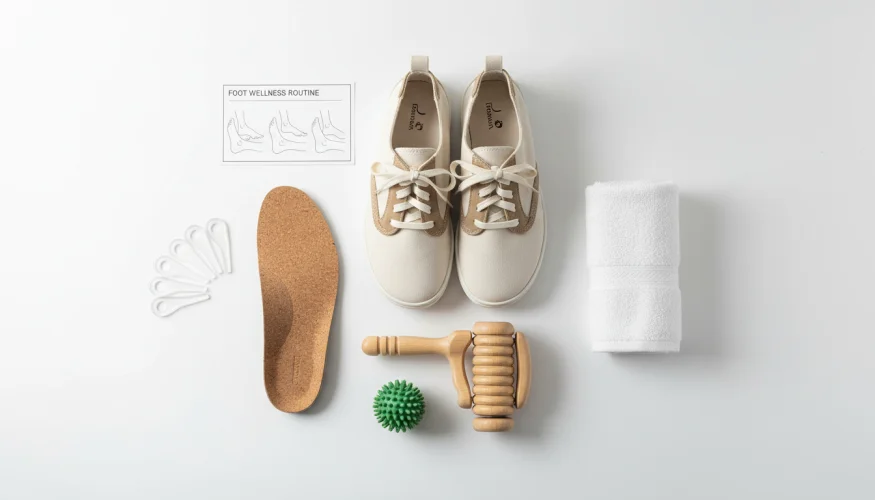
The good news is that foot exercises require no special equipment or gym membership. All it takes is a few minutes a day, a little patience and consistency. Listed below are the exercises that physiotherapists recommend most frequently – they are suitable both for prevention and for early and intermediate stages of bunions and fallen arches.
- Short foot exercise: Stand barefoot on the floor with feet parallel. Try to shorten the foot by drawing the heel towards the toes without curling the toes. You will feel the transverse arch activate. Hold for 5–10 seconds, repeat 10–15 times on each foot. This exercise is considered the foundation of intrinsic foot muscle strengthening.
- Big toe lift: Place the entire foot flat on the floor and try to lift only the big toe while the other toes remain on the floor. Then do the opposite – lift the other toes and leave the big toe down. This seemingly simple exercise trains coordination and strengthens the muscles that stabilise the big toe.
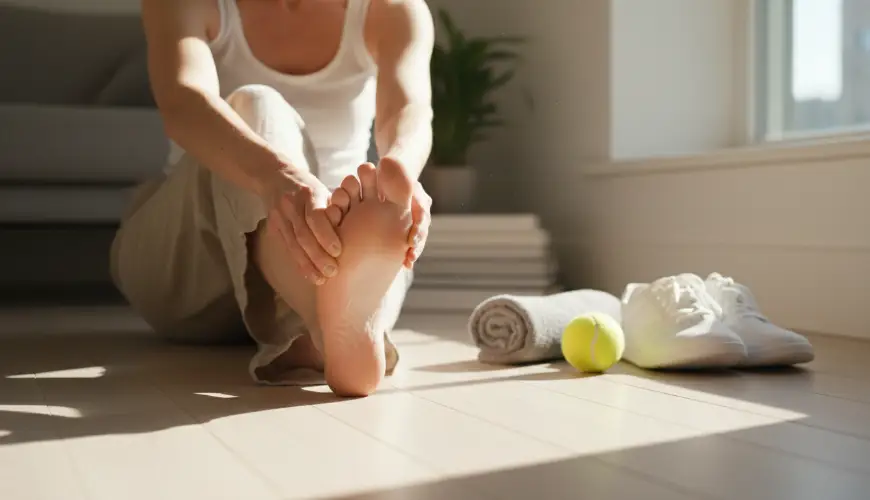
- Ball rolling: Roll up a towel or use a tennis ball and slowly roll it along the entire foot, from heel to toes. This exercise releases the plantar fascia, improves blood circulation and helps relax shortened tissues.
- Towel scrunching with toes: Place a small towel on the floor and try to pull it towards you using your toes. This strengthens the toe flexors and supports the transverse arch.
- Walking on the inner edge of the foot: Walk around the room so that your weight rests on the inner edge of the foot. This activates the muscles that raise the arch. Alternate with walking on the outer edge.
- Calf stretching: Stand facing a wall, place one foot behind you and slowly press the heel towards the floor. A shortened calf and Achilles tendon contribute to a fallen arch, so stretching them is an essential part of care.
The key to success is consistency. One-off exercise will not help – the muscles of the foot need time to strengthen and learn new movement patterns. Physiotherapists recommend exercising at least five times a week, ideally every day, and to expect results no sooner than six to eight weeks of regular effort.
Alongside exercise, choice of footwear also plays a fundamental role. Shoes with a sufficiently wide toe box, an appropriate heel height (ideally up to 3 cm) and good arch support are the foundation of both prevention and treatment. There are also orthopaedic insoles and special toe separators that help correct the position of the big toe and reduce pressure on the painful area. These aids are available without a prescription and can be a valuable complement to an exercise programme.
It is also worth mentioning that walking barefoot – where possible and safe – naturally strengthens the muscles of the foot. On grass, sand or at home on carpet, the foot works exactly as it should, without artificial supports and restrictions. This idea is also supported by research – populations that traditionally do not wear footwear demonstrably have a lower incidence of hallux valgus and flat feet. A study published in the journal Foot & Ankle International demonstrates this by comparing shod and unshod populations in different parts of the world.
As leading American physiotherapist and foot biomechanics specialist Gary Ward said: "The foot is not just the foundation of the body – it is its first language. If you listen to it, it will tell you more about your health than you expect."
Prevention is of course always better than treatment. If you do not yet have any difficulties, this is the ideal time to start caring for your feet – through regular exercise, suitable footwear and mindful movement. If pain or deformity already exists, there is no reason to panic. Conservative treatment under the guidance of a physiotherapist or orthopaedic specialist produces results in the vast majority of patients who are willing to invest time and patience. Surgery is considered only when other options have failed – and that happens less often than many people think.
Our feet carry us throughout our lives. It is time to start returning the favour.