
# What to Change in Daily Care for an Infant with Eczema ## Bathing and Skin Care - **Shorten bath
Red patches on cheeks, constant scratching, restless nights – these are images every parent of a baby with eczema knows all too well. Atopic dermatitis, as this condition is known in medical terminology, is one of the most common skin problems in early childhood. According to data from the World Allergy Organization, up to 20% of children in developed countries suffer from eczema, with the first symptoms very often appearing in infancy, before the first year of life. For parents, it can be a devastating experience – watching their baby in discomfort and not knowing where to begin.
The good news is that eczema in infants cannot always be completely cured, but it can be managed very effectively. And the key to success is usually a change in everyday childcare – from bathing methods to clothing choices to the environment in which the infant spends time. The changes don't need to be dramatic or financially demanding, but they must be thoughtful and consistent.
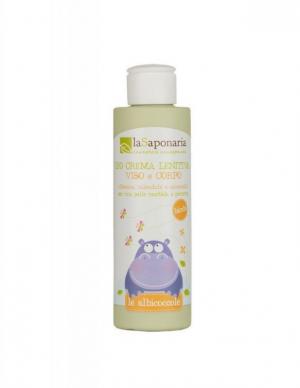
Try our natural products
What's actually happening beneath the skin's surface
To truly change the approach to care, it's important to understand what causes eczema. The skin of an infant with atopic dermatitis has a disrupted skin barrier – simply put, it cannot adequately retain moisture while also resisting external irritants and allergens. This defect is largely genetic, but that doesn't mean the environment plays no role. Quite the opposite – external factors can either significantly worsen or alleviate symptoms.
The mechanism is fairly straightforward: dry, irritated skin becomes more permeable to allergens, bacteria and chemical substances. These then trigger an inflammatory immune response, which manifests as redness, itching and flaking. The infant scratches, further damaging the skin, creating a vicious cycle. Breaking this cycle is the fundamental goal of all care for an atopic child.
Experts from the American Academy of Dermatology emphasise that regular and properly performed moisturisation is absolutely essential – and yet this is precisely the area where parents most commonly make mistakes without realising it. It's not just about whether to apply cream, but when, how and which one.
Bathing: less can be more
One of the most common mistakes parents of infants with eczema make is bathing for too long or in water that's too hot. Intuitively, it seems that water moisturises the skin, but the opposite is true – hot water and prolonged time in the bath dry out the skin and strip away the natural lipids that form its protective layer.
Dermatologists' recommendations are clear on this point: bathing should last a maximum of five to ten minutes, the water should be lukewarm (approximately 36–37°C), and instead of harsh soaps, special soap-free products designed for atopic skin should be used. These products, known as syndets or emulsifiers, cleanse the skin without disrupting its pH and natural protective film.
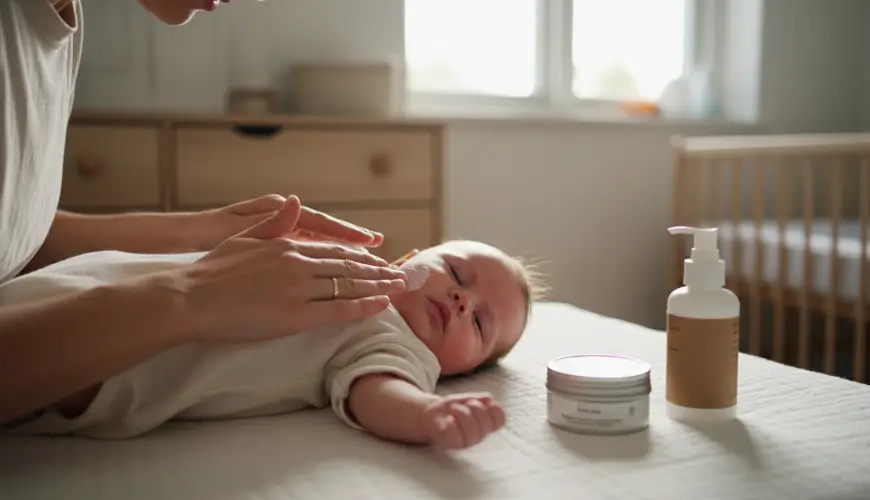
Immediately after bathing – and this means literally within two to three minutes – it is essential to apply a moisturising product to still slightly damp skin. This is the moment when the skin is best prepared to absorb active ingredients and seal in moisture. If cream application is delayed too long, the effect is considerably reduced. Experts call this technique the "soak and seal" method.
The choice of moisturising product itself is another key decision. For infants with eczema, thick emollient creams or ointments without fragrances, dyes or preservatives are appropriate, as these could further increase skin irritation. Light milky lotions, which are popular for their pleasant scent and texture, tend to be insufficient for atopic skin. The thicker the product, the better it creates a protective layer.
Clothing, laundry products and the home environment
Bathing and moisturisation are the foundation, but caring for an infant with eczema extends far beyond the bath. Equally important is everything that touches the infant's skin throughout the day – clothing, bedding and the home environment.
The fabric of clothing has a significant impact on how the infant's skin behaves. Synthetic fibres and coarse wool are unsuitable for atopic children – they mechanically irritate the skin and worsen sweating, which itself provokes eczema. The most suitable choice is soft organic cotton or bamboo, which has naturally thermoregulating properties and is gentle even on the most sensitive skin. Clothing should be loose, without constricting elastic bands and hard seams, and washed without fabric softener, which leaves chemical residues on the fibres.
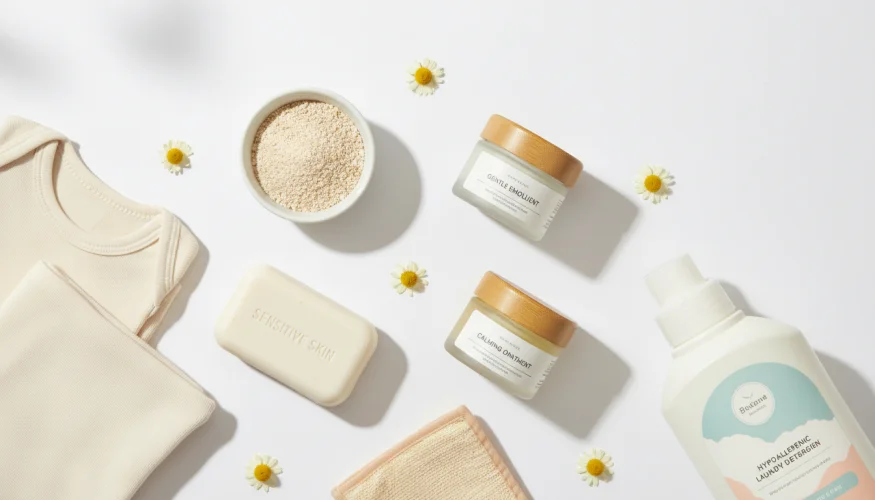
Laundry products are a chapter in themselves. Standard washing powders and gels contain enzymes, optical brighteners and fragrances that are a genuine burden for atopic skin. There are special hypoallergenic laundry products without these ingredients that are gentler yet sufficiently effective. The infant's clothing and bedding should be washed separately from other household laundry, always at a sufficiently high temperature to eliminate any dust mites.
House dust mites are indeed one of the most common triggers of eczema in infants. These microscopic creatures live in mattresses, pillows and rugs and feed on dead skin cells. Their droppings are a potent allergen. This is why dermatologists recommend using special anti-mite covers for mattresses and pillows, vacuuming regularly and maintaining lower air humidity in the infant's room – ideally around 40–50%. Air that is too dry dehydrates the skin, while air that is too humid promotes the proliferation of mites and mould.
Room temperature also plays its part. Overheated rooms cause sweating, which significantly irritates eczema. The optimal sleeping temperature for an infant with atopy is around 18–20°C, somewhat lower than is customary in many households.
Consider a specific example: a young mother in Prague noticed that her four-month-old son's eczema dramatically worsened every winter when the heating was on in the flat. After speaking with a paediatric dermatologist, she lowered the temperature in the nursery, purchased anti-mite covers and began using a hypoallergenic laundry product. Within four weeks, the condition of his skin improved significantly without needing to resort to stronger medications.
The breastfeeding mother's diet and the transition to solid foods
If the infant is breastfed, components from the mother's diet also enter the baby's body – and some of these can provoke eczema. The most frequently discussed foods are cow's milk, eggs, nuts and wheat. The scientific evidence in this area is not entirely clear-cut, and elimination diets for breastfeeding mothers should not be undertaken independently, but always in consultation with a doctor or allergist. An overly strict diet without a clear reason can cause nutritional deficiencies in the mother without any real benefit to the child.
As the European Academy of Allergy and Clinical Immunology states, preventive elimination of foods by breastfeeding mothers without a proven allergy in the child is not currently recommended. The emphasis is placed instead on dietary diversification and supporting natural breastfeeding, which itself has a protective effect.
When transitioning to solid foods, it is advisable to introduce new foods gradually and monitor skin reactions. If eczema worsens after a particular food, this observation should be recorded and discussed with a doctor, rather than immediately eliminating the food permanently. Allergy testing can help identify genuine triggers and spare the family from unnecessary restrictions.
When it's time to see a doctor and what to expect from the visit
Home care is enormously important, but there are situations where professional help is essential. If the infant's eczema is bleeding, weeping or showing signs of infection (yellowish crusts, warmth at the site of inflammation, fever), or if the child is barely sleeping due to itching, a visit to the doctor is urgent. A paediatrician or paediatric dermatologist can prescribe topical corticosteroid creams, which when used correctly are safe even for infants and can quickly calm acute flare-ups.
Fear of corticosteroids is widespread among parents, but experts identify it as one of the main reasons eczema treatment fails. As leading British dermatologist Professor Hywel Williams states: "Concerns about corticosteroid creams are very common among parents, but untreated or inadequately treated eczema causes the child far more harm than short-term topical corticosteroid therapy." The key is correct application – the right amount, the right frequency and the right duration of treatment under medical supervision.
In addition to corticosteroids, there are also newer non-steroidal medications, known as calcineurin inhibitors, which are suitable for sensitive areas such as the face or skin folds. Their prescription is always at the discretion of the doctor.
Everyday care as an investment in the future
Eczema in an infant is a demanding situation for the entire family. It requires patience, consistency and a willingness to adapt daily routines to the child's needs. Nevertheless, this investment is worthwhile – research shows that children whose skin barrier is consistently supported from an early age have a lower risk of developing allergies and asthma later in life. This phenomenon, referred to as the "atopic march", suggests that a disrupted skin barrier in infancy may serve as a gateway to broader allergic disease.
Proper care of an infant's skin with eczema is therefore not merely about alleviating current itching – it is a long-term strategy that can fundamentally influence the child's health in the years ahead. And although every baby is different and there is no single universal solution, the combination of gentle bathing, consistent moisturisation, appropriate clothing and a healthy home environment forms a solid foundation from which everything else can build.